
 E-Paper



India reported over 75,000 forest fires in April; Odisha worst hit
A senior FSI official said usual than warmer April and drier winter this year are the reasons for sudden spurt in the forest fires

 Prefer HTon Google


Even as Army helicopters have been pressed to douse forest fires in Uttarakhand’s Kumaon region, the Forest Survey of India (FSI) data on forest fires shows Odisha to be the worst hit followed by Uttarakhand and Chhattisgarh. Data also shows that the number of forest fires between April 20 and 27 are at least three times higher than that of the same period in 2023.
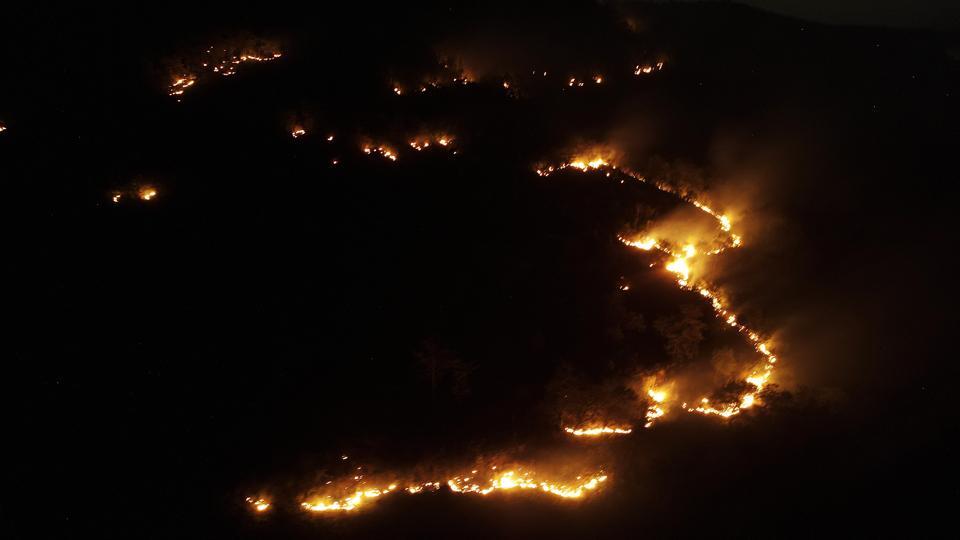
With temperatures rising and negligible rainfall in lower Himalayas and eastern plains, the number of forest fires reported in April, including today, was 75,494 as compared to 58,910 in March 2024 and less than 5,000 this February. In April 2023, the forest fires reported were 68,239.
A senior FSI official said usual than warmer April and drier winter this year are the reasons for sudden spurt in the forest fires. “There is no moisture on ground to control the natural spread of forest fires. The fires are spreading as it is a drought period,” said the official, who was not willing to be quoted.
The FSI data shows that close to 80% of the forest fires in April started after middle of the month, especially in plains of Uttarakhand and from Dhanbad in Jharkhand till Vishakapatnam in Andhra Pradesh in east and Nanded in Maharashtra in west, indicating the spread of dry summer weather.
As per FSI data, total forest fires in India recorded since April 20 was 19,797 of which 1,183 are major fires. The FSI defined major fires as ones which cover a minimum forest area of 300 acres. Some of the fires in Kumaon region including close to Army areas are major fires as per FSI definition.
“If you see India’s map, the plains of Uttarakhand and eastern coastal parts of India seem to be in red due to forest fires,” the official quoted above said, pointing to vagni portal of FSI, which shows forest fires on the country’s map.
Also Read | Army called in as forest fires rage in Uttarakhand; CM Dhami to preside meeting
Among the top five, Uttarakhand is the only north-western Himalayan state to be facing forest fires. There are not many forest fires in Himachal and Jammu and Kashmir, which has witnessed some rain and hail in the past few days. Uttarakhand reported 201 forest fires between April 20 and 27 in 2023 as compared to 3,462 for the same period this year.
The other states in top five --- Odisha, Chhattisgarh, Jharkhand and Andhra Pradesh --- also recorded much more forest fires this year as compared to 2023.
Odisha recorded 4,237 forest fires as compared to 1,499 between April 20 and 27 in 2023. Similarly, Chhattisgarh recorded 757 fires last year as compared to 2,116 this year, Jharkhand 633 as against 1,926 and Andhra Pradesh 527 as compared to 1,126 in 2023.
What is more disheartening is that the data shows higher intensity and spread of forest fires this year, especially in the eastern contiguous area witnessing temperatures over 40 degrees Celsius since mid-April. The impact of forest fire in Uttarakhand seems to be lesser as compared to eastern parts.
The forest officials said that in most cases the forest fire is because of human error. In Uttarakhand alone, police have registered 146 cases of fires due to human negligence for causing major forest fires. In Uttarakhand, the Indian Army was pressed into the service to control forest fire in Kumaon region. Uttarakhand chief minister Pushkhar Singh Dhami also held a review meeting and requested the Army to provide all possible help.


