E-Paper



India, Singapore announce agreements on semiconductors, healthcare
PM Narendra Modi arrived in Singapore on Wednesday on the second leg of a two-nation Southeast Asian tour

 Prefer HTon Google


India and Singapore on Thursday unveiled agreements for a semiconductor ecosystem partnership and greater interoperability between their digital economies even as they elevated their relations to a comprehensive strategic partnership.
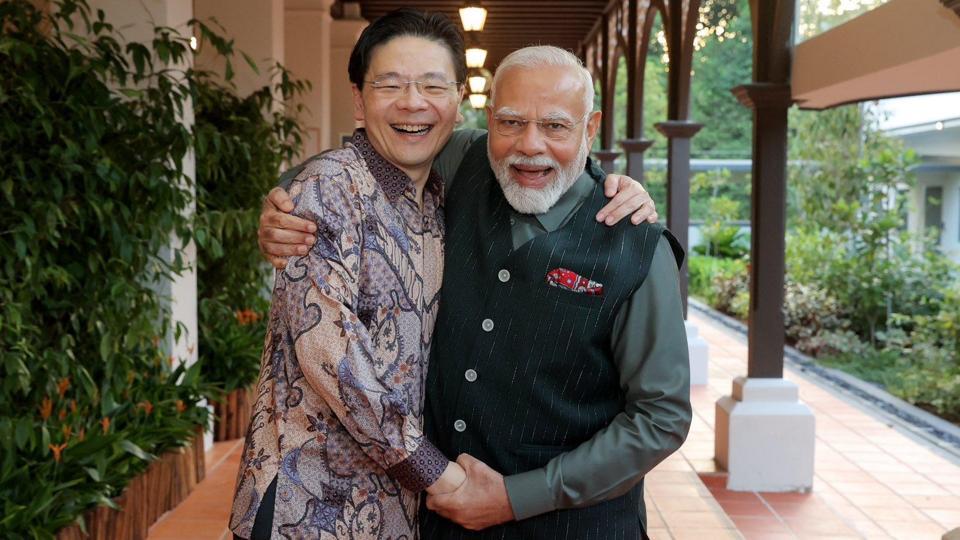
Speaking at a meeting with his Singaporean counterpart Lawrence Wong, Prime Minister Narendra Modi said the two sides will continue working together for regional peace, stability and prosperity.
Modi arrived in Singapore on Wednesday on the second leg of a two-nation Southeast Asian tour, after making the first bilateral visit to Brunei by an Indian premier. He described Singapore as an “important anchor” for India’s Act East policy launched a decade ago.
“Singapore is not just a partner country. Singapore is an inspiration for every developing country. We want to create many Singapores in India,” Modi said, speaking in Hindi.
Referring to achievements by the two sides in the past 10 years, including investments increasing nearly three-fold to $160 billion and the launch of real-time digital payments, Modi said: “I am happy that today we are together giving our relations the shape of a comprehensive strategic partnership.”
Also Read: Singapore PM Lawrence Wong hosts PM Modi for private dinner ahead of talks
Following talks between the two premiers, India and Singapore announced four agreements on semiconductors, digital cooperation, healthcare and medical research, and education and skill development.
The memorandum of understanding (MoU) on a semiconductor ecosystem partnership envisages cooperation to support India’s growing semiconductor industry while facilitating Singapore’s companies and supply chains to enter the Indian market. The MoU will create a platform to better connect and strengthen the complementary semiconductor ecosystems of the two sides.
The MoU on cooperation in digital technology will encourage greater interoperability between the digital economies of the two countries and build on earlier work such as the linking of the digital payment systems of India and Singapore. The main areas of cooperation under this MoU are data flows and data protection, digital utilities and digital public infrastructure, cyber-security and business-to-business linkages.
Under the MoU on education and skill development, the two sides will cooperate on technical and vocational education and training, while the MoU on healthcare and medical research envisages cooperation in disease surveillance, pandemic preparedness and prevention of communicable diseases.
Modi’s visit followed a meeting last month of the India-Singapore Ministerial Roundtable, which identified areas for cooperation such as skilling, digitalisation, mobility, advanced manufacturing, semiconductors, AI, healthcare, sustainability, and cyber-security.
Modi pointed to other areas where the two sides have made progress, saying 17 satellites of Singapore were launched from India in the past 10 years, while cooperation in defence has gained momentum. An agreement between Singapore Airlines and Air India has strengthened connectivity, he said.
The 350,000 people of Indian origin living in Singapore act as the “strong foundation” of bilateral relations, and India is “forever grateful to the whole of Singapore for the place and respect that Subhash Chandra Bose, Azad Hind Fauj and Little India have received”, Modi said.
He suggested the two sides should come up with an action plan to mark 60 years of diplomatic ties in 2025. “I am very happy to inform you that India’s first Thiruvalluvar Cultural Centre will soon be opened in Singapore. The great saint Thiruvalluvar has given guiding thoughts to the world in the most ancient language, Tamil,” he added.
Modi and Wong visited AEM, a leading Singaporean company in the semiconductor and electronics sector, and were briefed about the firm’s role in the global semiconductor value chain and its plans for India. The Singapore Semiconductor Industry Association made a presentation on the development of the semiconductor ecosystem in Singapore and opportunities for collaboration with India.
Also in Modi’s schedule were meetings with senior minister Lee Hsien Long, emeritus senior minister Goh Chok Tong and President Tharman Shanmugaratnam, and a CEOs roundtable to forge closer trade and investment ties.
Singapore is currently India’s largest trade partner within the Association of Southeast Asian Nations (Asean) and the sixth largest trade partner worldwide. Besides, Singapore was the largest source of foreign direct investment (FDI) into India in 2023, and its cumulative investments since 2000 are worth $160 billion.