
 E-Paper



India, Singapore sign key pacts on telecom, food security; hold discussions on nuclear technology, space
India and Singapore signed agreements on telecom and food safety while exploring cooperation in nuclear technology, semiconductors, space and cybersecurity

 Prefer HTon Google


India and Singapore on Thursday concluded agreements for cooperation in telecommunications and food security and explored ways to enhance collaboration in small modular reactors (SMRs), semiconductors, space and cybersecurity at a meeting of a special bilateral ministerial mechanism.
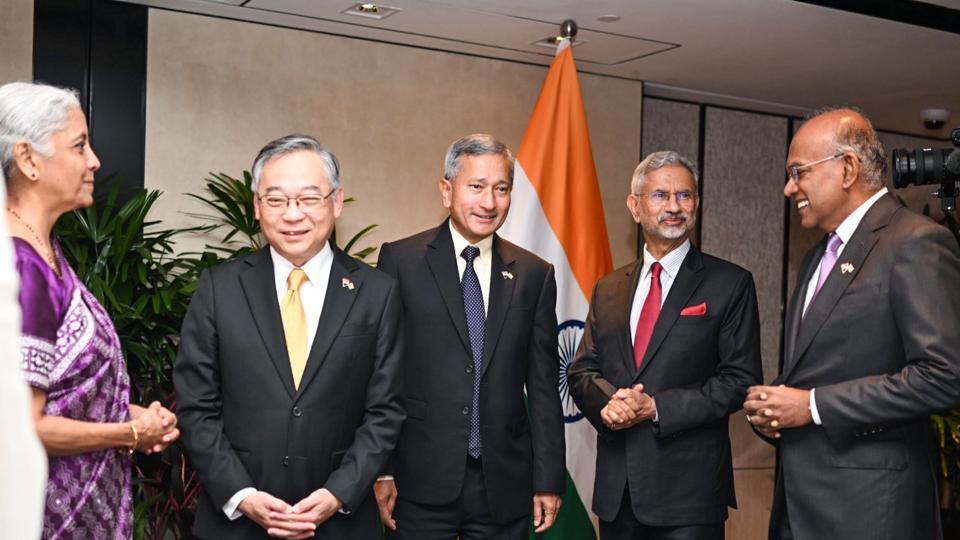
The fourth meeting of the India-Singapore Ministerial Roundtable (ISMR), hosted by Singapore, focused on cooperation in areas such as advanced manufacturing, digitalisation, skill development, healthcare and medicine, connectivity and sustainability.
India, Singapore sign agreements on telecom and food safety
The ministers witnessed the exchange of a memorandum of understanding (MoU) between the Food Safety and Standards Authority of India and Singapore Food Agency for cooperation in food safety and a letter of intent (LoI) between the Telecom Regulatory Authority of India (TRAI) and Singapore’s Info-Communications Media Development Authority (IMDA) for cooperation in telecommunications and broadcasting. Another MoU will facilitate cooperation in maritime heritage.
They also welcomed initiatives to develop new growth industries in India and Singapore, which will create trade and investment opportunities for businesses in both countries.
Also Read: At ministerial roundtable, India, Singapore agree to expand cooperation in key areas
External affairs minister S Jaishankar, part of the Indian delegation, described the meeting as “very productive” and said on social media: “Our discussions explored deeper ties in advanced manufacturing, semiconductors, connectivity, digital, fintech, skilling, green economy and clean energy domains.”
Both sides explore cooperation in SMRs, semiconductors
Singapore’s Deputy Prime Minister and Trade Minister Gan Kim Yong told reporters that the two sides discussed cooperation in nuclear technology, including SMRs. “We also discussed how we can share our experience and knowledge about SMRs,” he said.
Though Singapore has not decided whether it will adopt nuclear energy, it is important to keep pace with technology in this area. “That’s why we have discussed the possibility of working together to explore and share knowledge on this technology,” Gan said.
Singapore firms look to expand semiconductor ecosystem in India
In the field of semiconductors, Singaporean companies that have invested in India are looking at bringing in their suppliers to create an ecosystem in India, Gan said. “We discussed with India how we can make their (Singaporean SMEs) relocation or entry into India smoother,” he said.
Singapore is interested in upgrading skills and training the Indian workforce to support semiconductor and advanced manufacturing industries. “We hope to be able to establish training centres for semiconductors, particularly in areas where these semiconductor companies are investing in,” Gan said.
Gan referred to the growth of space technology in India and said, “We are very keen to discuss the possibility of collaboration with them, whether in research and development or even in commercial cooperation. The Singapore Space Agency will work with India’s counterpart, IN-SPACe to discuss the potential areas in which they can work together.”
India, Singapore discuss closer cybersecurity cooperation
The two sides are exploring collaboration in cybersecurity, a very important part of the digital infrastructure, Gan said.
Also Read: India, Singapore seal five pacts, pledge to enhance trade and investment
In the field of connectivity, Gan said the two sides discussed the bilateral air services agreement (ASA). “With the increased investment and trade between India and Singapore, we also expect two-way traffic to increase…We just discussed briefly the need to increase air connectivity, and the aviation authorities of the two countries will continue to discuss and explore opportunities on connectivity,” he said.
The members of ISMR also interacted with participants of the India-Singapore Business Roundtable (ISBR), and the Indian ministers met Singapore Prime Minister Lawrence Wong to discuss progress in bilateral relations. Discussions at the ISBR focused on improving the ease of doing business in India, enhancing capital market flows and cooperation in AI.
Also read: Indian national declared bankrupt in Singapore over unpaid wages to migrant workers
Besides Jaishankar, the Indian delegation included Finance Minister Nirmala Sitharaman, Commerce Minister Piyush Goyal and Minister of State for Electronics and Information Technology Jitin Prasada. The Singapore delegation included Deputy Prime Minister Gan, National Security Minister K Shanmugam, Foreign Minister Vivian Balakrishnan, Transport Minister Jeffrey Siow and Digital Development Minister Josephine Teo.
The ISMR is a special mechanism created in 2022 to advance collaboration in crucial sectors such as technology, investments and advanced manufacturing. The body meets every year, alternating between Singapore and India.



