E-Paper



India-UK sign FTA, PM Starmer calls it 'most significant' deal since EU exit
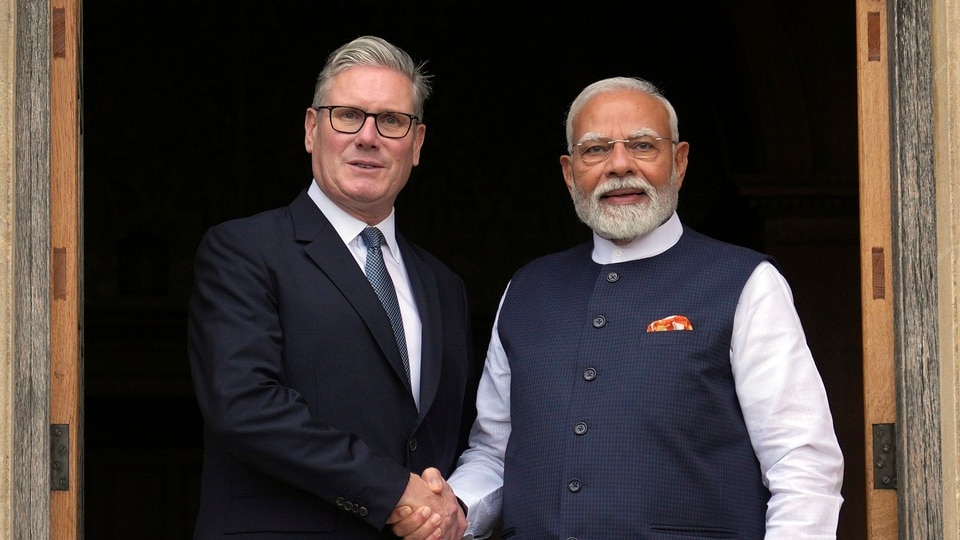
India and the United Kingdom signed a landmark Free Trade Agreement (FTA) on Thursday during Prime Minister Narendra Modi’s visit to the UK.

 Prefer HTon Google


India and the United Kingdom (UK) on Thursday signed a free trade deal, the Comprehensive Economic and Trade Agreement (CETA), with London permitting temporary business mobility for Indian professionals and New Delhi allowing concessions access to British automobiles and agri-food items, while keeping sensitive sectors such as dairy, apples and edible oils in the negative list.
The free trade agreement (FTA) may see a doubling of the bilateral trade from the current level of $56 billion by 2030. The deal will eliminate tariffs on approximately 99% of the tariff lines, covering almost 100% of the trade value. The UK will gain duty-free access for its 90% tariff lines that will cover 92% of existing merchandise imports from the country.
After the formal signing of the deal, Prime Minister Narendra Modi said: “We are committed to building a high-scoring, solid partnership.” He is in London to endorse the signing of the deal.
“A landmark deal with India means jobs, investment, and growth here in the UK,” UK Prime Minister Keir Starmer said.
Business mobility was one of the most sensitive issues for the UK during the bilateral negotiations, as were automobiles, the dairy and agriculture sector for India. “Easy business mobility will help India to boost its services trade in one of the biggest European markets. India already had duty-free access for over 60% of its merchandise exports to the UK, hence, its focus on the FTA was to gain greater access for services exports,” one of the officials said, requesting anonymity.
While the FTA will allow greater access for British agri-food items, including beverages, India’s sensitive agricultural sectors have been protected, he said. “The agreement takes fully into account the interests of Indian producers of sensitive agricultural products like dairy products, vegetables, apples, edible oils, oats, etc, by keeping those tariff lines under the sensitive list,” the official said.
According to the deal, India has secured mobility provisions for skilled professionals, including contractual service providers, investors, yoga teachers, and chefs; the UK said that such travels are “temporary” to deliver services and not a route for immigration.
The UK has provided a quota of 1,800 per year for qualified, professional Indian traditional chefs, yoga instructors, and classical musicians entering as contractual service suppliers. Under this arrangement, temporary entry and stay are permissible up to 12 months in any 24 months or for the duration of the contract, whichever is less, an official said.
As part of the deal, the two sides agreed on business mobility, granting access for short-term business travel into the UK and India. “This will give UK businesses and professionals a guarantee that existing access to the Indian market will continue,” the UK government said in an explainer, citing the example that UK businesses could also get the opportunity to supply services in India across sectors such as engineering and accounting.
In a post on X, Union commerce minister Piyush Goyal said: “Congratulations to Prime Minister @NarendraModi ji, UK Prime Minister @Keir_Starmer, and the people of India & the United Kingdom on the signing of the landmark India-UK Comprehensive Economic and Trade Agreement (CETA).”
“Duty-free access for about 99% of Indian exports unlocks nearly $23 billion in opportunities for labour-intensive sectors, marking a new era for inclusive and gender-equitable growth. Artisans, weavers, and daily-wage labourers employed in several MSMEs across textiles, leather, footwear, gems & jewellery, toys, and marine products will step into a new phase of prosperity. From village looms to tech labs, this FTA marks a historic leap for women through improved access to finance and deeper integration into global value chains,” he said.
This agreement is a big win for farmers, ensuring duty-free exports on nearly 95% of agricultural products, while fisherfolk gain from Zero Duty on 99% of marine exports, boosting their incomes, he said. “The deal will also have a transformative impact on manufacturing-intensive sectors like engineering goods, electronics, pharma, chemicals, food processing, and plastics. This agreement will also provide Indian consumers with quality goods at competitive prices,” he said.
Speaking about India’s services exports, he said the country’s talent in IT, services, and education will gain from easier access to the UK’s high-value markets. “The three-year exemption from social security contributions in the UK as part of the Double Contribution Convention is a significant breakthrough for Indian workers and their employers. Chefs, yoga instructors, musicians & business visitors will benefit, advancing our vision to be a global talent hub,” he said.
The India-UK FTA will open doors to UK customers, investors, and innovation hubs for our Startups, helping them expand their global footprint, he said. “This deal is a win-win for ‘Make In India’ and ‘Vocal For Local’, driving job creation, empowering communities, and reinforcing India’s strategic trade leadership. It ushers in a new era of economic cooperation, reinvigorating our bilateral trade ties,” he added.