India is yet to hear from Pakistan on a proposal for a coordinated response along with Iran to control the problem of desert locusts, people familiar with developments said on Thursday.
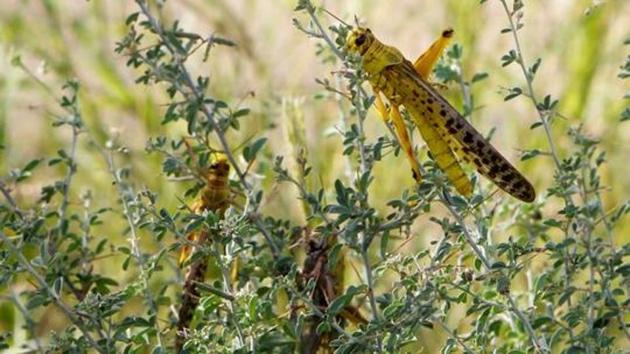
Iran has already responded positively to the Indian proposal, which includes an offer to supply pesticides to control locust populations in Sistan-Balochistan and South Khorasan provinces, the people said on condition of anonymity.
The proposal was made against the backdrop of reports that swarms of the destructive pests were making their way to Indian states such as Rajasthan after breeding and maturing in Iranian provinces and Pakistan’s Balochistan province.
“It remains to be seen if Pakistan will rise above its narrow-minded approach, as was seen in the case of India’s regional initiative for dealing with Covid-19, and come forward to cooperate with India on a coordinated desert locust control operation,” said one of the people cited above.
India mooted the coordinated response to control desert locust populations to Iran and Pakistan as part of efforts to further regional cooperation. India had suggested to Pakistan that the two countries could coordinate locust control operations along their border and New Delhi could facilitate the supply of the pesticide Malathion to Islamabad, the people said.
“The institutionalised mechanism of the Locust Warning Organization could be energised for such cooperation. These efforts will contribute to mitigate the impact of desert locust not only in the two other countries, but also for India,” said a second person.
{{/usCountry}}“The institutionalised mechanism of the Locust Warning Organization could be energised for such cooperation. These efforts will contribute to mitigate the impact of desert locust not only in the two other countries, but also for India,” said a second person.
{{/usCountry}}Pakistan was the last country to pledge a contribution to the South Asian Association for Regional Cooperation (Saarc) Covid-19 Emergency Fund, which was created at India’s initiative, and it has pushed for the fund to be placed under the Saarc Secretariat.
According to the Food and Agriculture Organization (FAO), hopper bands of locusts are maturing in the southwestern coastal plains of in Iran, and another generation of breeding is underway in the country’s southeast, where hatching is taking place on the coast and in the interior of Sistan-Baluchistan.
In Pakistan, adult groups of locusts are migrating to the Indian border from breeding areas in Balochistan, where hopper groups are present, and from Punjab and Khyber-Pakhtunkhwa provinces.
FAO reports suggest the desert locust population is expected to move from spring breeding areas in Balochistan to summer breeding along the India-Pakistan border. In India, more adult groups and small swarms have arrived from Pakistan in the past few weeks, and moved into Rajasthan, reaching Jodhpur.
The agriculture ministry leads India’s efforts in locust control and also spearheads initiatives to foster regional cooperation, the people said.
India has an existing institutionalised mechanism with Pakistan for such cooperation, including regular border meetings between locust officers of the two sides. Six border meetings, led by plant protection advisers of India and Pakistan, are held every year from June to November, either at Munabao on the Indian side or Khokhropar on the Pakistani side for exchanging information.
Wireless communication is maintained every year during June-November between Jodhpur in India and Karachi in Pakistan for exchange of information.
“There is consensus that the desert locusts could pose a grave challenge in 2020. The agriculture ministry has already started efforts to address the issue. In March, minister of state for agriculture Kailash Choudhary participated in a virtual meeting for the southwest Asian region coordinated by FAO to discuss regional cooperation to combat the desert locust problem,” the first person cited above said.