India is banking on two strategies – diversification into non-traditional markets and free trade agreements with major economies — to boost its merchandise exports that fell marginally in August this year after witnessing record growth in 2021-22, two officials with direct knowledge of the matter said.
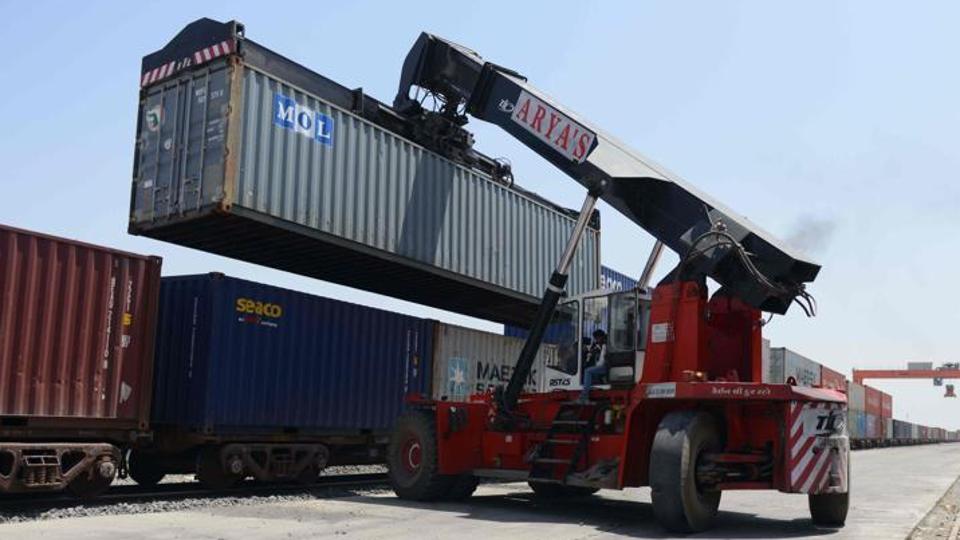
According to the latest data released by the commerce ministry on Saturday, India’s merchandise exports in August dipped marginally to $33 billion as compared to $33.38 billion in the same month a year ago. (AFP/ Representational Image)
India’s exports have been already diversified successfully from a traditional economy to non-traditional markets such as Indonesia (37.8% growth), Brazil (64.6% growth), South Africa (52.4% growth), France (38.9% growth) in the first five months of the current financial year, they added requesting anonymity.
“This gives us the confidence that Indian exports will sustain the momentum gained in 2021-22,” one of them said. Undoubtedly, the slowing down of major economies such as China has impacted global trade, and with the country being a major export market for India, the impact is quite visible, the second person added. This can be compensated by diversifying India’s export focus to newer destinations also, he said.
According to the latest data released by the commerce ministry on Saturday, India’s merchandise exports in August dipped marginally to $33 billion as compared to $33.38 billion in the same month a year ago mainly because of global headwinds, including the Chinese slowdown. India’s exports to China fell by over 35% to $6.8 billion in April-August 2022 compared to $10.5 billion in the same period the previous year.
“China slowdown is also an opportunity for India with its focus on Atmanirbhar Bharat Abhiyan [Self-reliant India Initiative]. Many advanced global economies want to de-risk their sourcing strategy and now looking at India as a reliable alternative to China. Many of them are eager to sign comprehensive free trade agreements [FTAs] with India,” the first official said.
India has already signed two major FTAs — one with the United Arab Emirates (UAE) and the other with Australia. A similar deal is expected with the United Kingdom (UK) by October this year. Besides, FTA negotiations are progressing well with Canada and the European Union (EU). “The EU deal is expected by the first half of next calendar year,” the first official added.
Commenting on the official trade data on Saturday, commerce secretary BVR Subrahmanyam said merchandise exports in August were “flat” due to several global headwinds -- the Ukraine war, high inflation, hardening of interest rates in major economies and the Chinese slowdown – but added that the country’s export growth is not “off-track” and that even conservatively, India can achieve exports of $300 billion in services and $450 billion in goods by March 31, 2023. In 2021-22 the corresponding numbers were $254.40 billion and $421.80 billion.
“India’s exports are holding ground” compared to other global economies, he said. Cumulatively, India registered a 17.1% merchandise export growth in the first five months of the current financial year to $192.59 billion and robust services exports at $95 billion in April-July 2022 registering 25% growth.
According to the first official, notwithstanding global headwinds, several sectors have achieved significant export growth in the five months of the current financial year. “Our electronics export performance has continued to show positive growth with a 54.7% increase in April to August, 2022-23 vis-a-vis corresponding period last year. Our readymade garment segment has gone up by 17.8% during this period,” he said.
“Our agricultural exports have been doing well with marine products registering a growth of 7.6%, meat and dairy products registering a growth of 13.6%, fruits and vegetables exports grew by 8.8%, cereal preparations and processed food products grew by 30.6%, coffee has registered a growth of 36.7%. Further, sectors, like oil mills, oil seeds, tea, rice etc. have also been doing extremely well,” he added.
Some of the sectors where a dip is seen are cotton yarns, fabrics, made-ups where exports have declined by 32%, in iron-ore exports have declined by 90% and in handicrafts, there has been a decline by 36%, he said. “The drop in exports in cotton yarn and iron ore has contributed to meeting the domestic demands and has helped domestic manufacturing,” he said.
According to the two officials, the government may launch a New Trade Policy soon that will elaborate India’s strategies to boost exports. On August 5, Union commerce minister Piyush Goyal called for a ‘Whole of Government’ approach to boost exports where all stakeholders — exporters, export promotion councils (EPCs), government agencies and Indian missions abroad — will work together with a shared goal.
The government has been increasing its international engagement to boost exports, he said while interacting with EPCs and representatives of industry associations in New Delhi on August 5. He also underscored the importance of FTAs and urged industry representatives to study FTAs and identify areas where India would have a competitive advantage.
Expressing confidence that India is on track, Goyal said the country has already touched the highest ever merchandise exports of $422 billion and all-time total exports of $667 billion (including services) in 2021-22, which is an increase of 34.5% over FY 21.
Follow India news real-time updates and the latest news covered on Hindustan Times, featuring today's critical updates on Sonam Wangchuk LIVE and more across India.
Home/India News/India's Two Strategies, As Per Officials, To Boost Exports

 E-Paper