
 E-Paper



Industrialised India has special climate responsibility: Frans Timmermans
Frans Timmermans sees contentious issues like a new carbon trading scheme and the issue of loss and damage being resolved at COP 26.


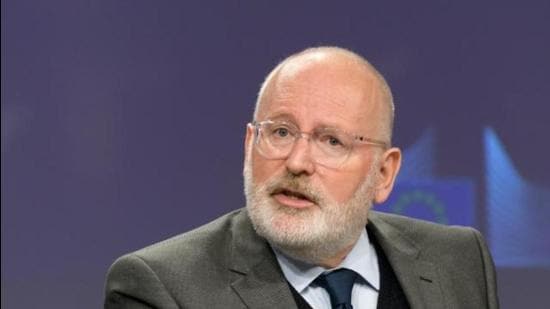
Days ahead of the Glasgow climate change conference (COP 26), Frans Timmermans, executive vice-president of the European Commission in-charge of the European Green Deal, who is on a three-day visit to India, in an interview to Jayashree Nandi, says he expects clear commitments on reducing emissions from developing countries in the next two weeks. He also sees contentious issues like a new carbon trading scheme and the issue of loss and damage being resolved at COP 26. With India, the EU will be working closely on green steel, green hydrogen, and other renewable energy projects. Edited excerpts:
Do you think the target of net zero emissions by mid-century is feasible and is it possible to keep global warming under 1.5 degree C?
It is extremely difficult. Humanity has been asked to change its ways in such a radical way in such a short period of time… I believe net zero by the middle of the century is possible and desirable. Net zero doesn’t mean there is going to be zero emissions, but that we will not emit more than the atmosphere can absorb. I think it is achievable. If major emitters on this planet reduce their emissions and the richest countries get serious about helping the poorer nations to reach the same goal, then 1.5 degree C is still within reach. We need to start moving now. It’s only 30 years from now. When the Berlin wall came down 30 years back, I was already an adult. I am not sure if I will make it to 2050, but my children will and I want them to make it in a planet that is able to live within its boundaries.
What are your expectations from India? The goal of net zero emissions is a global one, do you expect every country to commit to it?
It would be a noble undertaking if all countries commit individually to net zero by mid-century. But there is a special responsibility for industrialised countries and in many aspects, India is an industrialised country. There is a differentiated approach but common responsibility. Countries I represent here have had 200 years of building their societies on the basis of carbon and so built up 200 years of emissions. Other countries like India did not have these 200 years. Some countries still aspire to give their population the human development that we almost see as self-evident in Europe. Every human on this planet has the right to aspire to the same level of development as many of my co-citizens. No one can escape their responsibility, but this responsibility is differentiated on the basis of history, development and wealth and that I think would be a fair approach to the issue.
One of the most contentious issues to be discussed at COP 26 is a carbon trading mechanism. How do you see it coming up?
Globally, if you want to decarbonise your economy, you have to put a price on carbon. You can do this in different ways: through taxation, through regulation. We have decided to let the market do this. With the rights to emissions, initially this system was seen as unsuccessful and people were complaining about the fact that price of carbon was so low that it did not have an effect on the behaviour of market parties. Now, the complaint is that the price is too high. The fact of the matter is that the market is used to it, the system is working, those who must work with the system are decarbonising. So, we strongly believe in this system. A major emitter like China has also introduced carbon trading. Of course, everyone is free to choose how to do it, but that we have to put a price on carbon seems to me an essential element of decarbonising our economy.
Another unresolved issue is Loss and Damage (compensating vulnerable countries affected by climate disasters for the loss). Will there be consensus on that?
We have been dodging around this issue for so many years and it is linked to so many other issues that need to be clarified, such as share of proceeds, transparency, accountability, common timeframes, part of global compromise that could emerge. Loss and damage should be part of that compromise in fair ways, so that everyone can recognise themselves. I think it’s possible to reach that compromise in Glasgow. For the EU what is important is that on a global scale we can compare apples to apples and not apples to oranges. For us, (EU) elements of transparency and accountability are extremely important. If we get good understanding on that then the issue of loss and damage becomes within reach of compromise.
There is a lack of trust among developing countries because the $100 billion climate finance hasn’t come through. Will the money come and what are your views on a post 2025 climate finance goal?
I think we should concentrate now on the $100 billion and I have been doing everything I can to increase the contribution of the rich nations. I believe we in EU are making a serious effort to do our part. The president of EC has increased our contribution, which was already the largest. Our total contribution is around $25.4 billon. This gives us the right to tell other nations to do more. At the same time, I will not hide the fact that I am encouraging my own member states to do more. It’s very tough. We are not there yet. But I hope we can use the next days and weeks to get us over that line. Once that is achieved, we can also create a positive basis upon which we can start discussing the post 2025 finance goal.
The developing and developed countries stand divided ahead of COP 26. Developing nations expect rich countries to transition to net zero in advance so that there is carbon space for others. What will be your measure of success at the end of COP 26?
The measure of success in my view is at the end of COP 26 can we say with justification, with facts that we will stay well below 2 degrees C of temperature rise, we still have a shot at 1.5 degrees C. That is the measure of success and for that to happen, we need clear commitments on mitigation also from developing countries. So, I hope we can use the next couple of weeks to stimulate clarity on NDCs. Of course, that also means stimulating clarity on what richer countries will do on adaptation and finance. Everything starts and ends with mitigation. If there is no mitigation, then why invest in adaptation as the whole thing will get out of control anyway. But without adaptation, you will not be able to convince countries to invest in mitigation because they will say you are leaving me on my own here. The climate crisis is happening now, case in point the floods in India in the past few days.
What kind of meetings and partnerships did you forge during your visit in India?
I really enjoyed my conversations with environment minister (Bhupender Yadav) and power minister (RK Singh) where we discussed very concrete things we could do together. I am very impressed with the commitment in material and political terms to massively increase the generation of renewable energy in India. The 450 GW renewable energy target by 2030 is quite something. We have laid groundwork on increased cooperation between India and EU on several issues, including green hydrogen where EU is leading. We will build on our cooperation on renewable energy also, strengthen our supply chains, build our solar capacity, grids and share knowledge on smart grids. One area obviously is steel. We are on the verge of green steel, wherein we use hydrogen to create the furnaces to make steel. India as a steel producing country could profit enormously if we could jointly make that transition. Indian companies are already involved in it in Europe.


