
 E-Paper



Institutions can’t be retirement homes for judges, bureaucrats: Justice Narasimha
Justice PS Narasimha emphasised the vital role of fourth branch institutions like the ECI and CAG in democracy, urging their reinvigoration and accountability.


The “fourth branch” institutions such as the Election Commission, Comptroller and Auditor General (CAG) and public service commissions “cannot be retirement homes for civil servants and judges”, Supreme Court judge justice PS Narasimha said on Sunday as he underlined the critical role of these institutions in upholding democratic governance.
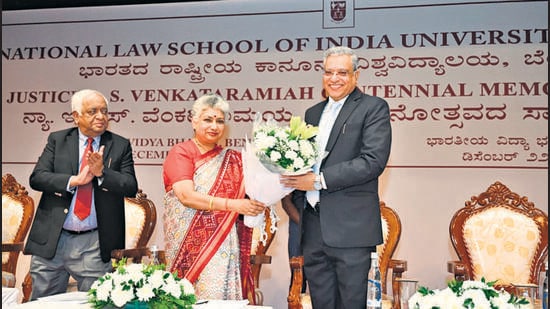
Justice Narasimha was speaking at the second Justice ES Venkataramiah Centennial Memorial Lecture in Bengaluru, an event to celebrate the life and legacy of India’s 19th Chief Justice of India, whose illustrious career was deeply intertwined with the themes of institutional integrity and democratic governance.
Justice Narasimha emphasised that the bodies under the fourth branch institutions must embody democratic values through collective decision-making, autonomy and accountability, calling for their reinvigoration to meet the demands of a rapidly evolving society.
“We need institutions that can withstand political tribulations, hold power-wielding officials accountable, and ensure a smooth democratic process,” said the judge as he elaborated on the unique function of fourth branch institutions, which operate independently of the three traditional organs of the state -- executive, legislature and judiciary.
Citing the Election Commission as a prime example, justice Narasimha praised the foresight of India’s Constitution-makers in establishing an independent body to oversee elections. He recalled the evolution of the Commission from a single-member body to a three-member panel, a change upheld by the Supreme Court despite concerns about delays in decision-making. “Today, we have an Election Commission which has plurality of thought, which I believe is any day better than an individual taking decisions all by himself,” he asserted. The judge also highlighted how the Commission safeguards the electoral process, calling it the “fountainhead of democracy.”
On the CAG, he emphasised its role as a “rear-view mirror” for financial irregularities, describing it as a critical link between political executives and public accountability. “The CAG creates transparency and accountability, exposing corruption, inefficiencies, and wastage in government spending, enabling corrective measures to be taken,” justice Narasimha said.
Justice Narasimha also addressed the challenges facing public service commissions, which are tasked with recruiting individuals of integrity and vision for government service. He lamented the growing litigation surrounding service disputes and called for a renewed focus on the constitutional principle that public service must subserve the interests of the state rather than becoming an end in itself.
“This position has given rise to enormous litigation on small issues leading to disputes of seniority, promotion, transfers, regularisation, etc. I think it is high time that the Public Service Commissions reflect on this disconnect or imbalance and ensure that bureaucracy in modern India draws the best of the talent, people of integrity and vision that can be an example to emulate by anyone across the globe,” added the judge.
Justice Narasimha also shed light on the importance of commissions like the National Commissions for Scheduled Castes, Scheduled Tribes, and Backward Classes in achieving social equality. He called for these bodies to adopt a more vibrant and proactive approach to eliminate caste and community prejudices, fulfilling the vision of BR Ambedkar.
Institutions like the National Human Rights Commission, National Commission for Women, and Central Vigilance Commission were also highlighted. Justice Narasimha described them as “integrity institutions” that serve constitutional purposes despite being statutory in nature.
Justice Narasimha identified six reasons for the underperformance of fourth branch institutions -- capacity failures, infrastructural deficits, lack of autonomy, enforcement failures, political interference and overlapping mandates. “Fourth Branch institutions can’t be retirement homes for civil servants and judges,” highlighted the judge, urging greater investment in their capacity, autonomy and accountability.
According to justice Narasimha, justice Venkataramiah, who he described as a “judicial statesman,” exemplified the principles of institutional integrity and democratic governance. He highlighted justice Venkataramiah’s pioneering efforts in legal aid and education. “He firmly believed in securing relief to litigants as early as possible, a belief he translated into reality as the secretary of a Legal Aid Society in 1948 -- long before legal aid or even the Constitution was in vogue,” added the judge.


