
 E-Paper



‘Internet's kid’ who loves Sahir Ludhianvi: Behind Sarthak’s CBSE probe, a quest to ‘always ask questions’ | Profile
Sharp one-liners are a key part of how he communicates, plus some serious inspiration from Urdu-Hindi poets not readily associated with Gen Z

 Prefer HTon Google


When the Central Board of Secondary Education reminded Class 12 students about the last day to apply for re-evaluation, the teenager whose blog had upended the board in the past few days had a request. "Can u please extend the deadline please because i was busy this week exposing you," Sarthak Sidhant wrote on X on Sunday, replying cheekily to the board's notice.
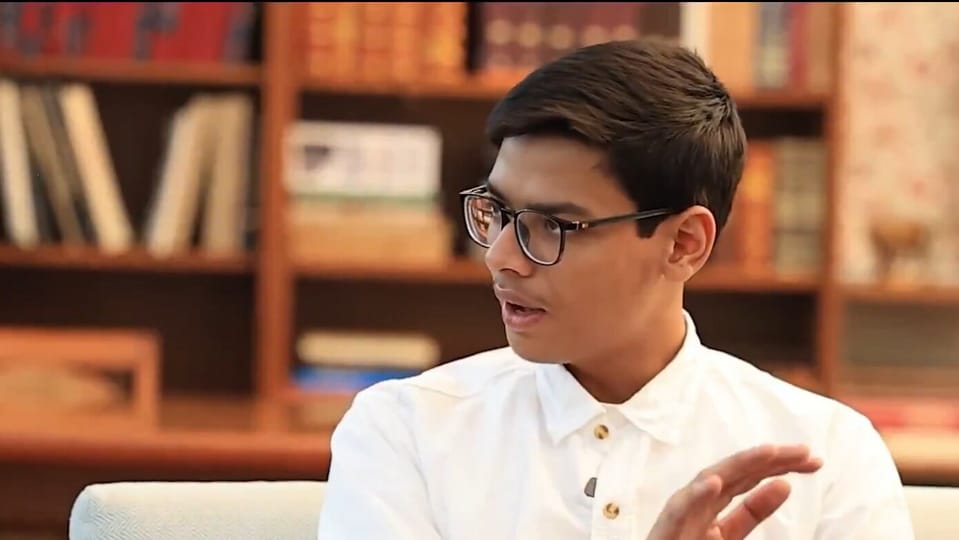
Cheeky replies appear to be his trademark online style, laced with some serious inspiration from Urdu and Hindi poets not readily associated with his generation — Sahir Ludhianvi and Ramdhari Singh ‘Dinkar’.
The Gen-Z teenager's joke at the CBSE's expense capped a week of intense action. His blog probing the board's new on-screen marking (OSM) system went viral; then he deposed before the Parliamentary Standing Committee on Education; the government then transferred the CBSE's top two officers and ordered an inquiry into the OSM vendor and system; and Leader of Opposition Rahul Gandhi met him and his family. He has said reporters have swarmed to his Ranchi home.
‘Very rational approach of living life and thinking’
Behind the tender audit and harsh scrutiny is a teen who recently turned 18, grew up in Bokaro, a government steel-plant town in Jharkhand, and moved to state capital Ranchi after his father died when he was in Class 10. His love for the internet comes via his love originally for all things computer.
In a profile on one of his main online homes, he calls himself "the Internet's kid" and "a dork", an atheist with "a very rational approach of living life and thinking". And his idea of society is "very french revolution".
"I am who I am," says the profile, written long before any of the attention. "I won't change myself for you," he concludes there.
When he said in a recent interview that he does not like watching movies or web shows, and instead likes “old songs with meaningful lyrics playing in the background while I work on my computer”, he was asked to pick a favourite.
Cites Sahir's humanist poetry
He reached for Sahir Ludhianvi, and the lines “Tu Hindu banega na Musalman banega, Insan ki aulaad hai insaan banega”, ‘You will neither be a Hindu nor a Muslim; you are the child of a human being, and a human you shall be.’
This powerful message on secularism by Ludhianvi was featured in the 1959 film ‘Dhool Ka Phool’, decades before the internet was even properly imagined. Sahir Ludhianvi (1921–1980) was a leading voice of the Progressive Writers' Movement and a Padma awardee.
Another poet he named there — and refers to repeatedly on his X account — was Ramdhari Singh Dinkar (1908–1974), the Jnanpith awardee. In his interview to The Hindu, Sarthak Sidhant cited his poem, “Lohe ke ped hare honge, tu gaan prem ka gaata chal; nam hogi yeh mitti zarur, aansu ke kann barsata chal.” The poem speaks of “trees made of iron” that will one day turn green if “your tears moisten the soil under it”.
‘Should keep asking questions’
“The sole message of this poetry,” he said, “is that one should keep asking questions and put in constant efforts to seek answers.” On X earlier, he shared a screen-text recitation of the Hindi poem in a male voice.
He mentions a sharper Dinkar poem among his inspirations, ‘Samar Shesh Hai’ (The War is Not Over). Its lines say the guilt of a wrong is not the wrongdoer's alone, and that those who stay neutral shall be judged by time. "Samar shesh hai, nahi paap ka bhagi keval vyaadh; Jo tatasth hain, samay likhega unka bhi apraadh," it says in Hindi.
He traces his curious mind to his upbringing that challenged notions, he told Rahul Gandhi in their interaction. He also referred to his parents' inter-caste marriage in multiple interviews as something that defined him. As did bereavement.
“After my father passed away due to cardiac arrest two years ago, I started questioning concepts like religion, philosophy and faith,” he said. He mentioned to Newslaundry how his parents were “progressive and conservative at the same time”.
On his own position, he said "sort of social justice", built on "a lot of liberty, a lot of freedom of speech". But Indian politics, he told Newslaundry, "is not about ideology" but about catering to particular issues. He has kept a wary distance from the wider protest wave after recent paper leaks and ex-related controversies. For instance, ahead of the Cockroach Janta Party's planned Jantar Mantar protest, he told HT “internet activism is okay” but said it should be rooted in action. "But I do believe protest is a fundamental right," he stressed.
What's the plan next?
Sarthak Sidhant was raised by two computer engineers who ran their own academy and, by his own account, used a computer mouse at three. He told the Hindustan Times he had outpaced the school syllabus by Class 6 or 7, teaching himself programming, software development, robotics and the internet of things, and took up AI in 2023.
For his Class 12 boards he sat the science-computer stream: physics, chemistry, mathematics, computer science and English. He is now waiting on college admissions. His entrance exams are done, he told HT, and he expects to study engineering, combining data science, AI and civic technology.


