E-Paper



Jaishankar, Chinese counterpart meet in Dushanbe, discuss disengagement at LAC
Jaishankar said in a set of tweets that he had discussed disengagement in the border areas with Wang Yi, and “underlined that progress in this regard is essential for restoration of peace and tranquillity, which is the basis for development of bilateral ties”

 Prefer HTon Google


India and China have agreed that their military and diplomatic officials should meet again and continue discussions to speedily resolve the remaining issues related to the dragging military standoff on the Line of Actual Control (LAC).
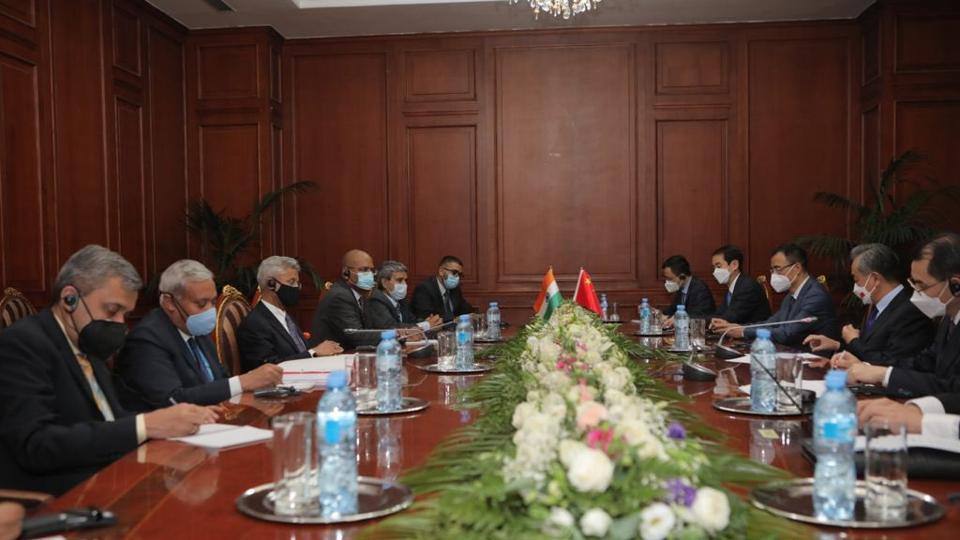
This was decided when external affairs minister S Jaishankar met his Chinese counterpart Wang Yi on the margins of the Shanghai Cooperation Organisation (SCO) Summit in the Tajikistan capital of Dushanbe on Thursday.
Jaishankar said in a set of tweets that he had discussed disengagement in the border areas with Wang, and “underlined that progress in this regard is essential for restoration of peace and tranquillity, which is the basis for development of bilateral ties”.
A statement issued by the external affairs ministry on Friday quoted Jaishankar as recalling that Wang had said at their last meeting on the sidelines of a meeting of SCO foreign ministers on July 14 that India-China relations “were at low ebb”, and that both sides had agreed a “prolongation of the existing situation was not in the interest of the either side as it was impacting the relationship in a negative manner”.
Also Read | PM Modi to address plenary session of SCO summit in Dushanbe
Jaishankar had “emphasised that the two sides should work towards early resolution of the remaining issues along the LAC in Eastern Ladakh while fully abiding by bilateral agreements and protocols”, the statement said.
The minister underlined it “was necessary to ensure progress in resolution of remaining issues so as to restore peace and tranquillity along the LAC”. The statement added, “In this regard, the ministers agreed that military and diplomatic officials of the two sides should meet again and continue their discussions to resolve the remaining issues at the earliest.”
Following several rounds of military and diplomatic talks, India and China withdrew their frontline troops and armoured units from the north south banks of Pangong Lake in February. In August, the two sides ended forward deployments at Gogra and dismantled all temporary structures and other infrastructure in this area.
The disengagement at Gogra involved a relatively smaller number of troops on both sides.
However, several friction points remain on the LAC, such as Hot Spring and Depsang. Both sides still have tens of thousands of troops deployed on the LAC as part of the standoff that began in May last year.
The two ministers also exchanged views on recent global developments, and Jaishankar said India “had never subscribed to any clash of civilisations theory”. He said India and China “had to deal with each other on merits and establish a relationship based on mutual respect”.
The statement added, “For this, it was necessary that China avoid viewing our bilateral relations from the perspective of its relations with third countries. Asian solidarity would depend on the example set by India-China relations.”
Though the statement didn’t give any details, Jaishankar’s remarks were an apparent reference to the situation in Afghanistan, where China has been working closely with its traditional ally Pakistan since the Taliban takeover in Kabul last month. China has provided aid worth millions of dollars to the Taliban setup and is among the handful of countries that have kept open their embassies in Kabul.