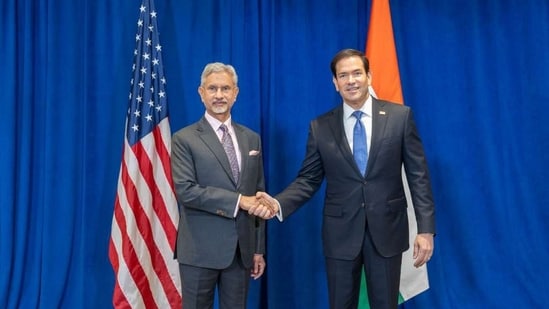
External affairs minister S Jaishankar said he raised New Delhi’s concerns over Washington’s sanctions against Russian energy buyers in a meeting with US Secretary of State Marco Rubio on the sidelines of the UN General Assembly’s High Level Week in New York.
The Lindsey O Graham Sanctioning Russia and Iran Act (SRIA) of 2026, signed into law last week, gives US President Donald Trump the authority to levy up to 100% tariffs on the top five purchasers of Russian oil and gas. India, China, Azerbaijan, Slovakia and Hungary are presently implicated by this provision.
Also read: India, China have ‘sufficient political, historical wisdom’ to handle differences: Chinese envoy
'Reiterated India’s interests,' Jaishankar
“Reiterated India’s interests and concerns with regard to SRIA. Also discussed the Gulf and Ukraine situations,” Jaishankar said in a post on X on Wednesday.
In a statement after the meeting, Rubio said that the US is coordinating with India on “regional priorities” and “multilateral efforts”.
{{/usCountry}}In a statement after the meeting, Rubio said that the US is coordinating with India on “regional priorities” and “multilateral efforts”.
{{/usCountry}}India’s Ministry of External Affairs, in a statement released after the law was signed, argued that the legislation could have implications for the India-US relationship as well as global energy markets.
“This issue has been discussed at high levels in recent months with various US interlocutors. Its potential implications for not just the bilateral relationship but also the international energy market have been very clearly articulated by the Indian side,” the MEA said in its statement on September 17.
Also read: ‘Iran will never bend the knee’: Pezeshkian warns Trump at UNGA, says ‘we are victims of terrorism’
New Delhi will safeguard the economy
The foreign ministry had said that New Delhi will take the necessary measures to safeguard its economy and work closely with trade and industry bodies. In addition, the MEA had said India would remain committed to ensuring energy security for its 1.4 billion people through diversified energy procurement based on market dynamics.
India’s concerns about the SRIA will also likely be discussed on Thursday, when foreign secretary Vikram Misri is expected to meet with his American counterpart Allison Hooker, who serves as Under Secretary of State for Political Affairs. Additional high level meetings may also take place in New York this week.
“Great to meet with Indian External Affairs Minister @DrSJaishankar in New York today. Together, we are building on the U.S.-India strategic partnership and coordinating on key regional priorities and upcoming multilateral efforts,” US Secretary of State Marco Rubio posted on X.
Also read: Iran's Pezeshkian flashes Minab victims' photos during UNGA address, US envoy walks out
Trump is a very strong believer in tariffs: Rubio
Later, Rubio told reporters Trump is a very strong believer in tariffs as a tool of national policy and the Russia sanctions act gives him that authority to influence what happens in the Ukraine conflict. “The law gives the President tariff authority. It’s the first time I think in like 70 years that Congress has granted the President tariff authority. The President is a very strong believer in tariffs as a tool of national policy. So this is good,” Rubio told reporters. However, Rubio pointed out the law also gives the President national security waivers, which allows him to apply them as needed in individual cases.
The SRIA was signed into law by President Trump on Friday last week after its passage in the House of Representatives on Wednesday. The Senate had passed the SRIA in August by a decisive margin.
Also read: India and China can build a new order together
To be sure, the bill does not name any country as a target. Instead, it tasks the US Trade Representative, in consultation with the Secretary of State and Secretary of Energy, to identify the five largest importers of Russian crude and gas by total volume over the preceding 12 months, with the list reassessed every 180 days. The tariff rate - which can be set at any rate up to the ceiling 100% - is set at the president’s discretion. The President is not compelled by law to place tariffs on purchasers of Russian energy.
However, the legislation’s key backers - especially Senators Richard Blumenthal and Jeanne Shaheen - have stressed that India and China are among the major targets of the proposed tariffs.
“To China and India: You better clean up your act. Buy your oil and gas somewhere else,” said Senator Blumenthal on Wednesday after the bill passed in the House of Representatives.
Deep Dive
What were the main concerns raised by Jaishankar during his meeting with US Secretary of State Marco Rubio?
Why is India unable to stop buying Russian oil despite US pressure?
How could the 100% tariffs on Russian oil affect India and its energy security?
The meeting comes days after US President Donald Trump signed the Lindsey O. Graham Sanctioning Russia and Iran Act into law, giving him expanded authority to impose tariffs of up to 100% on imports from the top five buyers of Russian oil and gas, a list that currently includes India.
The legislation had been passed by the US House of Representatives two days before Trump signed it into law.
The Lindsey O Graham Sanctioning Russia and Iran Act of 2026 cleared the House on Wednesday by 262-159 margin, after passing the Senate 86-11 on August 7.
It grants Trump the authority to impose tariffs of up to 100% on goods from the five largest purchasers of Russian crude oil and natural gas — a list that, by current import volumes, includes China, India, Slovakia, Hungary and Azerbaijan.
India's reaction to Russia santions bill
Hours after the US House of Representatives passed the legislation and sent it to President Donald Trump’s desk, India warned that the sanctions bill, which authorises tariffs of up to 100% on the five largest buyers of Russian oil, could have implications for bilateral ties as well as the global energy market.
India’s external affairs ministry said the government was determined “to take all necessary measures to protect its trade and economic interests” and would work closely with trade and industry bodies to address the fallout. New Delhi has discussed the bill “at high levels in recent months with various US interlocutors,” the ministry said, adding that India had “very clearly articulated” its potential implications, “for not just the bilateral relationship but also the international energy market.”
Also Read: US Congress clears Russia sanctions bill, hands Trump new tariff powers: What it means for India
The ministry also reiterated that India’s energy purchases are driven by national interest. “India remains firmly committed to ensuring energy security for its 1.4 billion people,” it said, adding that the country would continue sourcing energy through “diversified sourcing and on the basis of evolving market dynamics.”