
 E-Paper



J&K polls’ timeline to be decided by EC, unlikely to be held with LS, say leaders
Party leaders, privy to details, ruled out the possibility of holding polls in J&K simultaneously with the Lok Sabha elections early next year

 Prefer HTon Google


NEW DELHI The Union government is committed to adhering to the Supreme Court’s direction to hold assembly polls in Jammu and Kashmir but the timeline for the process will be determined by the Election Commission, a senior functionary of the Bharatiya Janata Party (BJP) said on Monday.
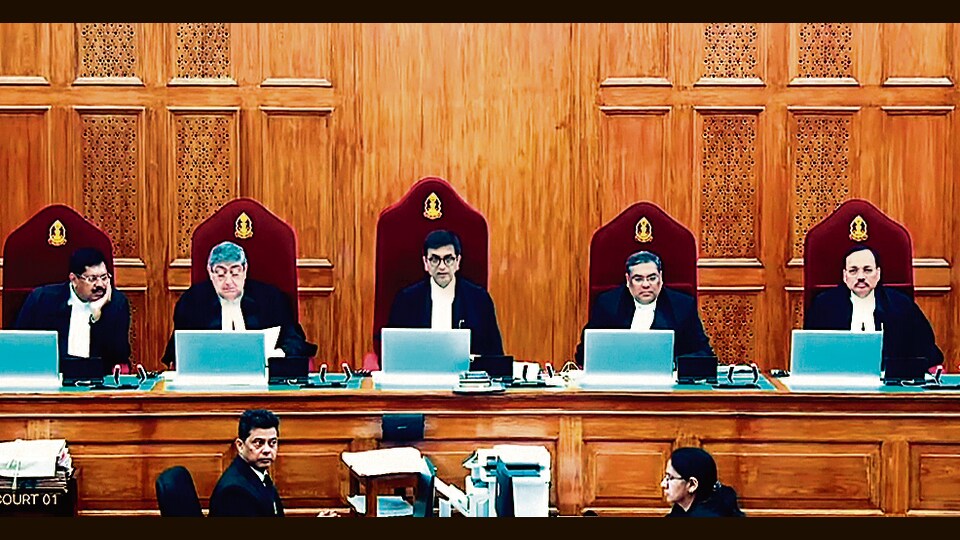
Party leaders, privy to details, ruled out the possibility of holding polls in J&K simultaneously with the Lok Sabha elections early next year, citing security concerns and other logistical limitations.
The SC while unanimously upholding the Union government’s move of reorganisation of J&K and the reading down of Article 370 that gave the erstwhile state special status, directed the government to restore statehood in the Union Territory at the earliest and hold polls to elect a new assembly by September 2024.
A senior party leader speaking on condition of anonymity said though the party is ready to contest polls in the state where the delimitation exercise to draw up constituencies has been completed, the process of conducting panchayat and urban local body elections will have to be completed first.
“It will not be feasible to hold the elections with the Lok Sabha polls in such a scenario,” the leader said.
“The term of the panchayats will be over in January; it will not be possible to hold polls in quick succession. The urban local body elections have also been delayed owing to the need to provide reservation. After the abrogation of Article 370, all the provisions of the Constitution are applicable to the UT, including reservation for OBCs. The GD Sharma Commission constituted by the J&K government has made its recommendations that are awaiting implementation,” the leader said.
The other impediment to holding early polls is the timing of the annual Amarnath Yatra, which happens in the summer. The first leader explained that it would be feasible to plan polling once the Hindu pilgrimage that spans 50-60 days, typically between July and August, ends so that security personnel deputed for the exercise can be retained for the polls.
Referring to the security requirements, a second leader said, “There is a need for a detailed security mapping of the region for the polling process to be held without glitches. If the elections are to coincide it may be difficult to move the forces on the ground. About 80-90 companies of personnel are required for polling duty.”
An official of the ministry of home affairs said the ministry’s stated position on Jammu and Kashmir has been that statehood would be granted at an appropriate time. Union home minister Amit Shah has said on multiple occasions that statehood will be restored after the delimitation process and elections, the official said.
On Monday, Shah, who moved the bill to read down Article 370 in Parliament on August 5, 2019, said the SC decision validates that the move was constitutional. In a post on social media platform X, he said, “...On the 5th of August 2019, PM @narendramodi Ji took a visionary decision to abrogate #Article370. Since then, peace and normalcy have returned to J&K. Growth and development have brought new meaning to human life in the valley once torn by violence. Prosperity in the tourism and agriculture sectors has raised the income levels of the residents of both Jammu, Kashmir and Ladakh. Today, the Supreme Court’s verdict has proved that the decision to abrogate #Article370 was completely constitutional.”
Before being designated as a UT, J&K was under governor’s rule after the collapse of the PDP-BJP alliance government in June 2018.
According to MHA data, incidents of terrorism in J&K have come down by 70% compared to those in the period under Congress rule from 2004 to 2014; civilian and security personnel deaths are 72% and 59% less, respectively.
Between 1994 and 2004, there were a total of 40,164 terror incidents, 7,217 from 2004 to 2014, and these came down to 2,197 in the last nine years, the data said.


