
 E-Paper



Just Like That: Beating Retreat and India’s long unfinished de-colonisation
The shift from ‘Abide with Me’ to ‘Vande Mataram’ at Beating Retreat reflects India’s slow but necessary journey toward cultural decolonisation

 Prefer HTon Google


Like many Indians, I too was upset when the Beating Retreat at Vijay Chowk in New Delhi, which marks the culmination of the Republic Day celebrations, stopped the tradition of ending the display of massed bands with the playing of the hymn ‘Abide with Me’. The hymn is both lovely and soulful, and the manner in which the bells on the towers of North and South Block synchronised their sound was, indeed, memorable.
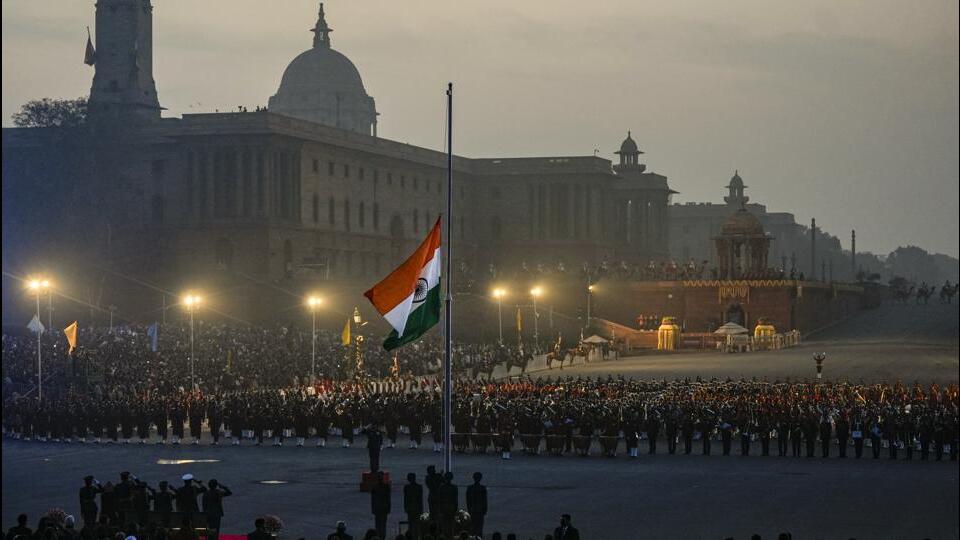
But this year, when the Beating Retreat ended with the playing of Vande Mataram, I found it deeply moving too. The way the notes of our iconic national song suffused the evening, with the esraj, flute, and the tabla combining perfectly with the bagpipe, clarinet, drums, and trombone of the military orchestra, was mesmerizing.
Change is not an easy thing to accept for those who are inflexibly inured to the old. For Indians of a certain anglicized background, whose knowledge of most things Indian borders on the minuscule, any attempt to deviate from the traditions which the British left us is sacrilege. I do not blame them for this, simply because their entire upbringing, education, and exposure are limited to the legacies of our erstwhile masters. For some of them, even social inclusion is restricted to only those who can speak English with the right fluency and accent. But the post-colonization process—which is not anti-British but pro-Indian—is about reclaiming our own cultural past. In this process, there is bound to be some displacement to create space for the creative expressions which are part of our own thousands-of-years-old civilizational heritage.
The aim of colonization is not only the military subjugation of the ‘natives’. Its success lies in the colonization of our minds. In this respect, British colonialism was a resounding success and was wrought with a planned vision and methodology. Nothing brings this out more clearly than the words of that far-sighted colonizer, Lord Macaulay. In his infamous Minute of 2nd February 1835, he rubbished Indian civilization and, with clinical clarity, pronounced what British policy would be: ‘We must at present do our best to form a class who may be interpreters between us and the millions we govern: a class of persons, Indians in blood and colour, but English in taste, in opinions, in morals and in intellect’. By the time the British left, he had succeeded beyond his wildest imagination.
Also Read: Just Like That: India’s long journey of faith, conflict and coexistence
When the Union Jack went down on 15th August 1947, and the Tricolour replaced it, we got political freedom, but the cultural legacy of colonialism continued for much longer and persists even today. This is what Macaulay, in a prophetic speech in the House of Commons, had predicted—an ‘imperishable empire’, which through the mental colonization of the Indian elite, would signify ‘triumphs which are followed by no reverse’, an empire ‘exempt from all natural causes of decay’. It is but natural, therefore, that when attempts are made to dilute or dismantle this empire—even after 75 years of Independence—there will be opposition from those who are, as Macaulay had planned, Indian in blood and colour but English in taste and opinion.
It is true that the process of cultural reappropriation takes time, is often flawed, unnecessarily jingoistic, lacking in taste, and tainted by excess. But even so, the attempt is valid, since failure cannot mean that success should not be strived for. It is here that the Beating Retreat function this year, which saw our massed military bands playing Indian tunes, is to be commended, although certain aspects of it—like any new venture—can be criticized or improved upon. Some of the melodies were forgettable, others less memorable, and some immortal. I believe the beautiful refrain of ‘Abide with Me’ could also have been retained, since Christians too are part of the many faiths that constitute our national fabric. In a few of the new selections, there was also an element of kitsch, with garish lighting and some politically partisan messaging, but on the whole, I am happy that, without jettisoning the Beating Retreat itself—a colonial inheritance—we tried to give it a more Indian profile, rooted in our culture and far more resonant with the masses.
To blindly resist change in order to fossilize the past is unsustainable. Every country tries to give its political messaging its own culture. In doing so, we have to keep at bay the extremists—who would like to purge anything non-Hindu from our definition of culture, including Muslims and the Moghuls, and implement puerile acts like rechristening the Mughal Gardens of Rashtrapati Bhavan as Amrit Udyan. The British came to rule, colonize, loot, and leave. The adherents of Islam stayed on and are very much a part of our national fabric.
Also Read: Just Like That | On wealth, succession and the legacy of family discord
This being said, it is equally true that under Macaulay’s Indian legatees, who inherited power after the British left, almost nothing seemed to change for a very long time, in terms of educational curriculum or even giving our own ancient languages primacy, and much more still needs to be done. I had a boss in the Indian Foreign Service who was so ‘British’ that he lampooned those who spoke in Hindi as ‘HMTs’—Hindi Medium Types—and those who spoke Urdu as UMT—Urdu (which he pronounced as ‘Ardu’) Medium Types.
One can only be grateful that, increasingly, such people are becoming redundant. This year’s Beating Retreat only reinforces that hope.
(Pavan K Varma is an author, diplomat, and former member of Parliament (Rajya Sabha). The views expressed are personal)


