
 E-Paper



Kanwad Yatra: Faith on the move, barefoot
Shiva devotees wait for this annual pilgrimage during the month of Sawan when they offer Gangajal to Shivlings at known and not-so-known temples. The pilgrimage ends on the last day of Sawan on August 15.

 Prefer HTon Google


It’s that time of the year when ‘Bol Bum’ chanting ‘kanwadias’ (some say Kanwarias), jogging barefoot with pots full of Ganga ‘jal’ (water) on their colourful bamboo contraption called ‘kanwad’ on shoulders, rule the roads, especially ones leading to famous Shiva temples across the country.
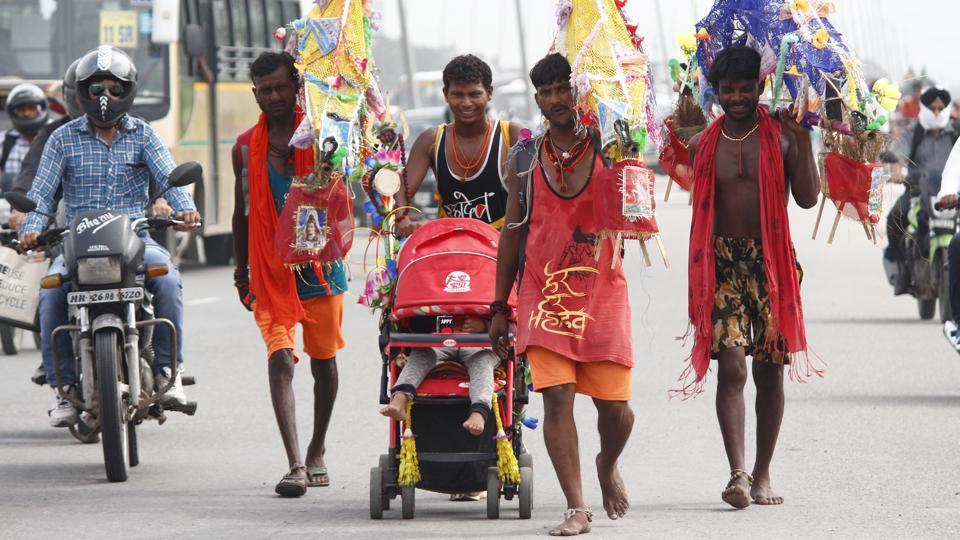
“Lord Shiva loves Ganga jal and is greatly pleased when he is offered the water from the ancient river during the month of Shravan. But there is a catch. The water that is offered to the lord should not be kept on the ground, something that each Kanwadia has to follow, something which further tests the believer’s resolve,” says Subuddhanand, an aide of Shankaracharya Swaroopanand Saraswati.
Tracing the origin of the age-old, at times 100 kilometre-long trek that culminates with devotees offering Ganga ‘jal’ on Shiva’s linga in famous and not-so-famous temples, isn’t easy.
The high priests of Hindu order – from Varanasi’s Kashi Vishvanath temple to Rishikesh’s famous Parmarth Niketan, from the experts of Vedas and Puranas to disciples of Shankaracharyas themselves – give different versions on the origins of the trek which also comprises express runners, called ‘Dak Bum’ who unlike the regular kanwadias don’t take a break but run through from the moment they fill their pots of Ganga water!
The Kanwad-origin versions vary vastly – some suggest Lord Rama was the first ‘Kanwadia’ (mostly referred to as Kanwaria but some religious heads aver it’s ‘kanwad’, a concocted version derived from ‘kandhad’ meaning ‘on shoulders’). Others credit demon king Ravana, a great Shiva devotee, as the originator of the trek which also finds its roots in the ancient legend according to which Lord Shiva consumed poison that emerged from the ‘samudra manthan’ (churning of the sea) featuring gods and demons.
“Everyone wanted amrit, the elixir of life, and other good things. None wanted poison. That’s when the Lord stepped in, balancing the poison on his throat, as both spitting it out or taking it in, would have been disastrous for the world. It is said that offering Ganga jal, especially during Shravan month, soothes the burning sensation that the Lord feels in his body due to the effects of the poison. And a joyous Lord blesses all,” explains Ramakant Shastri, the Varanasi-based knower of Puranas and Vedas.
Some feel it was Shravan Kumar, (the obedient son of blind parents who took them on a religious pilgrimage on a kanwad) and thus gave birth to holy trek.
Kanwad Yatra and OBC connect
Ved Murti ji, well-versed with the knowledge of Hindu rituals and customs, gives an interesting angle to Kanwad Yatra.
“In 1932 there was a great famine in and around Varanasi. Then 5 Yadavs had prayed to Lord Shiva to help them overcome the problem and in return promised that their successive generations would offer Ganga jal each year on the first Monday of Shravan month. That practice is being followed till date,” he said. This time, he says, there were nearly 50,000 Yadavs offering Ganga Jal to the Lord.
Yadavs incidentally are the numerically dominant OBC sub-castes in Uttar Pradesh. The Yogi Adityanath government which is busy wooing non-Yadav OBCs has since March 2017 scaled up the level on which Kanwad Yatra was organised. It has allowed them DJs, provided them security through sensitive pockets, got police and bureaucrats to shower petals on the foot soldiers of Hinduism. “The Kanwad Yatra has grown big over the years, getting wings during the BJP rule. But still, by and large, it remains a yatra that is undertaken mostly by OBCs and poor. In a way, the Kanwad Yatra being promoted by the BJP is also a tool to connect with OBCs and even dalits who too are undertaking this trek,” says Professsor Manoj Dixit, vice chancellor of RML Avadh University, Faizabad.
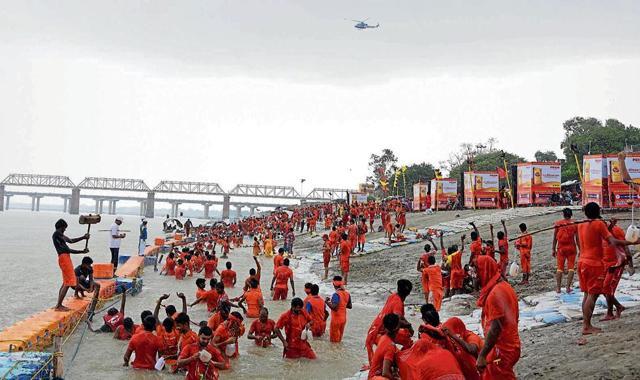
The Adityanath government’s management of the Kanwad Yatra got a thumbs up from the Shiva devotees, many of whom admitted that from the days when even arranging water was a task to now when food and water are on offer throughout the trek, it has been quite a change. A video of a senior police officer massaging the feet of a Kanwad carrier in western UP had gone viral.
“We have been participating in this yatra for generations. It is a family routine we have been following. So what I see now and compare with what my father and my grandfather narrated, I must say that things have become a lot easier,” says Ram Bauddha Maurya, 35, a Kanwadia from Balrampur.
Muslim Connect
At several places in western UP, Muslims have been welcoming Kanwad Yatra for years. But Varanasi-born Mehmood Hashmi, 45, doing business in Delhi is special. For he has been welcoming and taking care of the management of Kanwad Yatra that is undertaken annually from Delhi to Haridwar.
But, based on his experience of 9 trips to Vaishno Devi and visits to 8 of the 12 Jyotirlinga shrines in India, he says he could very well serve as a guide to anyone wanting to know more about Jyotirlingas, Vaishno Devi or rest of the important places associated with Hinduism. “Next year I would undertake a Kanwad Yatra myself,” he says.
Shrikant Acharya, the priest of Kashi Vishvanath temple says, “The Lord doesn’t discriminate on religious lines. He is as much for the Hindus as for the Muslims or for that matter for any other community.” He also draws an interesting analogy between triple talaq bill that was passed by Rajya Sabha making the instant divorce practice punishable by law. “Lord Shiva is also worshipped as ardh-narshwar, half of his body male, half female. It’s in this form that the lord teaches equality of sexes. So to me passing of the triple-talaq bill during the month of Shravan means that the injustice on community women would end. That’s equality which Lord Shiva stands for,” says Hashmi.
Charting Newer Routes
“Shiva teaches balance in life. He teaches us that man and woman are one and that Shiv and Shakti are inseparable. That’s why each Kanwadia who undertakes a long trek balancing pots full of Ganga Jal on shoulder,” says Ramakant Shastri.
He admits that the original Kanwad Yatra was the one that used to happen to Baba Dham in Baijnath Dham which is now in Jharkhand. “That’s perhaps because it’s here that Ravana is believed to have violated the Shiva advice against keeping his linga on the ground. Ravana who wanted to carry the Shiva linga to Lanka had to leave it at the place where Baijnath Dham is now located. But, now of course, places like Haridwar, Kashi, Rishikesh too are drawing large crowd,” says Shrikant Acharya.
Lucknow’s Mankamneshwar temple as well as the ones in Barabanki, too, are frequented by lots of Shiva devotees.
The trek is also happening at smaller places as the believers, unable to visit afar, are drawing water from local rivers and offering them in local Shiva temples.
The Kanwad Yatra has grown bigger. It’s more colourful and symbolism has increased. In various parts of Uttar Pradesh Kanwadias have been travelling with tricolour.


