
 E-Paper



Big guns fire as Karnataka poll campaign ends
Campaigning for the Karnataka assembly elections, where BJP hopes to defend its control over the only southern state, closed on Monday.

 Prefer HTon Google


A 40-day-long campaign for the Karnataka polls closed on Monday, setting the stage for the high-stakes May 10 assembly elections where the Bharatiya Janata Party (BJP) will hope to defend the only southern state under its control from challengers Congress and Janata Dal (Secular).
Also read: ‘4% Muslim reservation was unconstitutional, BJP removed it': Amit Shah ahead of Karnataka election
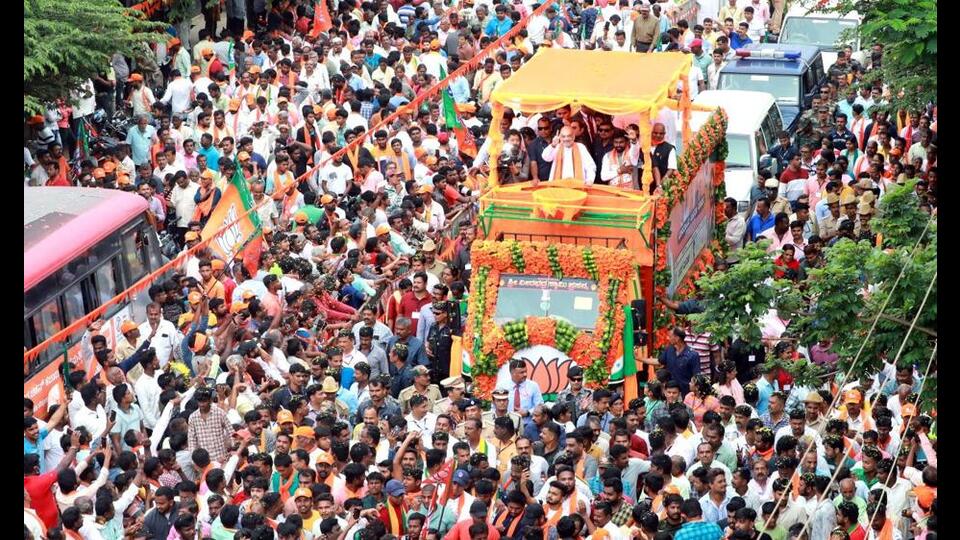
The BJP’s campaign was led by Prime Minister Narendra Modi, who addressed 21 rallies spanning the state, including a late blitz in state capital Bengaluru, where he addressed several meetings and held two road shows over the weekend. The Congress, in contrast, ran an equally aggressive but more local campaign led by former chief minister Siddaramaiah and state unit chief DK Shivakumar. The regional JD(S) relied on the charisma and ground connect of its patriarch, former prime minister HD Deve Gowda.
The final day of campaigning saw road shows and public events by leaders of all three parties.
While chief minister Basavaraj Bommai and former CM BS Yediyurappa turned out for the BJP, former chief minister Siddaramaiah, Karnataka Congress chief DK Shivakumar, and leaders Rahul Gandhi and Priyanka Gandhi Vadra held public meetings for the Congress. The JD(S) too pulled out the big guns on Monday, with Deve Gowda and former CM HD Kumaraswamy campaigning for the party.
The fates of 2,613 candidates will be decided across 224 seats by over 52 million voters. The Election Commission of India (ECI) announced that it had seized ₹388 crore since March 1, as compared to the ₹83 crore in 2018.
Karnataka chief electoral officer Manoj Kumar Meena said protocols are in place to deploy police personnel across the state. Vulnerable polling stations will be monitored online, he said.
The results in Karnataka, the biggest state to go to the polls in 2023 till now, will also pave the road to the 2024 general elections. A win for the BJP will consolidate its foothold in southern India and reinvigorate it for polls later this year in Telangana. A victory for the Congress will hand it a rare win in a direct contest with the BJP, boost its standing within the Opposition camp, and provide it a template of regionalism and caste aspirations to tackle the Hindutva and welfare umbrella of the BJP.
The high-decibel campaign was shaped by five broad issues — corruption, unemployment and price rise, promises to tweak the state’s reservation framework, comments targeting Modi, and the Congress’s manifesto likening the Bajrang Dal to the Popular Front of India and promising a ban.
The BJP’s campaign was led by Modi, Union home minister Amit Shah and former CM Yediyurappa, who stepped away in 2021 but played key roles in ticket selection and campaigning.
“I have travelled to all parts of Karnataka. The enthusiasm, inclination, and support for BJP in all areas. There is enthusiasm to form a BJP government. PM Modi’s popularity is tremendous which is getting converted into votes. It is clear the BJP is forming the government with full majority,” Shah said on Monday.
The party is hoping to be the first in more than three decades to come back to power, and tried to effect a generational change in its state unit. But its first list of 189 candidates, declared on April 11, sparked a rebellion with a dozen leaders leaving the party. Prominent among them is former chief minister Jagadish Shettar and former deputy CM Laxman Savadi who are fighting the election on Congress tickets. The BJP says the people will teach the turncoats a lesson. Senior state party leaders said 200 big rallies were addressed by top leaders, who spoke about the promises of “double engine government”.
“Prime Minister Modi and Home Minister Amit Shah did roadshows and rallies. I am confident that we (BJP) will win 135 seats in the Karnataka Assembly election. Congress is a drowning ship, its leaders Rahul Gandhi and Priyanka Gandhi Vadra won only 2-3 seats in Uttar Pradesh even after campaigning for 4-5 months,” Yediyurappa said.
For the Congress, which hopes Karnataka will become the fourth state it will run on its own, the ticket distribution process was smoother. The party also attempted to keep the rivalry between Siddaramaiah and Shivakumar out of the public arena, even releasing a video on Sunday showing the two leaders exhibiting bonhomie. Rahul and Priyanka Gandhi held road shows and rallies almost every day in the past fortnight, zeroing in on the party’s main poll plank, the state government’s alleged corruption— particularly through popular campaign slogans such as “40% sarkara” and “Pay CM”.The party also released five guarantees, including free electricity, stipends for unemployed youths and women, free rice and free bus rides for women.
Also read: Congress chief gets poll panel notice over Sonia Gandhi's 'Karnataka sovereignty' remark
“Prices have skyrocketed and the common person’s income has not increased, if not gone down. It has become difficult for people to sustain. That is why we want to introduce these schemes,” Shivakumar said.
To counter this, the BJP alleged that the Congress takes 85% commission, recalling former prime minister Rajiv Gandhi’s 1985 statement that only 15 paise of every rupee spent by the central government reached the poor. Modi also sought to corner the Congress over controversial comments made by Congress chief Mallikarjun Kharge likening the PM to a venomous snake. He said that the Congress was known for poor governance and will use the state as an ATM if it won. The Congress countered by pointing out that BJP lawmaker Basangouda Patil Yatnal also described former Congress president Sonia Gandhi as a “vishkanya” (venomous woman).
The JD(S) largely focussed on retaining its stronghold of Old Mysuru, which comprises 52 seats, and safeguarding its traditional vote base, the Vokkaligas. Its poll promises includes include Matrushree and women empowerment programmes, including loan waiver for women self-help groups and five free cylinders a year besides enhancement of widow pension.
The party also announced Raitha Chaitanya for farmers, Vikalachetanara Asare and an increase in incentives for lawyers, among a slew of promises to police personnel, on education, health, religious minorities, scheduled castes, and on youth empowerment.
Though few expect the regional party to reach the majority mark on its own, the party can play kingmaker in a tight election or a hung assembly, as it had done in 2018.
“JDS is not the B-team of BJP or Congress. We are the B-team of the people of Karnataka. PM Modi accused Congress of being an 80 per cent party, Congress called the BJP 40% government, but nobody dared to call JDS any percent party,” Kumaraswamy added.
Also read: 'They are dangerous': Mamata Banerjee slams BJP over Karnataka election, Manipur violence
Caste and reservations also played a key role in the campaign. In April, the BJP government rejigged the state’s reservation matrix, scrapping a 4% quota for Muslims and redistributing it equally between the Lingayats and Vokkaligas, two of the state’s dominant communities. The party also sought to subdivide the Scheduled Caste quota, sparking protests. In contrast, the Congress said it will restore the Muslim quota and increase the ceiling of reservations to 75%, far beyond the Supreme Court-mandated limit of 50%.
“The Congress tried to counter the BJP’s Hindutva with development agenda with social justice by promising higher reservation and a demand for national caste census,” said political analyst Sandeep Shastri. “Will it work or not would be known on May 13 when the votes will be counted.”
Faith-based appeals also played a part, especially after the Congress likened the Bajrang Dal, the youth wing of the Vishwa Hindu Parishad, to PFI in its manifesto and called for a ban. Modi said the announcement was akin to locking up Lord Hanuman, who is also known as Bajrangbali. Late in the campaign, Shivakumar visited a Hanuman temple in Mysuru and promised to build more temples to Anjaneya (another name for Hanuman) and renovate existing ones.
Some Congress leaders accepted that the controversy may consolidate the fringe Hindu votes for the BJP but added that the aim was to prevent a drift of Muslim votes to the Social Democratic Party of India, which is contesting 19 seats in coastal Karnataka, or Asaduddin Owaisi’s All India Majlis-e-Ittehadul Muslimeen. “The message we wanted to give, was given. We believe it will help us more than the BJP,” a senior Congress leader aware of the developments said.
Valerian Rodrigues, a former professor at Mangalore University and Jawaharlal Nehru University, said the announcement could help the Congress get more Muslim votes particularly in coastal Karnataka, where PFI and Bajrang Dal cadres have repeatedly clashed. “The controversy came too late [in the campaign]. The template for the election was more or less set. It could be a talking point in some parts in coastal Karnataka or in some urban areas, but it is too late for this to sink in as a poll issue,” he said.


