
 E-Paper



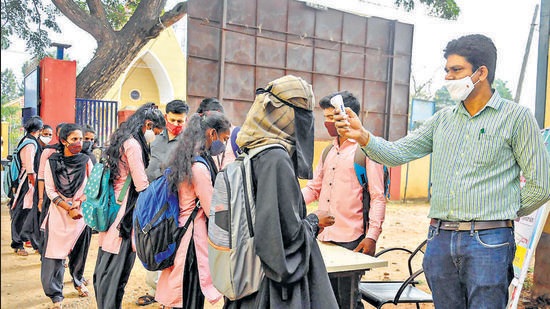
Karnataka gears up to restart physical classes after 4 months
After a gap of nearly four months, the Karnataka government has decided to reopen physical classes for students in Classes 9, 10 and 12 from August 23, that would allow children to be back in their schools for the first time since the second wave of Covid-19 infections


After a gap of nearly four months, the Karnataka government has decided to reopen physical classes for students in Classes 9, 10 and 12 from August 23, that would allow children to be back in their schools for the first time since the second wave of Covid-19 infections.
Parents and guardians, however, have questioned the decision of the government.
“Let them reopen schools where there is not much impact of Covid-19; but you cannot have one yardstick for the entire state,” Mohammed Shakeel, president of Voice of Parents, an association of parents and guardians, told Hindustan Times on Sunday.
He said that Karnataka says it wants to implement the National Education Policy (NEP) which states that students will graduate only in their 12th standard, which gives them no reason to push children below these classes to make them rush back to schools.
He, and multiple other parents, have even challenged the right of schools (private) to demand full school feels as well.
Shakeel said that by reopening schools, the government is helping these private institutions to collect fees and then when the third wave comes, close them down again.
However, according to Karnataka minister for primary and secondary education BC Nagesh, in the last one year, students didn’t receive the same kind of education in their homes, one of them being the technical aspect.
“In the last one year, no matter how much we tried we could not give the students the same kind of education in their homes,” Nagesh said on Sunday.
He listed a variety of reasons for the same which included the technical aspects like poor or no internet connectivity and the general disconnect between students and teachers in an online setting.
The decision to reopen schools come at a time when the number of Covid-19 cases in Karnataka appears to have stabilised but fears of an imminent spike looms large over the state, especially with the impending third wave.
Despite being known for its prowess in technology, the pandemic exposed the fault lines in Karnataka’s inequitable development; nearly half of the state’s young students lost an academic year due to internet accessibility--or the lack of it.
In July, S Suresh Kumar, the then primary and secondary education minister had stated that around 9.3 million students out of the total 10.05 million across private and public schools in Karnataka, have been accounted for in terms of access to devices, internet, TV, radio and even email.
Of the 9.3 million who have been accounted for, only 5,859,907 have smartphones/tablets while around 3,127,524 don’t have any access to such devices. Further, there are just 5,134,386 students who have access to the internet while 3,779,965 students do not have access to the internet, rendering the exercise of online classes as a redundant practice for these children, mostly from rural and backward regions of the state, Hindustan Times had reported on July 2.
Reopening of schools has been a contentious issue, especially at a time when there appears to be a resurgence of new Covid-19 infections.
Karnataka has 20,556 active Covid-19 cases after the state reported 1,189 new infections the last 24-hour, the health department said in its bulletin on Sunday.
The death toll rose to 37,145 as 22 more people succumbed to the virus.
The average positivity rate stands at 0.94% and the case fatality rate is 1.85%, according to government data.
To make matters worse, the testing numbers in Karnataka too have dropped with just 125,158 tests conducted on Sunday, including 92,842 RT-PCR tests, data shows.
While the state positivity rate is below 1%, there are at least eight districts that have a higher than state average, data from the Covid-19 war room shows.
Dakshina Kannada, which has been at the receiving end of heavy rains, has an average positivity rate ( in the last seven days) of 3.5% until 5 pm on Saturday while Udupi has 2.71%.
Kodagu has a positivity rate of 2.16% while it is 1.64% in Hassan.
Karnataka chief minister Basavaraj Bommai will be visiting schools and colleges on Monday to check if guidelines for Covid-19 safety has been taken into account.
Agriculture minister BC Patil as well as the BJP itself , have been asking children to return to school without fear.


