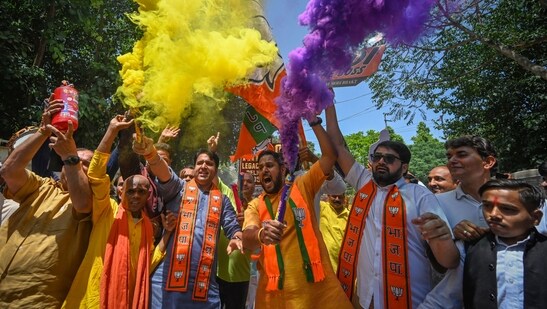
The election results for Assam, Kerala, Tamil Nadu and West Bengal are a mixed bag. The Bharatiya Janata Party (BJP) and the Congress-led alliance have won Assam and Kerala in keeping with the popular consensus among analysts. The BJP has finally wrested West Bengal from the Trinamool Congress after emerging as the main opposition party in the state seven years ago in the 2019 Lok Sabha elections. The biggest political shocker, however, has been Tamil Nadu, where the ruling Dravida
In the 11 assembly elections which have happened after the 2024 Lok Sabha, the BJP or National Democratic Alliance (NDA) has retained or improved its AC-wise seat share compared to the 2024 Lok Sabha in all but three elections: Jharkhand, Delhi, and Kerala (HT Photo/Sanchit Khanna)
BJP’s post-2024 recovery continues
BJP’s post-2024 recovery continues
When the BJP failed to retain its 2014 and 2019 parliamentary majority in 2024, many saw it as the beginning of the decline of its national political dominance. Assembly election results post 2024 Lok Sabha show that such assessments were wrong. In the 11 assembly elections which have happened after the 2024 Lok Sabha, the BJP or National Democratic Alliance (NDA) has retained or improved its AC-wise seat share compared to the 2024 Lok Sabha in all but three elections: Jharkhand, Delhi, and Kerala. Its improvement is the most pronounced in states which it had lost or was locked in an equal contest with the Opposition in 2024: West Bengal, Maharashtra, and Haryana. In some states, it has managed to turn the tables partly because it was the incumbent and could use economic palliatives such as cash transfers. In West Bengal, it has exploited anti-incumbency despite the incumbent offering populist benefits. Not only does this mean that theories of a post-2024-BJP-slump were wrong, but it also shows that economic palliatives alone are not a guarantee for non-BJP governments coming back to power. The DMK in Tamil Nadu, the TMC in West Bengal, and the CPI(M)-led LDF in Kerala have realised this the hard way.
Anti-BJP politics is weaker, but this time at the cost of non-Congress parties
The 2014 Lok Sabha elections were a watershed in Indian political history for two reasons. The first was that the BJP became the first non-Congress ideologically coherent political party to get a parliamentary majority of its own. While the Janata Party won a large majority in the 1977 election held after the Emergency, it was a conglomeration of socialists, the BJP’s predecessor Bharatiya Jana Sangh and other political streams. The second was the Congress’s seat tally falling to two digits, a predicament the grand old party has not been able to overcome till date. What was also extremely significant about the post-2014 national politics was the fact that non-Congress opposition parties actually had a higher number of MPs than the Congress in the 2014, 2019 and 2024 elections. The DMK and the TMC were the biggest non-Congress parties in the 2019 and 2024 elections. With the DMK and the TMC losing their states and the Congress itself sinking much below its 2024 Lok Sabha performance in states such as Maharashtra, Haryana and even Assam, India’s opposition finds itself in a predicament where it is weaker against the BJP as a whole, with the latest weakening at the cost of regional parties rather than the Congress. If the TMC and the DMK cannot overcome their latest reverses, the predicament is likely to continue.
It is factually wrong to call the BJP a Hindi belt party now
The BJP has 17 chief ministers in India today. With NDA/NEDA partners, it is in power in five other states and UTs. While the BJP now rules every Hindi-speaking state and UT except Jharkhand and Himachal Pradesh in the country, it also has chief ministers in all three non-Hindi-speaking large states in eastern India (Assam, West Bengal and Odisha) and all three non-Hindi-speaking western states (Maharashtra, Gujarat and Goa). It has been in and out of power in Karnataka since the 2000s and is now in an alliance with the ruling party in Andhra Pradesh. Many of the BJP’s successes in non-Hindi-speaking states such as Odisha, West Bengal, Assam, etc. have come in the post-2014 period, which suggests a more recent political traction for the party. In some of these states, such as Maharashtra and Assam, the BJP has actually replaced its regional allies to become the senior partner by a distance. To insist that the BJP is still a Hindi-belt-based party like its predecessor Jana Sangh is being oblivious to the truth.
Roshan Kishore is the Data and Political Economy Editor at Hindustan Times. He heads the newsroom's data journalism team, which produces Number Theory, a daily data-driven feature for the print edition and the HT app. Number Theory uses data analysis and story-telling based on it to add value to the newsroom’s daily coverage by putting stories in a larger context on a range of issues, including politics, macroeconomy, markets, global affairs and climate. Under his leadership HT’s data journalism work has established itself as a niche product in Indian journalism and pushed the boundaries of marrying academic rigour with news sense and speed. Along with writing and editing data stories, he has also been writing a weekly political economy column called Terms of Trade for HT Premium. A trained economist with an MPhil degree from Jawaharlal Nehru University, Kishore has also been a visiting fellow at the Centre for Advanced Studies of India (CASI) at the University of Pennsylvania. Along with his journalistic work, his writings have also appeared in journals such as the Economic and Political Weekly and working papers for CASI and UNESCAP.
Abhishek Jha is Assistant Editor-Data at Hindustan Times. He uses statistical programming to generate newsworthy insights from large datasets. He is part of the team that produces Number Theory, a daily data story feature of the paper’s print edition. Since March 2024, he has been writing Weather Bee, a weekly column for the Hindustan Times website. He is a chemical engineer by training, who specialises in stories related to weather, climate, and the environment. Jha has been at HT since 2018, where he offers data-driven perspective and analysis on politics, environment, weather, climate, economy and society. His work includes data coverage of elections in India and abroad, including the 2019 and 2024 Lok Sabha elections; the disasters and extreme weather resulting from changing climate, such as floods, droughts, heat waves, cold waves, and dwindling snow cap in the Himalayas; the factors that drive poor air quality in northern India; the changing patterns of land use; the Covid-19 pandemic and its impact on labour market conditions; the changing pattern of consumer spending seen in the new consumer spending surveys; and social norms seen in the surveys such as the National Family Health Survey.
Get Latest News, breaking headlines, and top India News, and today real-time updates from across the nation. Stay informed on politics, government policies, crime, Today Weather, and major developments on Hindustan Times
Get Latest News, breaking headlines, and top India News, and today real-time updates from across the nation. Stay informed on politics, government policies, crime, Today Weather, and major developments on Hindustan Times
Home/India News/Key takeaways from the election results | Number Theory
{{^htLoading}}
Advertisement
{{/htLoading}}
SHARE THIS ARTICLE ON
{{#usCountry}}{{/usCountry}}
Notifications
Get breaking alerts directly from the newsroom
Notifications are on!You'll be notified when news breaks