
 E-Paper



K-Rail environmentally and financially unviable, says Satheesan
Though the government has come up with an estimate of ₹64,000 crores for theproject, the realistic amount would be close to ₹1.33 lakh crore as per Niti Aayog, says Satheesan


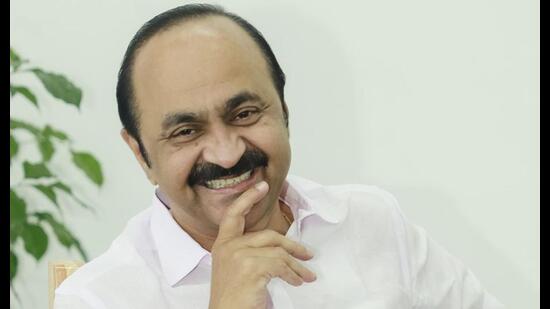
As the state is witnessing fierce protest over the government’s proposed high-speed K-Rail or SilverLine project, Kerala Leader of Opposition VD Satheesan spoke about Congress’s stand on the issue, state’s financial crisis and factionalism within the party. Excerpts:
Why is the Congress-led (United Democratic Front) UDF opposing the proposed K Rail project?
The project is not environmentally and financially viable for a state like Kerala. Kerala is environmentally fragile, and we witnessed heavy floods, landslides and cloudbursts in the last few years. The recent IPCC (intergovernmental panel on climate change) report red-flagged Kerala. The project, with its 30-40-foot-high embankments made of natural resources, is going to spell doom as it is planned to run through 164 hydrologically vulnerable locations. Besides, the state is facing an acute financial crisis. It is a known fact that the state government is finding it difficult to pay the salaries and pensions of its employees. Though the government has come up with an estimate of ₹64,000 crores for theproject, the realistic amount would be close to ₹1.33 lakh crore as per Niti Aayog. How a debt-ridden state will take up a humongous debt created by the project is the moot question.
The ruling Left Democratic Front (LDF) says you are anti-development.
Development is often misconstrued as “speed”. The development does not mean you must be implementing a multi-crore project without taking into consideration environmental and financial impact. We have to talk about sustainable development where development is in harmony with nature. The UDF is the one that implemented many developmental projects. It is sheer irony that the LDF, which opposed every project that was brought in by the UDF like Kochi airport and Metro, is now blaming us. The moot question to be answered before implementing any project is whether it is needed for the state, its financial and environmental impact and whether there are any alternatives. Essential studies, required for any project with a large impact are either missing or cooked up to make it viable. It lacks crucial basics like location survey, geological survey, techno-economic feasibility study, social impact assessment, and ridership assessment. This makes it clear that the government is mainly concerned with kickbacks from foreign loans, including those from the JICA (Japan aid agency).
Why do you (or the Congress?) often compare K-Rail to Nandigram & Singur?
We can draw clear parallels between the two. The government is trying to implement the project with an iron fist. See how the police dealt with the protestors in different areas. Even women, who have been otherwise confined to their houses, are seen agitating against the project. They are brutally manhandled. People at large are opposed to it, but the state government is trying to implement it at any cost. The chief minister (Pinarayi Vijayan) talks only to the elite class, ignoring the people who will lose their lifelong earnings. Apprehensions of economists and environmentalists are ignored. This is what happened in Nandigram and Singur. The CPI (M) (Communist Party of India (Marxist)) in Kerala is repeating the same mistake they made in Nandigram & Singur in West Bengal.
What alternative do you suggest to K-Rail?
The average speed of trains in the existing railway network in Kerala is low due to the combination of super-fast trains, low-speed passenger and freight trains running on the same track. We can overcome this by upgrading two lanes to four lanes. Two lanes can be reserved for faster trains, and the other two for slower trains. High-speed trains can stop at one station in each district, as envisioned in the SilverLine project. If more MEMU (mainline electric multiple units) trains run on the slower route, people from smaller stations can get on them and reach the main station. In such a situation, the speed of the existing trains can be improved. Moreover, the land available in the buffer zone of the railways can be utilised to construct the 3rd and 4th lines. The per kilometre construction cost of existing broad-gauge tracks is just 1/6th of the proposed SilverLine. ( ₹20-25 crore per km as opposed to ₹120-250 crore/km proposed in the K-Rail project).
Kerala must speed up all the ongoing rail projects to allow the lines to run Vistadome coaches and high-speed trains like the Gatimaan Express, which continues to use the broad-gauge track. Trains like Vande Bharat Express can run up to 180kmph on the broad-gauge tracks. Similar trains could be operated in Kerala if pressure is put on the central government. The standard gauge track without any future or expandability is a bad idea, and it is surely not in line with the Atmanirbhar (self-reliant) vision, as the whole of the Indian Railways run on the broad gauge.
CPI (M) says Congress and BJP are in the same boat.
We are with the people who are agitating against the project. We are with the people who have to leave their earnings and belongings for a non-priority project. We are not aligned with any party. It is the CPI (M) and the BJP who are hand in glove. It was evident during the recently-concluded legislative polls in2021.
Is it the end of faction politics in Congress?
The leadership change was an obvious one after the 2021 legislative elections. Fractional politics is a reality in the state Congress. But it should not grow to a level to subsume the party as a whole. The interest of the party should be given prime importance by every leader.


