
 E-Paper



K’taka guv returns temple tax bill, seeks clarifications
The Karnataka Hindu Religious Institutions and Charitable Endowments (Amendment) Bill, 2024, has prompted the governor to seek clarification from the state government regarding the potential inclusion of other religious bodies under similar legislative measures.


Karnataka governor Thaawarchand Gehlot has returned a bill to the Siddaramaiah government, seeking clarification on its provisions that propose utilising a higher portion of revenue from affluent Hindu temples for a common pool of funds. The governor’s decision, marking the first instance of such an action since the Congress government assumed power in May 2023, closely precedes the Lok Sabha elections.
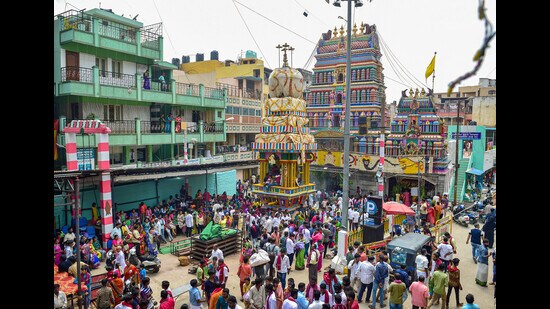
The Karnataka Hindu Religious Institutions and Charitable Endowments (Amendment) Bill, 2024, has prompted the governor to seek clarification from the state government regarding the potential inclusion of other religious bodies under similar legislative measures.
As per information from Raj Bhavan, amendments made to the law in 2011 and 2012 were invalidated by the Dharwad bench of the high court. This decision has been contested in the Supreme Court, where the high court’s ruling has been stayed, and the case is currently in its final stages of appeal.
“Since the case is still pending in the Supreme Court, it is necessary to get more clarification on whether the amendment can be made during the pendency of the case, specifically when the entire Act has already been struck down by the high court and appeal case is at the stage of final hearing (sic),” Raj Bhavan said.
“Further, has the state government conceptualised any legislation to encompass other religious bodies similarly as this bill?” the Raj Bhavan has asked.
“The governor has asked whether the amendment can be made during the pendency of the case which is at the stage of final hearing at the Supreme Court; also it is asked whether the government has conceptualised any legislation to encompass other religious bodies like — Bababudangiri Datta Peetha and one more such religious place, where two communities worship — in a similar fashion. It will be clarified,” Muzrai minister Ramalinga Reddy told reporters.
As per the bill, government will levy a 10% tax on temples with revenues exceeding ₹1 crore, and a 5% tax on those generating revenues between ₹10 lakh and ₹1 crore. This correction from the existing system essentially reduces the tax on a large section of temples. However, the opposition Bharatiya Janata Party (BJP) has accused the Congress government in Karnataka of implementing “anti-Hindu” policies.
Within the Muzrai department’s jurisdiction, there exist approximately 35,000 temples, segmented into distinct categories based on their annual incomes. Among these, 205 temples fall into group A, recording incomes surpassing ₹25 lakh annually, while group B encompasses 193 temples with earnings ranging between ₹5 lakh and ₹25 lakh. The remaining 34,000 temples, registering incomes below ₹5 lakh per annum, constitute group C.
Historically, group A temples have directed 10% of their collection box revenues towards a common fund, while group B temples have allocated 5%. Notably, group C temples have made no contributions to date as per this arrangement.
Under the new amendment, temples generating revenues exceeding ₹1 crore annually will be obligated to contribute 10% to the Common Pool Fund. Temples yielding revenues ranging from ₹10 lakh to ₹1 crore will be required to allocate 5% to the fund. Temples with incomes below ₹10 lakh will be exempt from contribution requirements altogether.
The bill was earlier defeated by a voice vote in the upper house, where the opposition has a majority, on February 23, after it was passed by the assembly on February 21.
Later the bill was reconsidered and passed by the legislative assembly once again on February 29, and it was sent to the legislative council and there too it got passed.
In the council it was passed amid din, as opposition BJP and JD(S) members were protesting in the House against the government over the pro-Pakistan slogan issue, while in the Assembly it was passed when the opposition had staged a walkout on the same issue.


