
 E-Paper



Landslide sparks ecological debate as Manipur counts the cost
They were once dense, green, lush hills, breathtaking in their expanse and beauty. But for the past many months, the landscape was also dotted with construction workers, engaged in an ambitious ₹14,000 crore railway project, a flagship programme of the state and union government.

 Prefer HTon Google


They were once dense, green, lush hills, breathtaking in their expanse and beauty.
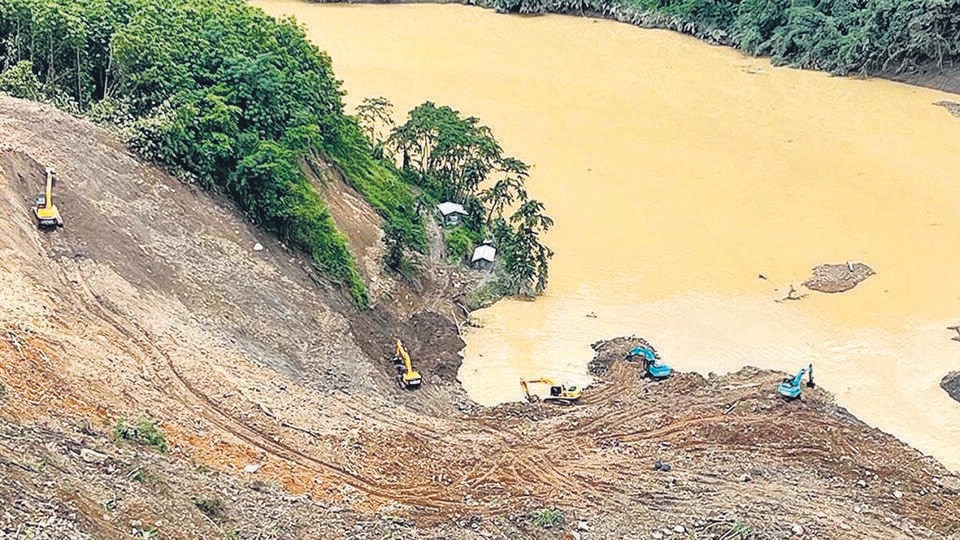
But for the past many months, the landscape was also dotted with construction workers, engaged in an ambitious ₹14,000 crore railway project, a flagship programme of the state and union government.
Those ambitions now lie crushed, perhaps temporarily, under the weight of the mountains after a massive landslide on June 29. All that remains of an under-construction railway station and an army camp are a tin roof, hidden under layer upon layer of slush, a brown scar on the otherwise green mountain-face. Under that debris there are human bodies that are yet to be found.
On July 20, chief minister Biren Singh announced that formal search operations were being called off, after the recovery of 56 bodies, of the 79 people crushed under the weight of the mountain; 18 people were rescued; three days later, on July 24, locals found two more bodies, with three still missing.
The landslide has disrupted the 111-kilometre-long Imphal-Jiribam railway project, part of the broader Trans Asian Railway network that looks to connect India to Thailand, Malaysia and Singapore. This particular stretch was to reach Imphal by December 2023.
But it didn’t come as a surprise to many in Manipur who had warned of the consequences of the uncontrolled ecological devastation that has been wrought on the green hills of the state.
The landslide
It was 11.30 pm on June 29, and the hill slope above the half-made Tupul railway station began to rumble and growl. “At the time, besides 42 personnel of a Territorial Army battalion who were stationed there to provide security to the project, 31 workers of two construction companies and 5 villagers of the area (two couples and a child) were sleeping in huts in the area,” Ram Karan Swami , the man in charge of the National Disaster Response Force (NDRF) in the region said.
As the rocks began to fall, people tried to flee. “Most people got stuck under the debris and were killed by large boulders. Some rocks got washed away with the debris and reached the Ejei river flowing near the site. Debris from the landslide completely blocked the river,” added Swami.
“I am still in shock. I was sleeping but woke up when I heard a deep rumble in the mountains. I ran out of the camp and saw debris falling from the hill behind our camp. Everyone came out and some started running towards the river. However, a large amount of earth, uprooted trees and rocks fell, burying most people. I only just managed to escape,” said a 32-year-old survivor requesting anonymity.
Due to the incessant rain and unstable slopes, personnel from TA who were able to escape the landslide, and took shelter on stable land near an under-construction tunnel, had to wait till the early hours of June 30 to start search and rescue operations. As news of the disaster spread, personnel from Assam Rifles, NDRF, SDRF, Manipur Police and Manipur Fire Services and other agencies joined the operation with 600 personnel and 50 earth excavators pressed into service.
The project
Begun in 2013, the first phase of the 111-kilometre long Jiribam-Tupul-Imphal broad gauge rail project was to be completed by March 2016. According to chief engineer Sandeep Sharma, the ₹14,000 crore link would pass through 46 tunnels, 22 major and 129 minor bridges. Officials of the North East Frontier Railways (NFR) said that the project was being undertaken in three phases, the third of which, from Khongsang to Tupul (27 km) will include the Noney bridge, which at a height of 141 metres is slated to be the world’s tallest pier bridge.
“Once constructed, the new line will form an important part of the proposed Trans-Asia Railway network, giving a boost to economic activity in north-east India,” said Manipur public works minister Thongam Biswajit Singh. The Trans-Asian Railway project intends to extend the railway line from Imphal to Moreh on the Manipur-Myanmar border, from where the line will be linked with Myanmar railway at the Moreh-Tamu border point. The project is a regional transport cooperation platform aimed at enhancing the efficiency and development of the railway infrastructure in Asia, officials said.
An official of the Public Works Department of Manipur said, “The Trans Asian Railway network will shorten distances and reduce transit times between countries and regions, while being a catalyst for international transport.”
The concerns
Locals in Noney, however, allege that over the past decade, they have been warning that a disaster like this may come to pass. “The Environment Impact Assessment report for the railway project should be on a public platform. We protested against the project as it affected the entire area. We wanted a halt to the dumping of earth, mud and rocks from the construction areas in Barak, Irang, Ejei, Maklang rivers and submitted a memorandum to the state government in 2019,” said Majabung, a resident of nearby Makhuam village.
On July 5, a team of the directorate of environment and climate change of the Manipur government conducted a survey of the landslide hit area, and in a report submitted to the Union government said that an area of approximately 31 hectares was affected. Geologically “shale inter-bedded with mud, silt and sandstone” that lay exposed impedes the mountain’s ability to resist the existing “gravitational force” the report added. “It seems that the recent precipitation during May-June 2022 became the threshold for ongoing massive landslide hazards in the study area.”
The survey said that since Manipur is in a high seismic hazard zone, changes in land use patterns on top of the hill “like deforestation, jhum cultivation and banana cultivation” also accelerated the soil erosion process.
“All of western Manipur has typical geological formations vulnerable to such landslides… the National Highways and Railway network routes require regular monitoring of the slopes in order to mitigate future loss,” it added.
Residents of nearby villages told HT that when work on the project actually began in the area in 2017, they expressed concerns on the effect it would have on their paddy fields. “Villages near the Ejei river like Noney, Tupul, Sinilong and Marangjing have been affected due to the depositing of cement and chemical laden water discharge. Fishing has also been affected,” said Maranjing village council secretary Jiandai Gangmei.
“They cut down the jungles on the hills and when we asked for replantation, it was ignored by the agencies.”
The government denies the allegations. “Land acquisition was done after consultation with the state machinery and the villagers. In any project, it is necessary to conduct environmental impact assessment and consultation and NFR did not neglect this,” chief public relation officer (CPRO) of the North East Frontier Railway Guneet Kaur said.
Landslides due to human activity
In August 2018, the Union environment ministry told the Rajya Sabha that most landslides in Manipur were “anthropogenically” induced. “Studies have indicated that landslides in Manipur are mostly anthropogenically induced, caused as a result of modification of slopes for construction, widening of roads, quarrying for construction materials, fragile lithology, complex geological structures and heavy rainfall,” then Union minister of state for environment Mahesh Sharma told the upper house.
In 2019, Geological Survey of India (GSI) prepared a landslide susceptibility report for Tamenglong and Noney districts of Manipur and found that 170 landslides took place in the area between 2011 and 2017. “Most landslides have occurred in extensive slope cuts during construction of road/railway lines. Out of 170 recorded slides, only 30 were on natural slopes and the rest were of anthropogenic origin (due to human activity),” GSI’s report said.
The report mentions the Noney-Maranching Road, around 24-km in length, located on moderate to high susceptible slopes. “The highly susceptible zone is concentrated along the areas where there are extensive slope cuts… slope cutting for the railway is being carried out extensively above the road stretch causing most of the landslides.”
What experts say
Environmentalist Salam Rajesh said that authorities should have been wary of the impact of continued construction activity, given the heavy rainfall the area had seen. The month of May saw Noney district receiving 348.5mm of rainfall, the highest in the state since 2013, according to the directorate of environment and climate change.
“The warning from the meteorological department about heavy rainfall was already there since June and it appears NFR officials did not heed it. This despite the fact that Manipur has soft red earth and sedimentary rock formations that are not stable,” Rajesh said.
Professor S Ibotombi of earth sciences department of Manipur University explained that heavy rainfall in a short period combined with human activity contributed to the landslide. “The oversaturated and weakened slope mass, nearly reaching liquid, led to this massive landslide,” Ibotombi said. “But the details can be ascertained only after thorough investigation.”
On July 5, Union minister of state for external affairs RK Ranjan visited the landslide site at Noney and said that he would request the railways ministry to review the ongoing project in a more detailed manner. He stressed on the need for proper impact assessment studies of such projects in a hilly state like Manipur. “As a student of earth sciences, I think the hydraulic pressure of muddy soil suppressed for a long time due to high volume of rainfall could have triggered the landslide. Detailed study is needed for starting construction works and development projects in a state like Manipur where rocks of the hill ranges are fragile and soil is soft and loose.”
Even as officials of NFR say that the project will continue as planned, fearful local villagers want more consultation before work is resumed, and have threatened protests if there are no conversations at the local level. “There is value in local knowledge because we have been staying in the area for generations. Construction work for the project should not continue further without public consultation. If they try to go ahead, we will obstruct work,” said Jiandal Gangmei.


