
 E-Paper



Layoffs, losses tear through key garment export hub
The first knitwear unit in Tiruppur was set up in 1925 and the growth of the industry was slow till late 1930s and became prominent by 1940s, according to TEA

 Prefer HTon Google


Shortly after the US confirmed a total of 50% duties on Indian goods August 27, RK Sivasubramaniam, a garment exporter based in Tamil Nadu’s Tiruppur, received an email from his buyer in New York that they can pay only 10% of the levy.
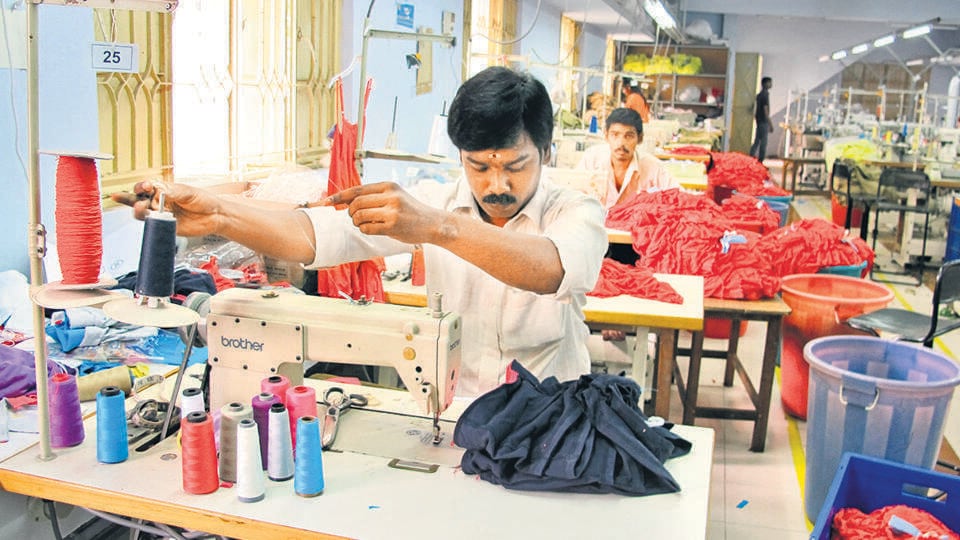
“The buyer asked me to bear the remaining amount. If I can’t, they want to cancel the order. This is from my major buyer to whom I ship half a million pieces every month,” said Sivasubramaniam, the managing director of Raft Garments.
A second generation businessman, Sivasubramaniam exports underwear for men and women. Around 50% of his output goes to the US, 20% to the European Union, 10% to the West Asia and 20% to the domestic market in India. He employs 400people.
Sivasubramaniam is among the 2,000 garment exporters from Tiruppur who fielded calls from clients asking to hold back production; many of the exporters fear that some production will move to competitive countries such as Bangladesh, Vietnam, Cambodia and Pakistan. “There is no business with the US now,” said KM Subramanian, president of the Tiruppur Exporters’ Association (TEA) and Chairman of K M Knitwear Pvt Limited.
Around a third of the exports from Tiruppur, a garment-making cluster accounting for 53% of India’s knitwear exports, is shipped to the US, including for major brands such as Walmart and GAP. Another third goes to the European Union and 10% to the UK, said N Thirukumaran, general secretary of TEA and chairman, Esstee Exports India Pvt Ltd.
Also Read: Cracks appear in Gujarat ceramic industry as tariffs hurt
The cluster recorded a revenue of ₹39,618 crore in the 2024–25 fiscal year. “The consequence of the tariffs will see the Tiruppur cluster losing ₹1,300 crore revenue every month,” said Thirukumaran. “We pushed whatever shipment we could last week. But, still, until last week, all of us and the buyers were hoping that the 50% tariffs would be withdrawn. There is a big panic now. A 50% tariff is not viable for any business.”
It’s not just the garment exporters who take a hit but also the ancillary industries, and migrant labourers. There are around 3,000 allied units such as spinning, knitting, printing, embroidery, of which around 90% are Micro, Small and Medium Enterprises (MSMEs), employing roughly one million people directly or indirectly , said Thirukumaran.
“As an entire cluster we are suffering. If the government does not intervene in the next one or two weeks, our association thinks people will lose jobs, and MSMEs who cannot bear the brunt will shut down,” Thirukumaran said. “Even a hawker selling fruit juice will be affected because who will buy (from him) when there are layoffs in a labour-intensive sector. It’s a value chain.”
The city’s dominance
The first knitwear unit in Tiruppur was set up in 1925 and the growth of the industry was slow till late 1930s and became prominent by 1940s, according to TEA. By 1942, the number of units increased to 34, and by 1961, it stood at 230. Till early 1970s, the industry catered only to the domestic market. Exports began in the 1980s with Italy after a garment importer from Italy, called Verona, visited Tiruppur in 1978 to source white T-shirts, according to TEA. He is credited with bringing the European business to the city. By 1990, exports touched ₹300 crore, with the latter half of the decade witnessing business in US that led to a sharp growth — in 2010, exports to the US overtook the EU.
Also Read: Tariff crisis looms over carpet industry
Exporters said that they work on wafer thin margins ranging between 5% and 8%. “Right now, I have 2 million pieces in hand which are ready to be shipped to the US in the first week of September but I’ve been asked to hold them,” said Sivasubramaniam.
“And, I’ve already invested for the next order cycle by buying yarn; the fabric is cut. The next stage is sewing. I don’t know what to do with the cut fabric now.” Subramaniam anticipated he would be staring at a loss of ₹3 crore a month.
He employs 400 labourers, of which half are local residents . The other half are migrant workers whom he houses in hostels. “Diwali is coming up. Employees need money, cash flow is affected and 50% of our work has halted. So what do we do?”
Exporters to the US receive production orders during August and September ahead of Black Friday on November 28 and Christmas on December 25; these orders have now been halted. Production orders for Fall 2026 have also been paused, said Thirukumaran.
Also Read: As tariffs bite, farms, mills diverge on import duty-cut
Multiple exporters said that they could have managed the 25% tariff. “It was only about 5% higher than tariffs imposed on Bangladesh. With some help from the government and negotiations with the buyers, we could have managed 25%. Now, it is impossible,” said Subramanian.
“Most of the US buyers have told us that they are moving to competing countries. Only some branded factories have trained labourers for more than 10 years to make garments in a certain style that may not move immediately.”
Tariffs wipe out FTA advantage
The industry was upbeat when India and the UK signed a Free Trade Agreement (FTA) but that might not be enough to compensate for the loss in the US market, exporters said. “The UK is not a big market like the US,” said Thirukumaran.
“Tiruppur exports 33% to the entire EU which has 27 nations compared to the 35% to just one country — the United States. UK accounts for only 10%, so, in the next three years, business in Britain can double, once the FTA comes into effect.”
Besides diversifying, exporters want the government to step up, like the Brazilian government which launched a Sovereign Brazil initiative of $5.6 billion to support exporters affected by the US tariffs on their goods, including coffee and textiles.
“To safeguard the textiles industry to not move out of India, the government has to help us in the short term. We are demanding that they reinstate the Rebate of State and Central Levies and Taxes (RoSCTL), and reduce interest subvention to 5%,” said Thirukumaran.
“In the long term, they have to fast track FTAs with the EU and identify other countries with whom we can trade. We need more market access. Bangladesh and Vietnam have zero duty with the EU whereas we have 9.6%.”
Amid this, Thirukumaran said exporters are not turning to the domestic market. “It is a totally different ecosystem and it has its own competitive market and it would take three to five years to see growth,” he said.
Way ahead
The industry is now hoping that the government reinstate relief packages introduced during Covid-19, such as extending 30% collateral free loan under Emergency Credit Line Guarantee Scheme (ECLGS) with 5% interest subvention similar to the one extended to MSMEs and large companies. “Some mills have stopped running their machines. Layoffs are inevitable now. The government has to extend a two-year moratorium for the repayment of principal amount,” said K Selvaraju, secretary general, Southern India Mills’ Association.
“They should extend 30% collateral free loan under ECLGS with 5% interest subvention and enhance Remission of Duties and Taxes on Exported Products (RoDTEP) rates, including the value cap and extend RoSCTL for further period of five years.”
According to exporters, a credit infusion of 30% under ECLGS is necessary for those hit hard by the US tariffs since it erodes export margins significantly, especially for MSMEs and mid-size players with tight working capital cycles. Collateral-free credit can meet their operational expenses. These schemes were introduced to refund the blocked and embedded duties and taxes. Exporters want both schemes to be extended till 2030 to avoid export taxes and sustain global competitiveness. The demand was tabled in front of Union finance minister Nirmala Sitharaman whom exporters met in Coimbatore on September 2.
Sivasubramian said he is planning to cut down his exports – currently 50% of his production – to 20% and diversify to the EU, UK and West Asia. That, along with some government relief, he hopes, will keep his business afloat. He is yet to respond to the New York buyer’s email.


