E-Paper



Cracks appear in Gujarat ceramic industry as tariffs hurt
The US is among the top three markets for the Indian ceramic industry and one that has helped build this area into an export hub over the past two decades.

 Prefer HTon Google


Khimjibhai Kundaria, the chairman of Gujarat-based Wintel Digital Vitrified Tiles and Wintel Surfaces, has only one aim these days – reworking his export strategy. His operations in Morbi town’s Nava Jambudia area rely entirely on exports, with 50% of shipments going to the US and the other half to West Asia and Europe.
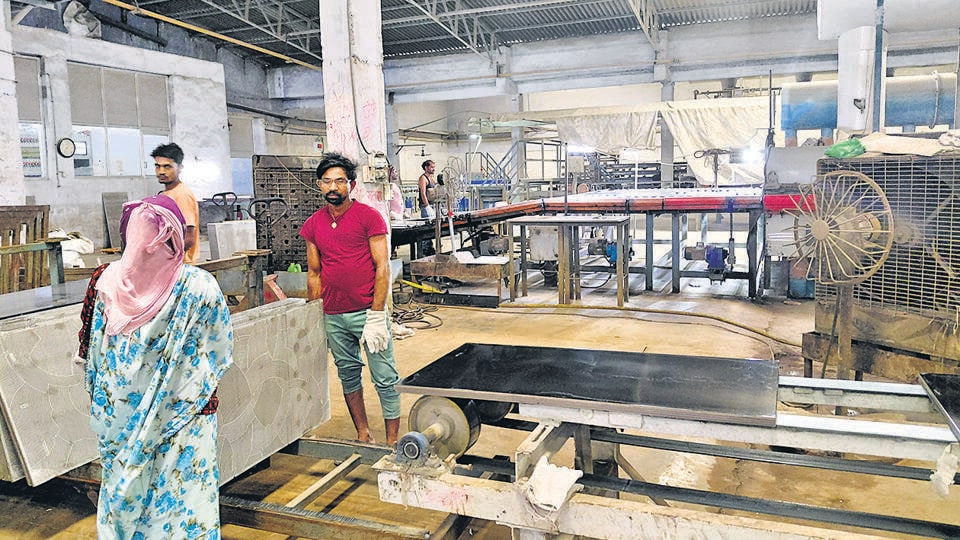
American buyers have pulled back nearly all the orders since the US tariff announcements, he said. “Buyers have stopped orders, exports are down, and the bigger effects are still to come,” said Kundaria, whose company ranks among India’s top five ceramic exporters to the US.
The US is among the top three markets for the Indian ceramic industry and one that has helped build this area into an export hub over the past two decades. The Morbi cluster exports around ₹1,200-1,500 crore worth of ceramics to the US annually. It produces 80% of India’s ceramics, feeding a global appetite across 150 countries.
But the tariffs that came into effect last month precipitated a crisis. Kundaria is already sketching new trade maps, hoping to pivot to Europe, West Asia, and East Asia. “Factories will function but they will have to change markets,” he said.
It’s not easy. New distribution networks must be built. Product specifications need adjustment for different regional standards. Years of relationship-building in the US must now be replicated across continents. It takes time, and money, all the while payinghundreds of employees.
Down the road in Ghuntu, Jitendra Aghara is in a similar conundrum. The owner of Simpolo Vitrified Tiles has a turnover of ₹1,850 crore and 3,000 employees. “What happened 20 years ago in Italy and 10 years ago in China is now happening with the Indian ceramic industry,” he said, referring to how rising production costs and protectionist measures are pushing once-dominant exporters to lose ground while new hubs emerge.
Aghara had started diversifying before the crisis. But Chinese manufacturers have established footholds in Gulf countries and Africa, creating competition in markets where Indian companies once faced little resistance. Post-Covid supply chain disruptions have sent freight costs soaring fivefold. Container shortages from Red Sea unrest to Gulf Coast hurricanes have strangled logistics networks. The Russia-Ukraine war pushed natural gas prices up five times, adding 30% to production costs for an industry where fuel represents a quarter of expenses.
“The challenges are not just from tariffs. We’re facing increased competition from Chinese factories in Gulf and African countries, rising input costs due to the war in Ukraine, freight costs that have gone up multiple times, and now these trade barriers. Each problem feeds into the next,” he said, describing the cascading effects that have reshaped the industry landscape.
Nearly 300 factories have shut down in the last three years. The overall production of Morbi has gone down nearly 30% in the same period, led by slowdown in demand and a problem of overstocking that led to liquidity crunches.
The tariffs have only compounded the problem.
Morbi, known as the Clock Town of India, turned to ceramics in the 1970s with the manufacture of naliya, or roof tiles, using red clay found in abundance near the town. These tiles were supplied across rural Gujarat and neighboring states. Black trap stone, also locally available, was used to build factory sheds, roads, and kiln foundations. By the early 1980s Morbi was producing mosaic tiles, its first step toward floor coverings. The real shift came in the mid-1980s when entrepreneurs imported discarded machinery from Italian and Spanish ceramic clusters, moving from roof and mosaic tiles to modern ceramic production. Many clock makers diversified into tiles, using their know-how and trade networks to set up units.
Modern ceramic production relies on raw materials like clay and feldspar sourced mainly from Kutch and Rajasthan. As output grew, Morbi developed frit and glaze manufacturing units, making the cluster self-sufficient. In the early 2000s, there was a major boost to the industry as members of the Kadva Patel community pooled capital to build larger plants with advanced technology.
At present, Morbi is the world’s second-largest ceramic tile manufacturing hub, housing over 900 MSME units, and providing employment to over 500,000 people.
Haresh Bopaliya, president of the Morbi Ceramic Manufacturers Association, embodies this journey. A school teacher in Mahendranagar village eight years ago, he partnered with friends to build a ceramic company now generating ₹50 crore in turnover.
“This is perhaps the only industry that runs entirely on credit. There is no deposit, nothing. A verbal guarantee is enough. More than 90% of the promoters are from the Kadva Patel community,” said Bopaliya, who runs the Livolla Granito factory.
This social fabric enabled something remarkable. “While 300 units closed, 100 new factories opened with cutting-edge technology and production capacities four to five times larger than their predecessors. The industry consolidated upward, not downward,” according to Bopaliya.
Yet the credit system that fuelled growth now threatens stability. Outstanding receivables from exports total ₹2,000 crore over three years. Domestic market dues add another ₹2,000 crore. The potential ₹4,000 crore loss has prompted the state government intervention which formed a Special Investigation Team in May 2023 to tackle financial frauds in the ceramic sector and recover funds of affected traders. But many companies hesitate to report their losses, fearing that the blacklisting of their clients will end hopes of recovery, according to Bopaliya.
Even as global headwinds intensify, Morbi’s manufacturers are betting on domestic growth. The Morbi Ceramic Manufacturers Association has petitioned to reduce GST on tiles from 18% to 5%, arguing that ceramics have evolved from luxury items to housing necessities for India’s expanding middle class. Lower GST rates could boost housing sector demand, encouraging tax compliance among smaller units operating on thin margins while creating multiplier effects across construction, cement, and logistics industries, said Bopaliya.
Manoj Aervadiya, president of Morbi Ceramic Association’s vitrified tiles division, said that Russia and the US have run neck-and-neck as top export destinations in recent years. His company Bluezone, like many others, is now scouting alternative markets as American demand craters. “There will not be an impact to the entire industry, but there are several companies that exported about 80% of their production to the US and they will be impacted,” said Nilesh Jetpariya of Kera Vitrified LLP.
From the fourth position globallyabout a decadeago, India rose to become the world’s second-largest ceramic producer in2023. China’s annual ceramic tile production of approximately 6.1 billion square metres is about 2.5 times larger than India’s production of approximately 2.5 billion square metres. The industry has also battled complaints of a health crisis. A recentstudy by Gujarat’s Peoples Training and Research Centre warns that 579 workers in ceramic factories face direct silica exposure, risking tuberculosis, silicosis, chronic obstructive pulmonary disease, and lung cancer. Another 1,150 workers face indirect exposure risks.
“The survey of 2,000 workers found that 579 respondents working in departments such as filling, glazing, and molding come into direct contact with silica and are likely to develop tuberculosis, silicosis, chronic obstructive pulmonary disease, and lung cancer. Additionally, 196 workers have indirect exposure to silica, while another 954 workers may also be exposed indirectly when assigned to silica-heavy departments,” it said. Then there are infrastructure issues. “If Morbi is to compete with China then it must have good roads and drainage systems. Look at the condition of roads leading to our factories. The local administration and the state government must do something about it,” said a tile manufacturer who spoke on condition of anonymity.
The Indian tiles market was valued at ₹50,000 crore in 2024 and was projected to grow at a CAGR of 9.49% from 2025 to 2032, reaching around ₹1 lakh crore, according to a July 16 Axis Securities report on Building Materials Sector. Historically, the market has maintained a steady CAGR of ~10%. Indian ceramic tile exports have also witnessed robust growth over the past decade, with export volumes rising from 55 million sqmts in 2013 to 589.5 million sqmts in 2023, translating to a CAGR of 21.5%, it added.
But the tariffs pose a risk to this growth. No one is more personally impacted than the workers who migrate to power Morbi’s factories. Lavkush Kumar, 29, arrived from Bihar’s Kharna village three years ago, transforming his income from ₹5,000 to ₹27,000 monthly as a machine operator at Nice Company Tiles. “I have seen videos on social media about the US imposing tariffs on India,” Kumar said. “There have been internal discussions where some have raised concerns about closure of factories in Morbi.”
Hritik Kumar Soni, 20, from Siwan, earns ₹21,000 at Livolla Granito. The money is needed for his father’s medical treatment. “I don’t know anything about the tariffs,” he said. Ramesh Yadav, 30, left farming in Uttar Pradesh’s Parsauni village six years ago for ₹32,000 monthly wages as a kiln operator. “I heard about tariffs from my supervisor but I don’t understand these big things,” he said. “I just hope the factory keeps running so I can send money home.”