
 E-Paper



Lens on 4 cough syrups after WHO flags deaths
The Drugs Controller General of India (DCGI) has also sought more details from the WHO, which on Wednesday issued an alert over four “substandard” cough syrups manufactured by Maiden Pharmaceuticals Ltd in Haryana’s Sonepat, and sold in The Gambia.


India’s drugs regulator has launched an investigation into reports of contamination of cough syrups made by an Indian firm that led to the deaths of 66 children in The Gambia, people familiar with the matter said on Thursday, with inspections being carried out at manufacturing units and other company premises in the country.
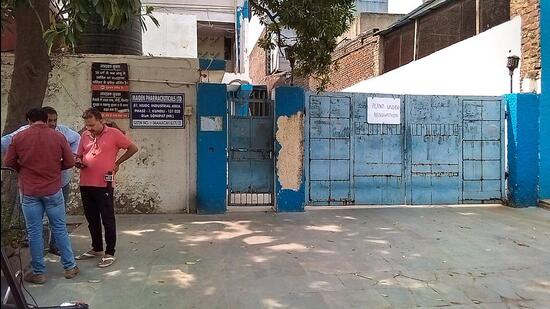
The Drugs Controller General of India (DCGI) has also sought more details from the World Health Organization (WHO), which on Wednesday issued an alert over four “substandard” cough syrups manufactured by Maiden Pharmaceuticals Ltd in Haryana’s Sonepat, and sold in The Gambia.
“The samples (controlled samples of the same batch manufactured by Maiden Pharmaceuticals Limited for all the four drugs in question) have been taken and sent for testing to Regional Drug Testing Lab, Chandigarh by CDSCO (Central Drugs Standard Control Organisation), the results of which will guide further course of action as well as bring clarity on the inputs received/to be received from WHO,” the Union health ministry said on Thursday.
The UN health agency on Wednesday issued an alert over four medicines – Promethazine Oral Solution, Kofexmalin Baby Cough Syrup, Makoff Baby Cough Syrup, and Magrip N Cold Syrup – made by the Indian firm, warning that the cough and cold syrups could potentially be linked to acute kidney injuries and deaths in children. “While the contaminated products have so far only been detected in The Gambia, they may have been distributed to other countries,” the WHO said.
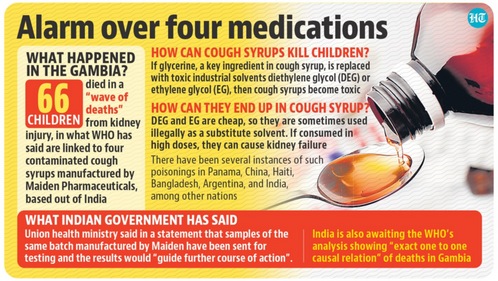
On Thursday, the health ministry said that as per preliminary enquiry of CDSCO, the drugs were only exported by the company and not distributed in the Indian market.
“The State Drug Controller had given licenses to the said company only for export of these four drugs… All these four drugs manufactured only for exports by Maiden Pharmaceuticals Limited are not licensed for manufacture and sale in India,” the Union government said.
Meanwhile, more than 30 months after 14 infants died in Jammu and Kashmir after consuming cough syrup manufactured by a Himachal Pradesh-based pharmaceutical company, police are yet to file a charge sheet in the case, even as the latest incident brings the spotlight back on to bad regulatory practices and poor scrutiny of such incidents.
WHO has warned that the four “contaminated” cough syrups produced by Maiden Pharmaceuticals in Sonepat could be the reason for the deaths in the small West African nation.
Haryana’s health minister Anil Vij said samples of the four cough syrups manufactured by the firm were also sent to the Central Drugs Laboratory in Kolkata for examination. “The samples have been collected by a team of the DCGI and Haryana’s Food and Drugs Administration Department and sent to the CDL, Kolkata for examination,” Vij said.
According to WHO, out of 23 samples tested, four were found to contain diethylene glycol and ethylene glycol “beyond permissible limits”. According to public health experts, the problem of these two contaminants is not new, and it is largely the result of a weak regulatory mechanism.
Toxic effects of the two chemicals can include abdominal pain, vomiting, diarrhoea, bladder dysfunction, headache, altered mental state, and acute kidney injury, which may lead to death.
“The Indian pharmaceutical industry has had a DEG poisoning problem for a long time now, with the first event being reported in 1972 in Madras. The reason that such poisoning events take place is because many pharma companies in India do not test all excipients before they are used in manufacturing drugs, despite the Good Manufacturing Practice code expressly requiring such testing,” Dinesh Thakur, public health activist, quoted from his upcoming book “The Truth Pill: The Myth of Drug Regulation in India”.
Thakur also said that the company in question has been in the news earlier also because of the substandard quality of its drugs.
“In 2005, a drugs inspector from Kerala filed a prosecution against the company for which in 2017, a judicial first-class magistrate court in Kerala fined it; it was one of the 39 companies blacklisted by Vietnam for violation of quality control regulation and drug regulation; the Bihar government also black-listed it in 2011 for substandard drugs, etc. That’s the track record,” he alleged.
HT visited the corporate headquarters of the company in Delhi’s Pitampuraon Thursday, but it was closed. When contacted over the phone, a company representative refused to comment on the matter.
In India, 14 patients died in Mumbai in 1986 when they were given glycerin contaminated with DEG. A second episode of poisoning occurred in 1998 as a result of children ingesting DEG; at least 33 children are known to have died in that episode in Gurugram.
DEG and EG are often found as contaminants in glycerin, which is used as a sweetener in formulations of many pharmaceutical syrups ingested orally. While they can make their way into medicines as a result of bad import and export practices, the two chemicals are also used on purpose illegally as cheaper substitutes to glycerin.
The health ministry, meanwhile, has sought more information from WHO on their investigation.
“It has also been informed by WHO that the certificate of analysis will be made available to WHO in near future and WHO will share it with the Indian regulator, which is yet to be done. The exact one-to-one causal relation of death has not yet been provided by WHO to CDSCO,” said the ministry.
“As a robust national regulatory authority, CDSCO has requested WHO to share at the earliest with it the report on establishment of causal relation to death with the medical products in question, etc.,” it added.
According to people familiar with the matter, WHO on September 29 informed DCGI that the UN agency was providing technical assistance and advice to The Gambia after the deaths. The health agency also cautioned that the contaminated medications may have been distributed outside of the West African country.
“It is an ongoing investigation, which the central and state governments are doing in collaboration. Both the central and state drugs regulators are working together to get to the bottom of the issue,” said a senior government official, asking not to be named.
CDSCO said it responded to WHO within an hour-and-a-half after receiving intimation after taking up the matter with the state regulatory authority. A detailed investigation was launched to ascertain the facts and details into the matter in collaboration with Haryana state drugs controller, an official said.
Preliminary investigations ascertained that Maiden Pharmaceutical Limited was the manufacturer licensed by the state drug controller for the products under reference and holds manufacturing permission for these products.


