
 E-Paper



Lumpy skin disease: Centre plans to launch mass vaccination drive
The virus, called capripoxvirus, is spread by blood-feeding insects and mosquitoes, causing thick nodules to form on the skin, with accompanying symptoms such as debilitating fever and lower milk production, especially among cows and buffalos.


Several states are battling large outbreaks of a deadly virus in cattle that results in a condition called lumpy skin disease, causing financial losses to farmers and hitting milk output, even as the Union government said it was preparing to launch mass vaccination with a breakthrough indigenous vaccine.
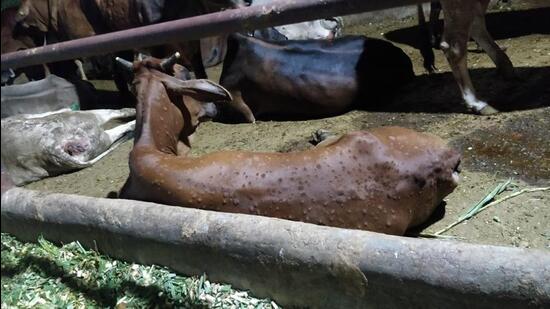
The virus, called capripoxvirus, is spread by blood-feeding insects and mosquitoes, causing thick nodules to form on the skin, with accompanying symptoms such as debilitating fever and lower milk production, especially among cows and buffalos.
Lumpy skin disease has killed or infected large bovine populations in states such as Rajasthan, Gujarat, Haryana and Punjab. Two research institutions under the flagship state-run Indian Council of Agricultural Research (ICAR) have developed a vaccine, Lumpy-ProVax Ind, that has been shown to be effective in preventing the disease.
Although the disease is not known to infect humans, scientists say they are worried about such a possibility. “Due to its recent spread in unnatural hosts, there are growing concerns about its zoonotic implication, although confirmatory evidences of human infection are lacking,” an ICAR statement said.
Zoonotic pathogens are those that jump from animals to humans, such as the SARS-CoV-2 virus that causes Covid-19.
Union agriculture minister Narendra Singh Tomar on Wednesday said plans were afoot to commercialise the vaccine and launch mass vaccination, especially in six states where cattle deaths have been highest. Until now, the Centre had authorised states to use goat pox vaccine to control this disease, which is partially effective.
After being detected first in Odisha in 2019, the disease was mainly restricted to eastern parts of the country, according to the ICAR. It then rapidly spread to almost all the states, with spikes in June, July and August.
Lumpy-ProVax Ind have been developed by the National Equine Research Centre and the Indian Veterinary Research Institute.
The disease has killed about 14,000 cows in Rajasthan in 23 of the 33 districts of the state as on August 11. In close to a week’s time, the infection has spread from 16 to 23 districts, and the death toll reached 14,000 from 4,000, Rajasthan animal husbandry department officials said.
The highest 2,752 deaths have been reported from Ganganagar, followed by Barmer (1,657) and Jodhpur (1,691). Rajasthan animal husbandry secretary PC Kishan said the death rate is falling down and the infection is getting controlled. “The state will soon issue guidelines for the vaccination, which will be started from non-infected districts. We have demanded 20 lakh vaccines from GoI (government of India), of which 2 lakh will be received in next three-days,” he said.
In Gujarat, close to 3,000 cow deaths, mostly in Kutch district, have been reported so far. As many as 37,840 cattle are affected by lumpy skin disease in Kutch district, a Gujarat government statement earlier this week said. Many states, such as Gujarat, have banned inter-district movement of cattle to prevent the disease’s spread.
Apart from these states, Punjab has reported 672 deaths, Himachal Pradesh 38, Andaman and Nicobar Islands 29 and Uttarakhand has registered 26 deaths.
Almost every Indian state currently has cases, according to an official of the ministry of animal husbandry. According to Dr Naresh Jindal, the director research at the Lala Lajpat Rai University of Veterinary and Animal Sciences, Hisar, cows have been worst affected.
The two state-run institutes can produce 250000 dosages per month, according to BN Tripathi, the ICAR’s deputy director general (animal science). Lumpy-ProVax Ind is a homologous live attenuated LSD vaccine, whose immunity lasts for a year and the cost per dose is ₹1-2, according to Tripathi.
“If the disease is not checked, it could impact milk output, especially in states such as Gujarat where outbreaks have been severe,” said Abhishek Agrawal, a commodity analyst with Comtrade.
(With inputs from Sachin Saini in Jaipur)


