E-Paper



Rohini Commission may recommend key changes to OBC quota policy
The report, which is more than 1,000-pages long, is divided in two parts.

 Prefer HTon Google


New Delhi: Even as the results of the first-of-its-kind caste survey are awaited from Bihar, and the Supreme Court continues to hear objections against it, including from the Union government, the latter is mulling over a voluminous report on the reorganisation of the 27% other backward classes (OBC) quota that was submitted to it on August 1.
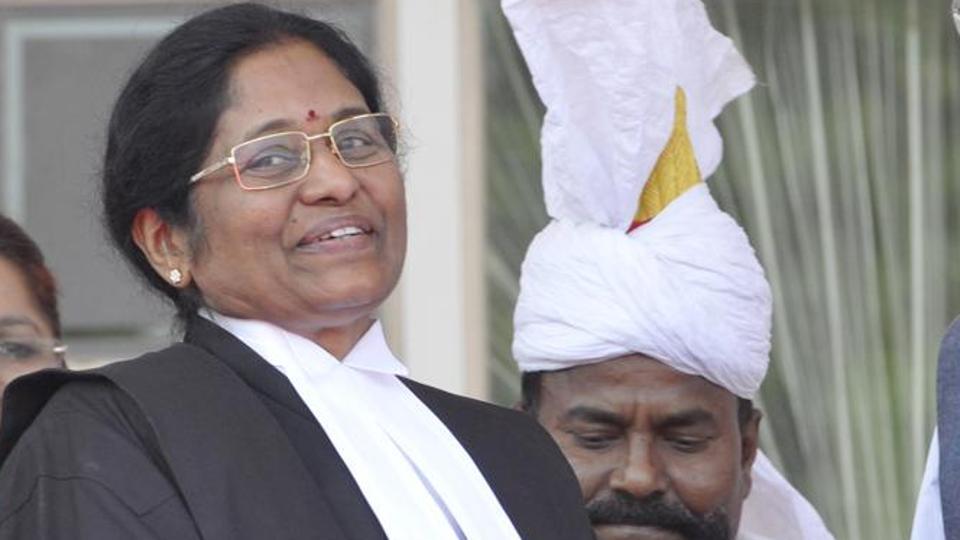
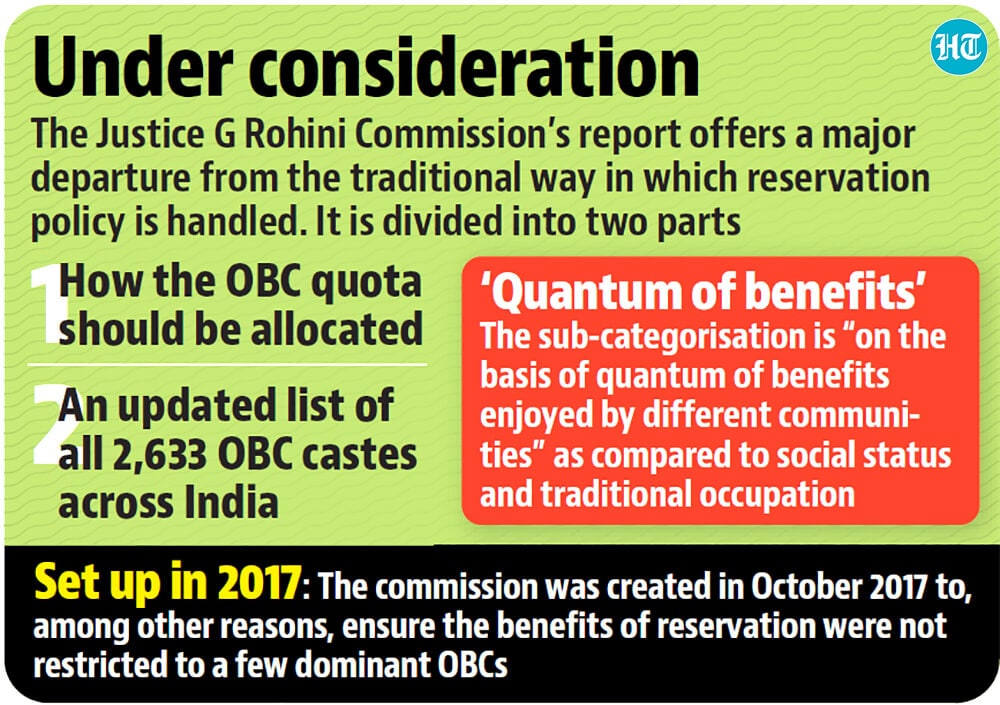
The contents of the Justice G Rohini Commission’s report are strictly under wraps, but HT learns that its recommendations are a major departure from the traditional way in which reservation policy is handled. The report, which is more than 1,000-pages long, is divided in two parts -- the first deals with how the OBC quota should be allocated; and the second is an updated list of all 2,633 OBC castes across the country.
According to people familiar with the recommendations, the commission has said that “the purpose of sub-categorisation is not to establish a new hierarchy among OBCs, but to provide a level playing field for all”. Indeed, one of the reasons why the commission was set up in October 2017, was to ensure the benefits of reservation were not restricted to a few dominant OBCs. To be sure, this also fit in with the BJP’s political outreach to OBCs that had not benefitted.
Explained: What is the Rohini Commission on OBCs?
The commission, the people added, has proposed the sub-categorisation of “the Central List of OBCs primarily on the basis of quantum of benefits enjoyed by different communities.”
The people, who asked not to be named that the commission has recommended the criteria for this sub-categorisation, going beyond those adopted by earlier commissions like the Kaka Kalelkar or by the panel headed by BP Mandal. Both used social status and traditional occupation of a community as criteria for reservation, they explained. Even the 10 states in India who have sub-categorisation, go by the status of a community, whether it is de-notified or nomadic, religion or the caste status before conversion to Christianity or Islam.
Several community delegations met members of the Rohini Commission and recommended continuing with the said criteria, the people said, adding that the panel disagreed with this approach.
“From the data on the benefits of reservation availed by different communities, the commission found that some that are extremely backward in their ascribed status have substantial representation in both services and education in some parts of the country,’’ they said. It makes little sense to group “ communities that are highly incomparable” in the same category, they added.
The commission’s report recommends an alternative approach, the people said. As HT first reported in December 2019, they looked at data linked to 100,000 admissions under the OBC quota in central education institutes and 130,000 recruitments in the central government between 2015 and 2018. The data found that a quarter of the share of benefits went to just 10 OBC castes, another quarter to 38 castes, a third quarter to 102 castes and under a fourth (22.3%) to 506 castes . However, a staggering 983 castes got no benefits while 994 jousted for 2.68% of the benefits.
This data forms the basis of the commission’s recommendation, HT learns.
While the number of sub-categories isn’t confirmed, it is likely to be three or four where the castes with similar access to benefits compete with each other. It could be three bands — those that have got no benefits could get 10%, those with some benefits 10%, and those with maximum benefits 7% -- or there could also be four bands, said a person aware of details on condition of anonymity. However, the sub-categorisation process is “essentially numerical’’ and on the basis of data, this person added.
The commission only sought to “determine which of the communities can reasonably compete with each other, and can be placed together’,’ the people cited in the first instance said. This is the importance of the second part of the report that lists the history of each of the castes and the reason why they are considered backward.
While there is a fear among those waiting for the report that it will cut out those OBC groups which are seen as beneficiaries of most reservation benefits, the panel doesn’t think that it will lead to a “significant loss’’ for any single community, the people added.
The government may take up the report in its cabinet meeting after which, it will be tabled in Parliament but it is up to the government whether it accepts or rejects it.
Justice Rohini did not respond to repeated requests for comment.