E-Paper



Malik gets life in prison in terror funding case
A Delhi court on Wednesday sentenced Jammu & Kashmir Liberation Front (JKLF) chief Mohammad Yasin Malik to life imprisonment for waging war against the State, saying that his crimes struck at the heart of the idea of India but holding that they didn’t fall under the “rarest of rare” category.

 Prefer HTon Google


A Delhi court on Wednesday sentenced Jammu & Kashmir Liberation Front (JKLF) chief Mohammad Yasin Malik to life imprisonment for waging war against the State, saying that his crimes struck at the heart of the idea of India but holding that they didn’t fall under the “rarest of rare” category.
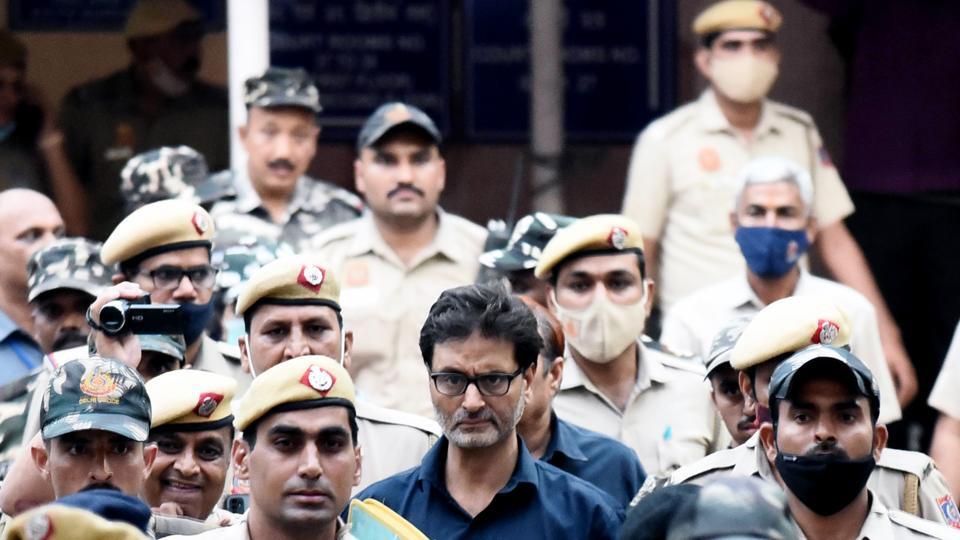
The National Investigation Agency (NIA) demanded the death penalty for Malik, who pled guilty to his crimes on May 10, but the court took a more lenient view. Under Section 121 (waging war against the State) of the Indian Penal Code (IPC), the minimum punishment is life imprisonment while the maximum is death.
NIA judge Praveen Singh said waging war against the State or abetting it was a serious crime, but the death penalty should be awarded in exceptional cases where the crime shocks the collective consciousness of the society and is committed with unmatched cruelty and in a gruesome manner.
“The manner of the commission of crime, the kind of weapons used in the crime lead me to a conclusion that the crime in question would fail the test of rarest of rare cases as laid down by the Supreme Court,” the judge said.
NIA argued that the court should consider that Malik was responsible for the genocide of Kashmiri Pandits, but the judge rejected the argument. “I find that as this issue is neither before this court, nor has been adjudicated upon and thus the court cannot allow itself to be swayed by this argument,” the court said in its 20-page order.
The court awarded Malik life imprisonment under Section 121 of the IPC and Section 17 of the Unlawful Activities Prevention Act (UAPA) and imposed a fine of ₹10.65 lakh on the convict under various sections.
He was awarded 10 years rigorous imprisonment under sections 120B IPC, 121A of the IPC and sections 15, 18 and 20 under UAPA. Additionally, he was also sentenced to five years imprisonment for sections 38 and 39 of UAPA. All the sentences will run concurrently.
“These crimes were intended to strike at the heart of the idea of India and intended to forcefully secede J&K from UOI. The crime becomes more serious as it was committed with the assistance of foreign powers and designated terrorists. The seriousness of the crime is further increased by the fact that it was committed behind the smokescreen of an alleged peaceful political movement,” the judge said.
The sentencing of Malik, one of the top separatists in the Valley who was linked to several killings but later became a part of government outreach programmes, sparked protests in Srinagar and a partial shutdown in the region. Pakistan Prime Minister, Shehbaz Sharif, condemned it.
The families of some victims of crimes linked to Malik said they were not happy with the verdict and demanded the death penalty. “Many people would have got relief today but not me. I am not at peace,” said Shalini Khanna, the wife of Ravi Khanna, who was among four air force personnel shot dead by JKLF militants in 1990.
Malik is also charged in several other cases, including the 1989 abduction of Rubaiya Sayeed, daughter of then home minister Mufti Mohammad Sayeed, and the 1990 killing of four Indian Air Force personnel.
Malik was arrested in 2019 on terror funding charges. On May 10, he pleaded guilty under sections 16 (terrorist act), 17 (raising funds for the terrorist act), 18 (conspiracy to commit terrorist act), and 20 (being member of terrorist gang or organisation) of (UAPA and sections 120-B (criminal conspiracy), 121 & 121 A (waging war against the state) and 124-A (sedition) of the IPC.
Pleading guilty refers to an accused accepting his crime and subsequently, also the punishment. On May 19, the judge convicted Malik, noting that sufficient time was provided to the accused to consider his plea and he was also granted an opportunity to have legal advice to make an informed choice.
The court said Malik may have given up arms in 1994, but never expressed any regret for the violence he had committed prior to that. The court also said that Malik “betrayed” the good intentions of the government and took a different path to orchestrate violence in the guise of political struggle.
“It is to be noticed that, when he claimed to have given up the path of violence after the year 1994, the government o f India took it upon its face value and gave him an opportunity to reform and in good faith, tried to engage in a meaningful dialogue with him and as admitted by him, gave him every platform to express his opinion. However...the convict did not desist from violence,” the judge said.
It also rejected Malik’s contention that he followed the Gandhian principle of non-violence and was spearheading a peaceful non-violent struggle and said that the evidence placed on record by the NIA proved otherwise.
The judge also observed that the “convict cannot invoke the Mahatma and claim to be his follower because in Mahatma Gandhi’s principles, there was no place for violence, however high the objective might be”.
“It only took one small incident of violence at Chauri Chaura for the Mahatma to call off the entire non-cooperation movement but the convict despite large scale of violence engulfing the valley neither condemned the violence nor withdrew his calendar of protest which had led to the said violence,” the court said.
The judge said the manner in which the crimes were committed was a conspiracy whereby there was an attempted insurrection by instigating, stone pelting and arson, and a very large-scale violence led to shutting of the government machinery
Malik was produced in the court amid tight security. Dressed in a blue kurta, he waited for the punishment to be pronounced, tucked in a chair in the middle of the courtroom and guarded by security officials.
He was represented by advocate Akhand Pratap Singh, the court-appointed amicus in the matter, since Malik did not have a counsel and had argued his case himself.
Seeking minimum punishment (life imprisonment in this case), Malik’s counsel argued that there were chances of the convict reforming because his conduct was satisfactory in custody and after giving up arms in 1994, he never sheltered or provided logistical support to any terrorist.
After the sentence was announced, clashes erupted between supporters of Malik and security forces in Srinagar’s Maisuma locality – Malik’s native place – amid a shutdown in various parts of the city. Mobile internet services were suspended in some areas and additional forces deployed.“We are afraid that this will further compound the uncertainties in the region and will only fuel more alienation and separatist feelings. NIA court has delivered its verdict but not justice,” People’s Alliance for Gupkar Declaration spokesman, Mohammad Yusuf Tarigami, said in a statement.
Pakistan condemned the sentence. “India can imprison Yasin Malik physically but it can never imprison the idea of freedom he symbolises. Life imprisonment for valiant freedom fighters will provide fresh impetus to Kashmiris’ right to self-determination,” Pakistan’s Sharif said.