
 E-Paper



Manipur violence: SC questions why former CM Biren’s full audio tape not sent for examination
The Supreme Court questioned Manipur officials on why an audio tape linking ex-CM N Biren Singh to ethnic riots wasn't fully examined forensically.

 Prefer HTon Google


The Supreme Court on Monday questioned the Manipur government authorities why the entire audio tape containing material alleging complicity of former chief minister N Biren Singh in the ethnic riots was not sent for forensic examination. The issue was pointed out in a petition filed by a Kuki Organisation for Human Rights Trust on November 20.
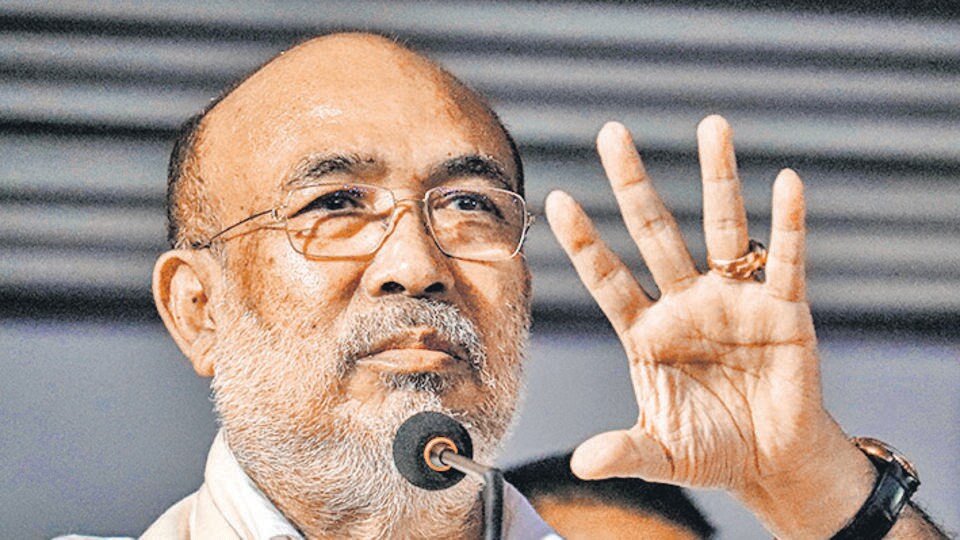
The case pertains to a 48 minutes and 46 seconds audio clip revealing the alleged involvement of the former CM in fuelling the ethnic clashes between Meitei and Kuki communities in Manipur.
Seeking a response from the government, a bench of justices Sanjay Kumar and Alok Aradhe said, “If the entire tape was available with you, it should have been sent for forensic examination. The affidavit filed by the petitioner shows that only limited portions of the tape were sent to the National Forensic Science University (NFSU) Gandhinagar.”
Additional solicitor general (ASG) Aishwarya Bhati appearing for the state sought time to file a response.
Posting the matter for January 7, the bench permitted the state to file a response and said: “Admittedly, the entire audio clip of 48 minutes and 46 seconds was available with you. But the NFSU report shows only limited parts.”
Advocate Prashant Bhushan appearing for the Kuki organisation said that in the entire tape, the relevant portion is contained in the 48 minutes clip which is continuous and has been tested and found to be genuine by a private reliable forensic agency called Truth Lab. He further stated that this called for a court-monitored probe by a special investigation team (SIT) as the Truth Lab confirmed the voice sample to be that of the former CM.
The affidavit filed by the petitioner said, “The forwarding agency - the office of the Superintendent of Police, Cyber Crime, Manipur, transmitted only four short, cut-out clips of durations 0:30, 1:28, 0:36, and 1:47 minutes, instead of the complete 48-minute 46-second recording thereby giving an incomplete and misleading representation of the evidence. Consequently, the NFSU could not verify the continuity or authenticity of the original recording..”
The NFSU report suggested that the clips were “tampered” as four exhibits showed signs of “modification and tampering”. It concluded that the clips are “altered” and do not constitute the original source recording and are not scientifically fit for forensic voice comparison.
Bhushan said that the petitioner was “shocked” to discover later that the audio clips actually transmitted were incorrect, incomplete, and did not represent the original recording. “Such selective transmission of material raises serious concern regarding the bona fides of the Respondent’s conduct and its impact on the fairness of the ongoing investigation.,” the petitioner body’s affidavit stated.
This was the second time the court sought a forensic probe of the tapes furnished by the petitioner. In August, the court expressed dissatisfaction with the report of the Guwahati forensic lab which failed to give any finding on whether the voice in the clips is that of Singh.
The violence that began in May 2023 and lasted till February this year claimed more than 260 lives and displaced several thousands in the northeast state.
After two years of unrest and violence in the state, Singh stepped down from his post as CM on February 9, 2025, following which President’s rule was imposed on February 13. The tapes in question leaked by a whistleblower allegedly contained audio recordings during a closed-door meeting with the former CM. The Centre and state had questioned the right of the petitioner body to file such a petition when first information reports (FIR) pertaining to the riots are pending before the trial court.


