A Maoist attack in Chhattisgarh’s Dantewada district that claimed the lives of 10 policemen and the driver of their vehicle on Wednesday fuelled speculation about possible violations of the standard operating procedure that could have led to gaps in security.
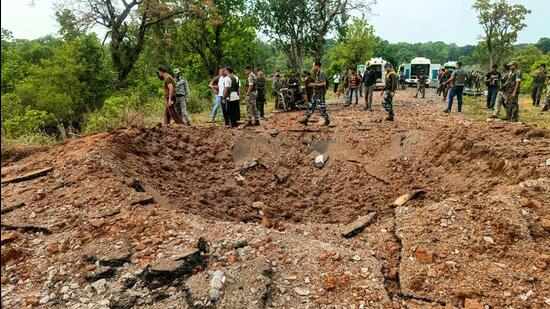
The men -- part of a four-vehicle convoy that was returning from an anti-Maoist operation 75km away -- were travelling in an unprotected and rented minivan when an improvised explosive device (IED) tore through their vehicle, barely 700m from the Aranpur police station.
A police official said the crater on the road suggested that the Maoists had dug a foxhole to plant the explosives at night. “That this could happen undetected so close to the Aranpur camp is a matter of concern,” said the official, requesting anonymity.
A former police official said the troop movement in an open minivan appeared to break protocol, especially because of the apparent absence of an advance recce by a road-opening party. “ First and foremost , the movement of the security forces should never be on vehicles on that road. It should be on foot or bikes but if jawans were going on the road, there should be a road opening party ( ROP) to sanitise the road,” he said.
“The basic aim of the ROP is to remain on both sides of the road so that the IED could not be triggered and prevent the Maoists from ambushing the team. I don’t think there was any ROP on that road,” the former official added, requesting anonymity.
Experts believe that there was also a lack of human intelligence, made worse by the lapses in following protocol. “This is sheer carelessness, nothing else. It should be properly investigated,” the former official said.
Bastar inspector general of police Sunderaj P said the sequence of events will be investigated. “There are different operations that are carried out like search operations or others. But since they are done through one general road and the team has gone into the forest, it’s important to find out the sequencing of the incident. We are trying to ascertain the point of mistake and then further actions will be taken,” he added.
The attack – which claimed the most casualties since 22 security personnel died in a gunfight with Maoists in Bastar two years ago – hit an arterial road critical for anti-Maoist operations and part of a trifecta of routes cutting through the heart of the rebel heartland. For decades, the security apparatus and the government have attempted to build a network of roads in and around Jagargunda in Sukma to help forces gain better access to the thickly forested region. Of these three are important -- Bijapur to Jagargunda, Dornapal to Jagargunda, and finally, a 81-km stretch from Dantewada to Jagargunda through Aranpur. It is this last road that was completed four months ago and saw the IED blast on Wednesday. But authorities are attempting to figure out when the IED was planted under the black-tarred road.
“I believe that it is a limitation of explosive detection equipment because many times, the IED cannot be detected by detectors and there are reasons behind it,” said a second former official who was posted in Bastar for a long time.
The official said the Deep Search Metal Detector ( DSMD) has limitations.
“If the detonator is planted two feet inside the road , the DSMD will not be able to detect it even after proper search. The equipment needs to be bolstered. It is clear that the Maoists were planning for the blast hence they took all measures to avoid detection of the explosives,” said the second former official.
Read: ‘We will end Naxalism soon’: Chhattisgarh CM after 10 jawans killed in attack
Investigators believe that the explosives may have been planted during the road construction work completed four months ago.
“The best chance is that they planted the IED during the construction work and triggered it on Wednesday. They were probably waiting for their best chance in the tactical counter-offensive campaign (TCOC),” said second official.
The TCOC, usually between March and June every year, refers to a period where Maoists of different areas regroup to damage the security forces.
Intelligence officials based in Bastar said that the Darbha division committee, the sub-division of the Maoists that operates in and around Aranpur, was holding meetings in an attempt at revival. “The last big attack the Darbha division committee carried out was during the last election cycle when they killed MLA Bhima Mandavi. Since then, there has been silence. There was chatter about meetings being held, and pressure being put on villagers by them, and this will now have to be countered,” the first official cited above said.