On December 29, 1951, as the country was in the midst of its first election, the Hindustan Times ran an article on how the state of Rajasthan was preparing for polls. “Over 50,000 workers of various candidates are roving up and down the sandy regions of Jaisalmer, Jodhpur and Bikaner on camels, the hilly tracts in the Bhil areas of Udaipur, Dungarpur and Banswar on foot and the cultivated areas of Jaipur and Kotah divisions in jeeps, displaying party symbols and appealing to voters,” the report stated.
At the time of Independence, around 555 princely states covered 48% of the territory of undivided India
The evocative description however belied the battle lines that were being drawn on the ground, especially in the desert state where 74 candidates were fighting for 20 Parliamentary seats, and 622 candidates were in the fray for the 160-seat state legislature. Among the contestants were a large number of independent candidates — many among whom were members of royal families that had ruled over the very people they were now hoping to represent democratically.
“The main election plank has now shifted from general to specific issues. While the Congress is promising a new deal for the peasant with the impending end of the jagirdari, the jagirdars who are contesting well over 100 seats say the demand for abolition must come from below and not imposed from above, and that the question of such a far-reaching reform should be left to the new legislature,” the HT report stated.
At the time of Independence, around 555 princely states covered 48% of the territory of undivided India and the Indian Independence Act (1947) offered them the choice of joining India or Pakistan or remaining independent sovereign states. However, Sardar Vallabhai Patel and VP Menon persuaded several to sign Instruments of Ascension or Instruments of Merger, and promised them a tax-free privy purse to compensate them for their loss of earnings. Many did.
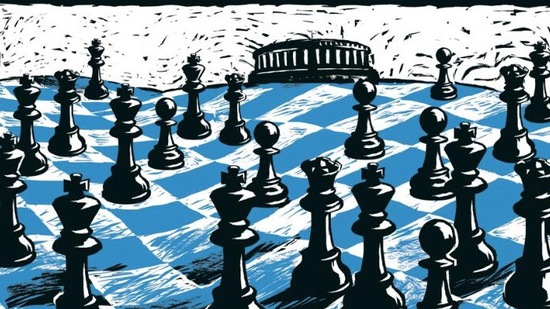
Thus, by all accounts, the first election held between October 1951 and March 1952 was no ordinary one. Only one-third of the country’s population was literate and kings had lost the power to govern. Many of the titular kings of India were appointed as Raj Pramukh (governors) of the state; some as ambassadors; while still others contested the election. Though they had lost the power to rule, they still had control over the land on which a large number of voters were tenant farmers.
An HT report dating December 20, 1951 provided some numbers. “According to the latest figures available, over 45 princes (or members of ruling families) are standing for election to Parliament and State legislatures. They include the Raja of Bilaspur and Maj Gen Himatsinhji, deputy minister, who have been returned unopposed to Parliament. Thirteen of these princely candidates come from Madhya Pradesh, six from Bombay, seven from Orissa, four from PEPSU [Patiala and East Punjab States Union; a state till 1956], one from Madhya Bharat, 10 from Rajasthan and 2 from Saurashtra. Among the candidates is one Maharani. Two princes stood as Congress candidates.”
Members of the influential families of Madhya Bharat (part of present-day Madhya Pradesh) — the Scindias and Holkars — were appointed Raj Pramukh and deputy Raj Pramukh, respectively, so they did not have a direct role to play in the first elections, historian Mridula Mukherjee said.
Rajasthan saw a more pitched battle. Former journalist Arvind Singh said that the principalities of Rajputana gathered under the banner of Ram Rajya Parishad led by Hanuwant Singh, the then titular king of Jodhpur, and Maharaja Ganga Singh of Bikaner. “Ganga Singh had gone to the extent of saying that mediocre people will now rule us, clearly showing their disenchantment with the new democratic set up, in which, common people had the power to decide,” Singh said. Ram Rajya Parishad, a Hindu nationalist party started in 1948, won 10 seats in Rajasthan and Gujarat in the first general elections.
In southern India, after merging the Hyderabad state with the Indian Union on September 17, 1948, Mir Osman Ali Khan, the last Nizam, remained a titular head of Hyderabad state and Raj Pramukh, said senior Muslim scholar and journalist Mir Ayub Ali Khan.
In an article published in the Economic and Political Weekly in 1971, titled Princes in Indian Politics, political scientist William L. Richter wrote that princes and members of princely families competed for parliamentary and assembly seats starting from the first general election in 1951-52, but that numerous princes scored heavily in the fourth general elections of 1967.
With inputs from Srinivasa Rao Apparasu and Ramesh Babu
Chetan Chauhan is the National Affairs Editor looking into all aspects of news and features from across India.
A Chevening scholar with over three decades of experience in reporting and news management, Chetan has extensively covered all important aspects of the social sector, political economy, environment and climate change nationally and internationally. He did a journalism course at the Reuters Institute of Journalism in Oxford and Digital Media training at Nanyang Technological University in Singapore.
He started as a reporter with The Statesman in 1996 and joined the Hindustan Times in 2000 in the metro bureau covering environment, crime and Delhi politics. He covered hot local news, from the Jessica Lal murder case to the rebellion of Delhi Congress MLAs against then Chief Minister Sheila Dikshit, to the replacement of toxic vehicle fuel with cleaner compressed natural gas (CNG) in the national capital.
Some of his stories on air pollution became part of the Supreme Court’s landmark MC Mehta versus Government of India case in the National Capital Region (NCR), forcing the government to take corrective measures.
As part of the national political bureau since 2004, he covered important central sectors such as environment, education, social justice, labour, rural development, water resources, renewable energy, agriculture, broadcasting and the Planning Commission for more than a decade producing several exclusive and investigative breaking stories.
His specialisation is the environment, having covered at least a dozen United Nations global conferences on climate change, biodiversity and wildlife including climate summits in Paris, Copenhagen and Bali.
He also covered India’s two five-year plans ---11th and 12th and reported on drafting and execution of right based laws such as Right to Education, Right to Information and rural job guarantee law, MG-NREGA, now being introduced in new format as VG-RAM-G Act. He has in-depth knowledge of social sector issues.
He was one of the first to report on tigers vanishing from Sariska and Panna wildlife reserves in 2004 and 2008, respectively, leading to the setting up of the National Tiger Conservation Authority (NTCA) and the introduction of stringent penal provisions for poaching. He has written extensively on the rising human-animal conflict in India and the degradation of India’s biodiversity hotspots because of mining and other activities.
Since 2004, Chetan has covered Parliament comprehensively and participated in training on the nuanced coverage of Parliament proceedings. He has travelled extensively across India to cover national and provincial elections since 1998, especially in the Hindi heartland states, considered India’s road to power.
He writes a regular column for Hindustan Times, Ecostani, on important national politics, economy, Himalayan ecology and environmental issues. His other responsibilities include providing inputs for edits and edit page articles for the publication, apart from managing news flow from across India.Read More

 E-Paper