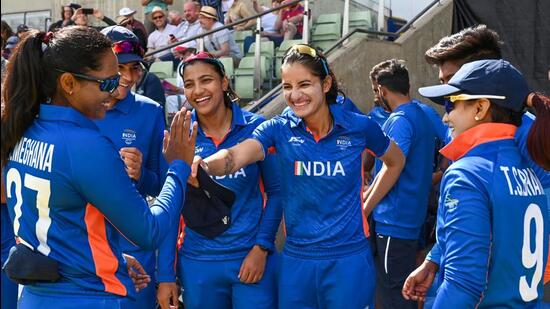
From once being a cricket body reluctant to integrate women’s cricket under its wings, the Board of Control for Cricket in India (BCCI) on Thursday took a historic step towards introducing pay parity in the sport by announcing that India’s women cricketers will be paid the same match fee as men for international matches – ₹15 lakh for every Test, ₹6 lakh for an ODI, and ₹3 lakh for a T20I.
From once being a cricket body reluctant to integrate women’s cricket under its wings, the Board of Control for Cricket in India (BCCI) on Thursday took a historic step towards introducing pay parity in the sport by announcing that India’s women cricketers will be paid the same match fee as men for international matches – ₹15 lakh for every Test, ₹6 lakh for an ODI, and ₹3 lakh for a T20I.
(PTI)
BCCI becomes only the second cricket board after New Zealand Cricket (NZC) to pay its men and women equal match fees.
“I’m pleased to announce @BCCI’s first step towards tackling discrimination. We are implementing pay equity policy for our contracted @BCCIWomen cricketers. The match fee for both Men and Women Cricketers will be same as we move into a new era of gender equality in Cricket,” BCCI secretary Jay Shah tweeted.
The move was received with cheers by women cricketers, past and present. “Truly a red-letter day for women’s cricket in India with pay parity announced for women and men,” India captain Harmanpreet Kaur tweeted. Vice-captain Smriti Mandhana declared it “amazing news”, while former captain Mithali Raj called it a “historic decision”.
Australian Lisa Sthalekar, who recently became the first women’s president of FICA – the international cricketers’ association – also welcomed BCCI’s decision. “So pleasing to see this. Huge news for women’s cricket in India, plus life changing for individuals. I have no doubt this will help with the perception of the game in the biggest cricket loving country,” she said.
The revision in match fees takes the salary for women’s players up six times for Tests and ODIs, and three times for T2OIs. But it won’t make their collective match earnings anywhere close to that of the men – simply because they play much fewer matches in comparison. In the upcoming Future Tours Program (FTP), the Indian women will be playing two Tests, 27 ODIs and 36 T20Is between 2022 and 2025, while the men’s team will be playing 38 Tests, 42 ODIs, and 61 T20Is from 2023 to 2027.
So an all-format male international cricketer who plays in all these matches would make ₹10.5 crore. In comparison, a woman cricketer would only take home ₹3 crore.
Then, in terms of annual retainer, the variance in earnings between the genders is still massive. India’s best-paid women’s cricket contracts are valued at ₹50 lakh, which is half of the lowest men’s contract (Grade C), and 14 times less than what a Grade A+ contract for men’s cricketers is worth – a reflection of the head start that men’s cricket has over women’s cricket in terms of revenue earning potential.
As per the BCCI’s old revenue sharing formula, 70% of gross media revenue is allotted to state associations. The players receive 26% share from the remaining revenue. This 26% is split three ways – 13% for international players, 10.6% for domestic players and the rest for women and juniors. This disbursement formula was based on revenue earnings potential of each vertical.
In the last five years, retainership of international and women players and match fees of domestic players have all been revised.
While some critics pointed to these disparities to call equal pay claims misleading, BCCI officials say this is only the start. “Once the women’s IPL takes off, market value will go up automatically and cricketers will be compensated more,” an official said. The inaugural women’s IPL is slated for 2023.
“I call it a revolutionary decision because it’s come from BCCI, while Australia and England who have been playing more actively for the past 50 years are yet to do it. Unlike the past, the current BCCI dispensation wants to promote women’s cricket,” said former India captain Shanta Rangaswamy. “I hope domestic cricketers are also offered equal match fees as that way you can benefit many more cricketers.”
India’s men domestic cricketers now get match fees up to ₹60,000 per day based on seniority from ₹35,000; the lowest graded player is awarded ₹40,000. Senior women domestic players receive ₹20,000 per day from ₹12,500 they earned earlier.
Shah, in his statement, called it the “first step to tackle discrimination”, and domestic women cricketers hope the benefits of Indian cricket’s riches will eventually reach them too.
Rasesh Mandani loves a straight drive. He has been covering cricket, the governance and business side of sport for close to two decades. He writes and video blogs for HT.

 E-Paper