
 E-Paper



Middle-East Corridor is new Indian spice route to rival the Chinese silk road
India-Middle East-Europe Economic Corridor: Barring a small stretch of railroad that has to be built by Saudi Arabia, the entire corridor is complete.

 Prefer HTon Google


On the eve of the 10th anniversary of China’s Belt-Road-Initiative next month, India, the US, the UAE, Saudi Arabia, France, Germany, Italy and the European Union literally check-mated President Xi Jinping by signing the MoU to establish the India-Middle East-Europe Economic Corridor (IMEE-EC) to connect Asia and Europe by promoting economic integration.
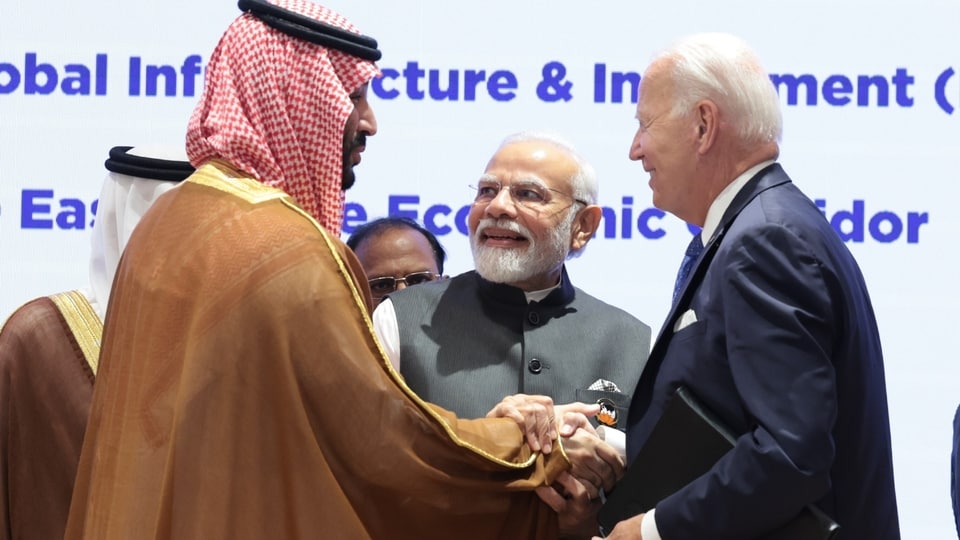
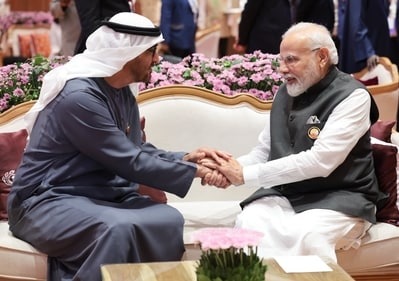
At a time when Italy, a G-7 power, under Prime Minister Giorgia Meloni is poised to withdraw from China-sponsored BRI, it was propitious to note that US President Joe Biden joined hands with estranged friend Saudi Arabian Crown Prince Mohammed bin Salman at the behest of Prime Minister Narendra Modi to solidly back the project. UAE President, a very close friend of PM Modi and an ally of India, was one of the promoters of the project and a firm believer of the Arabian Peninsula acting as an economic bridge between India and Europe. With another close friend Emmanuel Macron providing support, Germany and Italy along with the European Commission have joined hands in the groundbreaking project.
The Middle East corridor consists of two separate corridors. The East Corridor will link the Indian port of Mundra on the west coast to Fujairah port and then using the railroad via Saudi Arabia and Jordan transport goods through standardized containers to the Israeli port of Haifa. The west corridor will be from Haifa, from where the Indian goods will reach various ports like Marseille in France and other ports in Italy and Greece.
Barring a small stretch of railroad that has to be built by Saudi Arabia, the entire corridor is complete and can be activated in near future. The project is very ambitious as it has the potential to link countries like Vietnam, Thailand, Myanmar and Bangladesh with this corridor if the Myanmar junta allows a dedicated port for this project and walks out of the ever lengthening shadow of China. For instance, Bangladesh has six railway exit points to India, and all could be utilized for sending goods to Europe via Mundra port.
The ME corridor MoU comes at a time when the Chinese BRI project is being questioned not only outside the donor country but also within the country as a number of participating countries have no money to pay back Beijing debts due to high interest rates and are being forced to swap debt with equity in the project. Countries like Pakistan, Sri Lanka, Kenya, Zambia and host of others have no money to pay and the bad debts to the tune of USD 100 billion and more are mounting for China, which has nearly invested USD one trillion in the past decade with the objective to extract economic leverage from the recipient country on time of choosing. For example, the China Pakistan Economic Corridor has not only put Islamabad in a deep economic crisis but also a political crisis with Balochistan and Sindh in a rebellious mood and Khyber-Pakhtunkhwa under siege from Tehreek-e-Taliban Pakistan terrorists. The economic condition of Sri Lanka is worst with hardly any traffic at either the Chinese built Hambantota airport or at the deep sea port. While Sri Lanka like Nepal is playing a hedging game between India and China, the fact is that Colombo cannot survive with IMF loan injection and US support. The USD-local currency exchange rate in Pakistan and Sri Lanka is spirally into abyss, while Nepal currency is only holding as it is tied to Indian Rupee.
Driven by participating counties like US, UAE, Saudi Arabia and India, the new spice route has the capacity to not only out-flank the BRI but also over-take it in future as the new spine of global trade based on new global supply chains. It is quite evident that the US under President Biden is committed not only to the ME corridor under the Partnership for Global Infrastructure and Investment initiative but also to backing the global bio-fuels alliance. Spice route is the new silk road.


