
 E-Paper



MNREGS workers in Odisha to get extra 200 days
In January 2020, the state government had announced 100 days of additional work for job seekers under the Mahatma Gandhi National Rural Employment Guarantee Act (MGNREGA) in the four districts under a special livelihood package, thus assuring 200 days of work at minimum wages. This has now been extended to a total of 300 days in a year that is expected to arrest distress migration.

 Prefer HTon Google


Villagers in 20 blocks of four Odisha districts of Balangir, Bargarh, Kalahandi and Nuspada that are prone to distress migration will be given 200 days of work in a year by the state government in addition to the mandated 100 days under the central rural jobs guarantee scheme, the state cabinet decided on Tuesday.
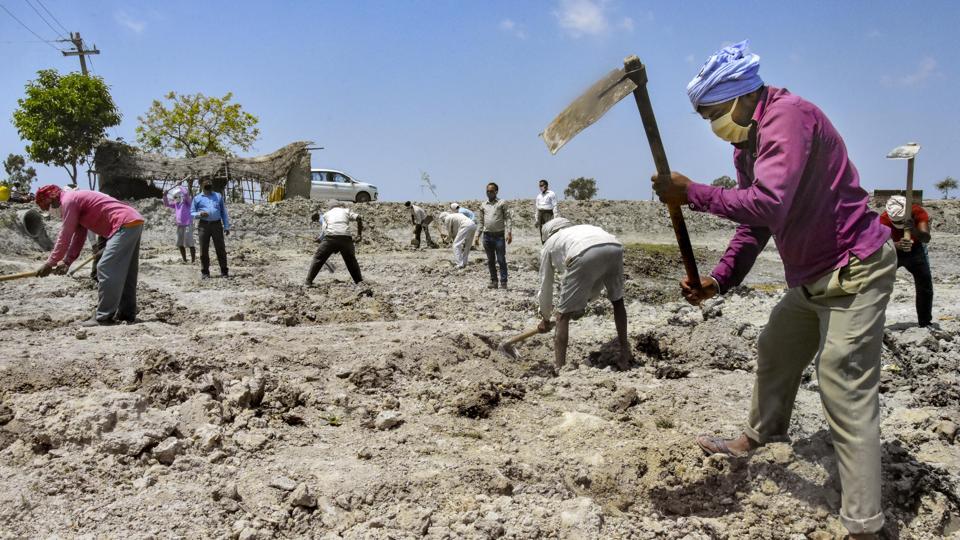
In January 2020, the state government had announced 100 days of additional work for job seekers under the Mahatma Gandhi National Rural Employment Guarantee Act (MGNREGA) in the four districts under a special livelihood package, thus assuring 200 days of work at minimum wages. This has now been extended to a total of 300 days in a year that is expected to arrest distress migration.
The scheme will also ensure that job seekers under MGNREGA in these 20 blocks will be paid additional wages above the notified wage rate for unskilled workers, which was revised upwards to ₹326 per day in Odisha. The daily rate for MGNREGA is ₹286.30 per day.
The additional amount — the difference between minimum wages for unskilled workers and notified wage rate under MGNREGA — will be borne by the state, said AKK Meena, the state’s Panchayati Raj secretary. The state budget for the current financial year has provided for wages for 300 days in these blocks, Meena said. The scheme will be implemented from this month.
Odisha could be the first state to have a state-specific scheme that ensures 300 days of government guaranteed work in a calendar year, migration experts said. A key source state of migrant labourers, nearly 3 lakh people migrate to Andhra Pradesh, Chhattisgarh, Gujarat, Tamil Nadu and Telangana every year for working in brick kilns or construction sites.
Although Odisha’s GDP growth is higher than states like Haryana, Punjab, Kerala, Chhattisgarh, Madhya Pradesh, Maharashtra and Jharkhand, the seasonal migration has been fuelled by jobless growth.
Among the different forms of migration, distressed migrants remain the most impoverished and unrecognised. They form the lowest strata of the society, disadvantaged by caste, poverty and structural inequalities. In the four districts, distress migration has been a popular coping strategy during lean periods of agriculture.
“It’s an excellent scheme, and if implemented well, can stop distress migration in those areas. But it may not be able to stop aspirational migration,” said Umi Daniel of Aide At Action, a non-profit. “The scheme should also go beyond just digging of soil for ponds and help the workers to have a permanent source of income.”
“Ideally, there should be a convergence of schemes of departments so that a villager who can build a cattle shed for his livestock under MGNREGA can also get a loan to buy cattle,” he said.



