E-Paper



Modi hails transformation of Vibrant Gujarat, recalls indifference of previous govt
Modi, who was the Gujarat chief minister when the summit was launched in September 2003, said far from cooperating, the previous government put hurdles in their way


Prime Minister Narendra Modi on Wednesday hailed the transformation of the Vibrant Gujarat Global Summit as an institution while recalling the indifference of the previous Congress-led Union government to the biennial event. He said the central ministers in the earlier government refused to attend the event and even threatened foreign investors to discourage them from participating.
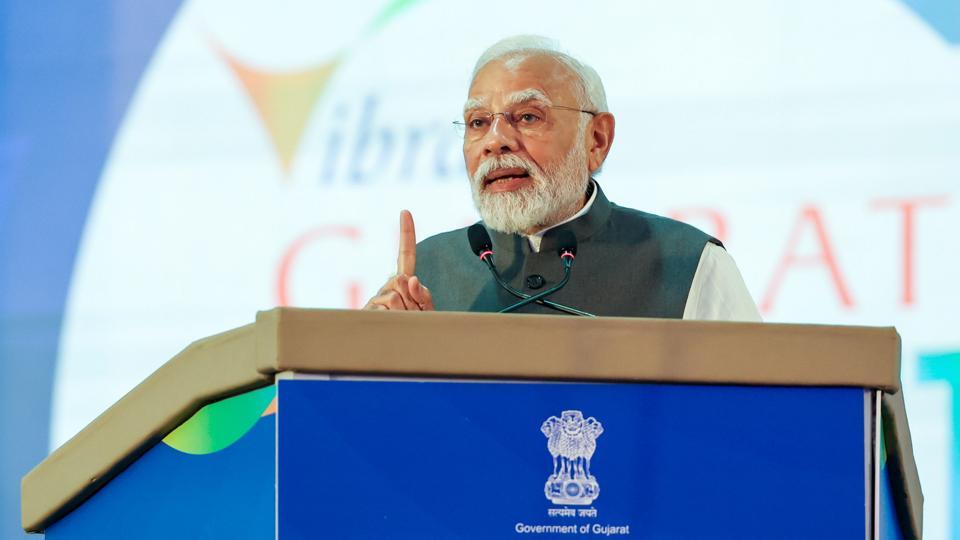
“...those who ran the central government saw Gujarat’s development through the prism of politics. ...In-person, they would tell me that they would like to attend but would later refuse,” Modi said in his address to an event marking 20 years of the summit in Ahmedabad.
Modi, who was the Gujarat chief minister when the summit was launched in September 2003, said far from cooperating, the previous government put hurdles in their way. “Twenty years have passed...we cherish all the memories—both sweet and bitter. Today, the entire world is watching Vibrant Gujarat.”
He said foreign investors chose to invest in Gujarat despite challenges due to their positive experiences—good, transparent, policy-driven governance, fairness, and equitable growth opportunities. “I have always maintained that Gujarat’s progress shows the progress of the entire nation.”
Modi said the summit, whose next edition is scheduled to take place in January, maybe a brand for the world, but it is his bond with Gujarat’s 70 million people. “It is a bond of limitless love.”
Modi referred to Swami Vivekananda’s wisdom to emphasise three stages of an idea—initial laughter, criticism, and eventual acceptance. He added it was particularly true of an idea that is ahead of its time.
Modi recalled the challenging circumstances under which he took over as the Gujarat chief minister in 2002. He referred to the 2001 earthquake, which left thousands dead. “Gujarat grappled with famine. The Madhavpura Mercantile Cooperative Bank collapsed...133 more banks were severely affected. The state’s financial sector was in dire straits. At that time, I assumed the role of a leader for the first time.”
Modi said it was a new role for him with no prior experience in running a government. “Then, violence erupted in Gujarat in the wake of the heart-rending Godhra incident.“
He said the challenges were beyond anyone’s imagination. “As chief minister, I had limited experience, but my faith in Gujarat and its people remained unwavering.” He referred to agenda-driven doomsayers and a conspiracy to defame Gujarat. “Those who had an agenda were trying to interpret things in their own way. They said that Gujarat’s industrialists, and traders will go away...the state will be shattered in a way that it will become a burden for the country.”
He said an attempt was made to create an atmosphere of despair. “It was said that Gujarat will never be able to again stand on its feet. I took a pledge that whatever the situation, I would get Gujarat out of this. We were not only thinking of rejuvenation but also of the future.”
He said the summit became an important medium against this backdrop. “It allowed us to talk to the world, to show it the industrial might of the country through Gujarat, and India’s talent and rich heritage.”
Modi said there were no big hotels in Gujarat when the summit started. “In 2009, when Vibrant Gujarat was organised, there was a slowdown in the world. Everyone told me not to hold it as it would be a flop. I told them then it would not stop. If it flops, we will be criticised but it should not stop.”
He said the number of participants has grown from 100 in 2003 to over 40,000 from 135 countries. “Thirty exhibitors then and now over 2000.” He credited idea, imagination, and implementation for the summit’s success.
Modi recalled the humble beginnings of the summit in makeshift tents. “Instead of hotels, business houses, and university guest houses generously provided accommodation for guests.”
He said the inception of the summit was truly an unprecedented and unheard-of idea. “Its resounding success inspired other states to follow suit, reflecting the groundbreaking nature of the initiative.”
Modi said the vision was to accomplish something that had not been attempted at a national level. “Establishing a partnership with a developed country was a groundbreaking move. It surprised many about how a state could achieve such a feat. However grand the idea and imaginative, the vision and path to success demanded meticulous planning and relentless effort.”
He said the summit’s evolution from a one-time event into an enduring institution is a testament to its impact. “Its influence extends far beyond the event itself, with a continuous process that operates within and outside the government, both before and after the event. With each edition, Vibrant Gujarat reached new heights, relentlessly focusing on infrastructure development and economic progress.”