
 E-Paper



Modi, Hasina seal pacts, hail bilateral partnership
India and Bangladesh on Tuesday signed seven pacts for cooperation in areas ranging from sharing of river waters to space, and unveiled new connectivity and energy initiatives, with the two sides holding up their partnership as a role model for the neighbourhood.


India and Bangladesh on Tuesday signed seven pacts for cooperation in areas ranging from sharing of river waters to space, and unveiled new connectivity and energy initiatives, with the two sides holding up their partnership as a role model for the neighbourhood.
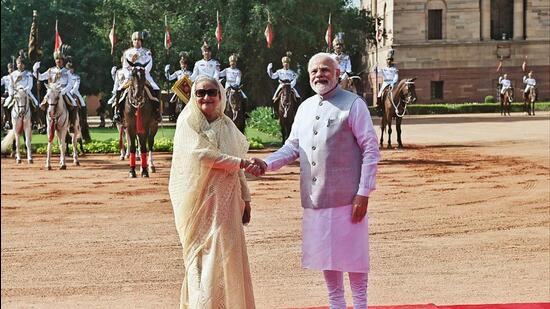
Following talks with his visiting Bangladesh counterpart Sheikh Hasina, Prime Minister Narendra Modi said both sides had stressed on cooperation against terrorism and fundamentalism. “In order to keep the spirit of 1971 alive, it is very necessary that we jointly face forces that want to attack our mutual trust,” he said.
Modi described Bangladesh as India’s largest development partner and the biggest trade partner in the region, while Hasina said India is the “most important and closest neighbour” for her country. She added, “Bangladesh-India bilateral relations are known to be a role model for neighbourhood diplomacy.”
Hasina held out hope the two countries will resolve the issue of sharing the waters of the Teesta river – an agreement on the matter has been pending since 2011 – just as they have settled “many outstanding issues in the spirit in friendship”.
Modi noted two-way trade is growing and India is the largest market for Bangladeshi exports in Asia, and announced the two sides will soon begin negotiations on a comprehensive economic partnership agreement (CEPA).
Two-way trade is currently worth $18 billion, and foreign secretary Vinay Kwatra told reporters the two leaders wanted discussions on CEPA to begin this year and be completed in time for Bangladesh’s graduation from Least Developed Country (LDC) status in a few years.
One-on-one talks between the two prime ministers was followed by a meeting with their delegations, with the agenda focused on political and security cooperation, connectivity, energy, water resources, trade and investment, border management and security, and regional and multilateral issues.
The two sides signed seven memorandums of understanding (MoUs) covering the withdrawal of water from the cross-border Kushiyara river, cooperation in space technology for governance and development, collaboration on IT systems used by railways in areas such as movement of freight, science and technology cooperation, training of Bangladesh Railway personnel and Bangladeshi judicial officers in India, and cooperation in broadcasting between Prasar Bharati and Bangladesh Television.
Earlier this week, the two sides also signed the first contract under a $500-million line of credit offered by India in 2019 for funding purchases of defence gear. “It was a modest amount but it was an important first step and...will open a path for further engagement...in the field of defence,” Kwatra said.
The agreement on Kushiyara river was the first water-related pact signed by the two sides since the Ganges Treaty of 1996, and Modi and Hasina noted the 54 rivers shared by the two countries are closely linked to livelihoods. The agreement on sharing the waters of Kushiyara river will benefit southern Assam in India and Sylhet region of Bangladesh, Modi said.
The two leaders unveiled the first unit of the Maitree super thermal power project being built in Bangladesh’s Khulna division with concessional funding from India. The unit was synchronised with the national power grid in August, and the project will generate 1,320 MW when completed.
They inaugurated the 5.13-km Rupsha rail bridge, part of the 64.7-km Khulna-Mongla port broad gauge railway project and built by an Indian contractor for $169 million. The total cost of the project, also being constructed with an Indian loan, is $389 million. It will increase connectivity with Mongla, Bangladesh’s second largest port.
India has provided concessional loans worth $9.5 billion for projects in Bangladesh, especially connectivity initiatives. These include a project for improving rail connectivity between Khulna and Dhaka, Chilahati and Rajshahi and connecting Mongla port with Darshana-Gede at a cost of $312 million, the Parbatipur-Kaunia rail project to facilitate transportation of fuel that is being built for $120 million, and the supply of road construction equipment and machinery worth $41 million to maintain Bangladesh’s road network.
Modi said there were talks on connecting power transmission lines between the two countries. “India will continue all kinds of cooperation for the development and expansion of Bangladesh’s railway system,” he said.
The two sides discussed enhancing cooperation for flood mitigation. “India has been sharing flood-related data with Bangladesh on a real time basis and we have also extended the period of data sharing,” he said.
Modi pledged India will walk step by step with Bangladesh in realising “Bangabandhu” Sheikh Mujibur Rahman’s vision of a stable, prosperous and progressive country. “Our conversation today was an excellent opportunity to reiterate this core commitment,” he said.
Hasina said the talks had focussed on ways to “materialise our commitments and accommodate each other’s priorities in a mutually beneficial manner”. Referring to the issue of sharing of river waters, she added: “I know as long as Prime Minister Modi is here, Bangladesh and India will resolve all these problems.”
Kwatra said both sides underscored the importance of continuing close security cooperation for counter-terrorism, border management and tackling cross-border crimes. Criminal activities across the border should be limited and those responsible should be apprehended and dealt with according to the law, he said.
Sameer Patil, senior fellow at the Observer Research Foundation (ORF), said the range of agreements signed by the two sides reflects the momentum of their relationship and a desire to extend areas of convergences. “While traditionally counter-terrorism and security cooperation have provided the necessary anchor for these ties, New Delhi and Dhaka are keen to explore forward-looking themes like space, connectivity and technology,” he said.


