E-Paper



Modi says BJP committed to North-East in poll pitch
In a final campaign push in the North-East on Friday, Prime Minister Narendra Modi said in Meghalaya’s capital Shillong that “sabka saath, sabka vikas” is a manifestation of true secularism by the Bharatiya Janata Party (BJP) and its alliance partners, while reiterating his party’s commitment to removing the Armed Forces Special Powers Act (AFSPA) in Nagaland.

 Prefer HTon Google


In a final campaign push in the North-East on Friday, Prime Minister Narendra Modi said in Meghalaya’s capital Shillong that “sabka saath, sabka vikas” is a manifestation of true secularism by the Bharatiya Janata Party (BJP) and its alliance partners, while reiterating his party’s commitment to removing the Armed Forces Special Powers Act (AFSPA) in Nagaland.
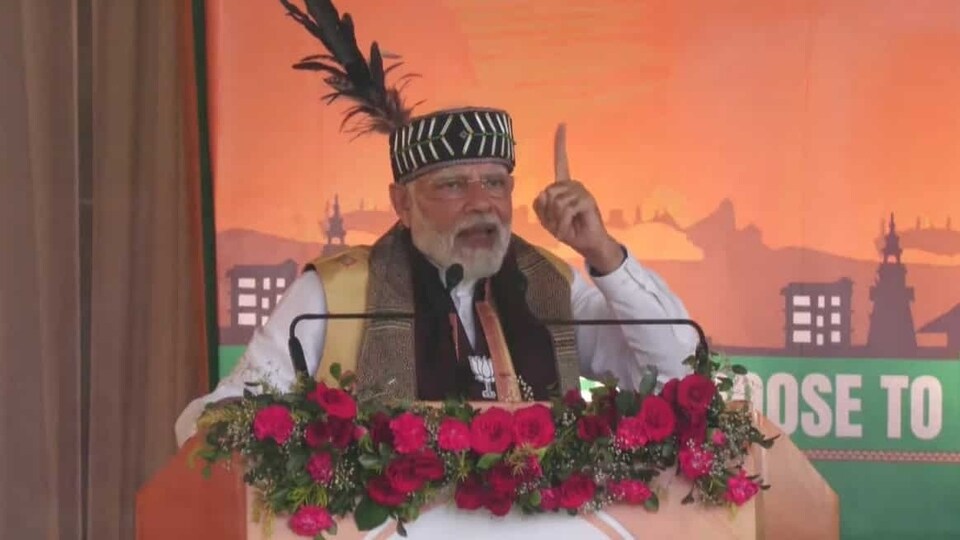
Addressing three back-to-back rallies in the two states that go to polls on February 27, the PM also hit out at the Congress and other parties for ignoring the North-East.
Speaking in Shillong, Prime Minister Modi said, “The BJP does not discriminate on the basis of religion, region, creed or caste. Our schemes are meant to benefit all. Sabka saath, sabka vikas is our secularism. Nation first and people first is our party’s commitment.”
Also read: India saying 'Modi tera…’: In Meghalaya, PM reacts to ‘kabar khudegi’ slogan
Both Nagaland and Meghalaya have a significant Christian population, with 88 percent according to the 2011 Census in the former, and 74.59% in the latter.
The BJP is focused on people and not a few families, the PM said at the rally in Tura in Meghalaya, in an apparent swipe at dynastic politics.
“Meghalaya wants a stable and strong government under a strong party. Instead of those who promote family first, we will give you a government, which keeps people first,” Modi said.
The current Meghalaya chief minister and leader of the National People’s Party, Conrad Sangma, is the son of former chief minister and Lok Sabha speaker PA Sangma.
To be sure, the BJP, which won two seats in the 60-member assembly in the 2018 elections and is a partner in the NPP-led state government, but both parties are contesting the 2023 elections on their own.
The PM’s Tura rally was shrouded in controversy after the state government allegedly denied permission to use the PA Sangma stadium saying that it was under construction.
While the NPP and the BJP engaged in a war of words over the issue, CM Sangma said his government had no role in it. Sangma is seeking re-election from South Tura. The West Garo Hills district eventually approved the Altogre Stadium in Tura for the rally.
“Some people don’t like your love for BJP. They have lost their sleep. They tried a lot to ensure that this rally doesn’t take place. But to meet people of Meghalaya and to connect with them, Modi doesn’t need a playground as people of Meghalaya have given him space in their hearts,” Modi said, referring to the tussle over the venue of the rally.
The PM also renewed his party’s double-engine government pitch.
Also read: BJP means people first, instead of family first, PM Modi at Meghalaya rally
“For better development, the Centre needs to work with the state government. There has been rapid progress in other northeastern states like Assam, Manipur, Arunachal Pradesh and Tripura, which have BJP-led governments. Meghalaya also gets lot of central funds, but people tell me that money meant for roads, schools, colleges and hospitals have not been utilized,” Modi said.
The PM exuded confidence that “lotus”, the BJP symbol, will bloom in the state, as the party has always prioritised the well-being of its people.
“Those who have been rejected by the country, deemed unacceptable by people and find themselves immersed in hopelessness are now chanting ‘Modi teri kabar khudegi’ (Modi, your grave will be dug). But, people in every nook and corner of India are saying ‘Modi tera kamal khilega’ (Modi, your lotus will bloom),” the PM said.
“People will give a befitting reply to those who use such offensive language,” he said, a day after Congress members purportedly raised the controversial slogan after one of its leaders, Pawan Khera, was deplaned in Delhi from a Raipur-bound flight.
Khera was arrested in connection with an FIR over his remarks about Modi, and was released on bail later on the same day after an intervention by the Supreme Court.
At a rally in Nagaland, Modi said that the BJP was committed to removing the controversial Armed Forces Special Powers Act, and said that incidents of violence in the state have decreased by 75%.
“We are striving day and night to ensure AFSPA is removed from all of Nagaland and the rest of the northeast. Because of the BJP and NDA governments in the region, border disputes among states are getting addressed and it will lead to progress and prosperity,” he said at the rally in Dimapur.
The Prime Minister also targeted the Congress for ignoring the North-East during its years in power.
“Congress and its partners had the policy of getting votes and forgetting Nagaland and the rest of northeast. They did not give importance to stability and progress in the region. The party used to control Nagaland through a remote from Delhi,” he said.
The BJP is contesting the elections in alliance with the Nationalist Democratic Progressive Party (NDPP), a continuation of the successful agreement it had in 2018, where it contested 20 seats and the NDPP 40.