
 E-Paper



Modi unveils logistics policy in growth push
NLP is an outcome of eight years of efforts, a result of his 22 years of experience as the chief minister of Gujarat and Prime Minister of the country, and the policy aims to benefits the industry, small entrepreneurs, farmers, consumers and the economy as a whole, Modi said


Prime Minister Narendra Modi on Saturday said enhancing logistics efficiency for greater competitiveness in the global market is a “low-hanging fruit” and “with some efforts”, the country’s average transportation costs can be brought down to a “single digit from the existing level of 13-14%”.
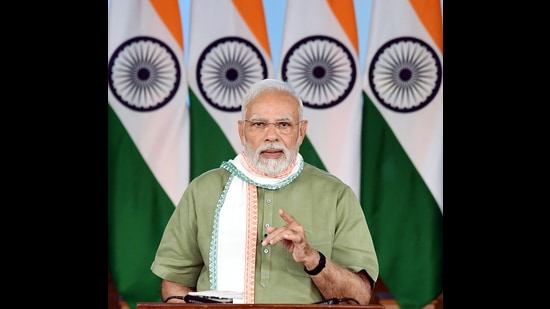
Launching the National Logistics Policy (NLP) in New Delhi, the Prime Minister said it is “a driving and a guiding force”, and both the government and stakeholders are responsible to realise it on the ground. “Policy plus performance is equal to progress,” he said, seeking coordinated efforts of all stakeholders in making country-wide logistics more efficient and cost effective. When parameters, road map and timeline for performance come together, then policy plus performance equal progress, he said.
NLP is an outcome of eight years of efforts, a result of his 22 years of experience as the chief minister of Gujarat and Prime Minister of the country, and the policy aims to benefits the industry, small entrepreneurs, farmers, consumers and the economy as a whole, Modi said. NLP is a significant step in fulfilling the “pran” (vow) of India being a developed country.
Correlating NLP’s purpose of infusing efficiency and speed with the nature of the cheetah — an animal known for its speed — and mentioning that India has become the 5th largest economy in the world, he said: “Desh usi tez gati se aage badhna chahta hai (the country aspires to move with the same pace).” Earlier in the day, PM Modi released eight cheetahs, which were declared extinct in India in 1952, in the Kuno National Park. These cheetahs have been brought from Namibia under “Project Cheetah”.
The Prime Minister said NLP should not be seen in isolation as it is part of the government’s “Aatmanirbhar Bharat Abhiyaan” (Self-reliant India Initiative) and linked with many projects already launched to boost infrastructure, create jobs and boost the economy.
Deloitte India leader and partner, government and public sector, Arindam Guha said NLP aims to build upon earlier initiatives of the government such as the ₹111 lakh crore National Infrastructure Pipeline (NIP), the PM Gati Shakti National Master Plan, the Multi-modal Logistics Parks (MMLPs), and the National Single Window system.
NLP aims to seamlessly connect transporters, warehousing facilities, freight forwarders, customs, regulatory bodies and other stakeholders to have an efficient supply-chain network that would reduce average logistics costs and make essential commodities cheaper for consumers. Guha said some of the key pillars under the policy are — quality logistics infrastructure with emphasis on first and last mile connectivity, use of digital technologies for planning and tracking such as the Unified Logistics Interface Platform (ULIP), development of a national logistics plan for identifying key priorities, and creation of a skilling-cum-certification ecosystem for job aspirants in the system.
Speaking about the policy, the Prime Minister said it will bring “new energy” to all sectors. He said schemes such as Sagarmala and Bharatmala have improved logistics connectivity for systematic infrastructure development. The total capacity of Indian ports has increased significantly and the average turn-around time of container vessels has come down from 44 hours to 26 hours, he said. For promoting export, 40 air-cargo terminals have been constructed, 30 airports have been provided cold-storage facilities and 35 multimodal hubs are coming up in the country, he said.
“Through waterways, we can do eco-friendly and cost-effective transportation, for this many new waterways are also being built in the country,” he said, while mentioning “Kisan Rail”, “Kisan Udan” and drone experiments of the Covid-19 period that helped transportation of essential commodities, farm produce and vaccines across the country.
Speaking about NLP as a tool for ease of doing business, he said it will bring all the digital services related to the transportation sector into a single portal, freeing the exporters from a host of very long and cumbersome processes. He said the PM Gati Shakti National Master Plan will be supporting NLP. PM Gati Shakti is a national master plan for multi-modal connectivity that institutionalises holistic planning of major infrastructure projects, hitherto planned and designed in silos.
“A huge data of information related to different infrastructure projects of state governments has been prepared. Today, data from the central and state governments in about 1,500 layers are coming on the PM Gati Shakti portal,” the PM said. “Gati Shakti and National Logistics Policy together are now taking the country towards a new work culture. The talent that will come out of the recently approved Gati Shakti University will also help it a lot,” he added.
Speaking on the occasion, Union commerce minister Piyush Goyal said NLP will reduce logistics costs, make Indian products competitive in the international market and boost trade. It will increase employment opportunities, support small industries, encourage startups and immensely benefit farmers in terms of checking wastage of perishable commodities and reducing delays in transportation of farm produce to markets, thus increasing their income. Eventually, consumers will get better quality products at cheaper rates.
Hiranandani group managing director Niranjan Hiranandani said: “The progressive road map to accomplish seamless last mile connectivity with an integrated platform and approach will scale up India’s global manufacturing hub proposition globally. The policy will give thrust to manufacturing, MSME, infrastructure and real estate sector to generate much needed employment and investment.”
Ketan Kulkarni, chief commercial officer of BlueDart, said: “The policy will help bring down the transportation, warehousing and inventory costs which will consequently reduce the overall logistics cost down to around 8% of GDP in the next five years. Digitalisation of the logistics sector and creation of unified portals will play a crucial role in bringing the logistics sector together.”


