
 E-Paper



Modi-Shah and the new grammar of elections
The Bharatiya Janata Party does not shy away from admitting that all elections are contested with Prime Minister Narendra Modi being the face

 Prefer HTon Google


NEW DELHI: During the 2014 Lok Sabha elections, as the prime ministerial candidate of the Bharatiya Janata Party, Narendra Modi called up a senior party leader who has to his credit several electoral wins, to get a sense of how the election was shaping. The leader, who later became a minister in the Modi Cabinet, is learnt to have told him, “…earlier people in our constituencies voted for us, now they are voting for Modi.”
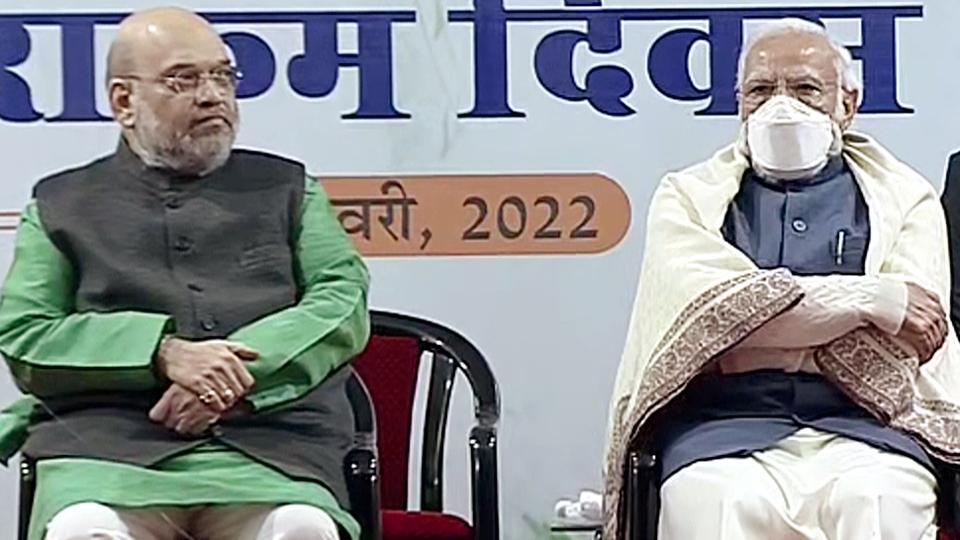
There have been many highs and lows and various twists and turns in the BJP’s electoral story since it came to power at the Centre with a thumping majority in 2014, but the postscript has consistently been “it’s a vote for Modi”, even if the election was to pick a new state assembly.
The outcome of the fiercely contested assembly election in Uttar Pradesh is no different.
The slogans and posters may have boasted of a “double engine” government, a reference to the PM Modi-CM Yogi Adityanath combine, but the victory, overcoming several factors including anti-incumbency, is largely attributed to the popularity of Prime Minister Modi.
New processes
BJP leaders candidly admit that the party’s approach to electoral politics underwent an enormous change post-2014 when Modi, the three-time Gujarat CM, and his trusted lieutenant Amit Shah embarked on a journey from Ahmadabad to New Delhi.
Groomed in the Rashtriya Swayamsevak Sangh’s time-tested approach of wearing out one’s shoe leather, Modi and Shah added newer dimensions to the party’s designs to expand its footprint. There was swift adaptation to technology, relying on the novelty of smartphones, to forge a direct connect with the masses by sidestepping traditional media, and within the party by creating a system where workers were heard and seen beyond the hierarchical verticals.
While “election winning machine” entered the lexicon of the party’s electioneering model, a senior leader said the process initiated by the Modi-Shah duo has ensured that all party and election-related programmes are now designed with “surgical precision”.
“By now, everyone is familiar with Shah’s Panchayat-to-Parliament formula, which means, every election is fought with a sight on victory. And as for the state elections, he says these should not be viewed as limited to a particular state, but have an impact on the region, and the country at large, so there is no scope for dropping the ball,” said the senior leader.
What the BJP’s critics see as a centralised, almost autocratic way of running the party is perceived as running a tight ship within. During Shah’s presidency, political management at booth and village levels became reference points even for opposition parties that were goaded to revisit their party structures at the grassroots.
To inculcate discipline, senior leaders including Shah have the same responsibilities as panna pramukhs as the rest of the cadre.
“The focus on strengthening the organisational base at the booth levels helped mobilise support for the party that has close to 12 million members today…and this is no mean feat. Our presence at the lowest unit has helped us overcome caste factions, biases and reap the benefits of social engineering,” said a second leader.
The leader went on to add, “At meetings with party leaders, the PM has consistently underlined the need for out-of-the box social and political agenda; for schemes tailored for the youth, the weaker sections, women, and the older demographic. He sets the agenda for ‘New India’ and our leaders follow the cue…”
The template set by the duo has also ensured that decision making is not challenged. Stories of a fiery Uma Bharti lashing out at the party seniors and staging a walk-out from party meetings, or a Kalyan Singh rebelling and breaking away, are now just references from the past.
PM is the face
The BJP also does not shy away from admitting that all elections are contested with the PM being the face. Even when the party nominates a CM candidate, as was done in the case of Uttar Pradesh with the senior leaders endorsing Yogi Adityanath for the second term, it is the PM who is the chief campaigner, crowd-puller and the pivot on which the party’s elections campaign hinges.
In UP too, the PM led the charge, addressing rallies across 198 assembly constituencies and kept the tempo high through virtual conferences.
“In the past, there was a perception that with the PM being at the centre stage, it did not matter who the state representative would be. This observation came about in the wake of appointments such as ML Khattar in Haryana, Raghubar Das in Jharkhand and Biplab Deb in Tripura…but the same holds true even in states where the CMs have a reasonably strong support base and are seen as leaders to reckon with,” said the first leader.
Consequently, in the party’s election manifest, the PM’s image as a “performer, incorruptible and strong leader” is cited as evidence of the party making good on promises.
Local to global
Apart from social engineering, the now-famed formula of eliciting support from a conglomeration of disparate castes, the Modi-Shah duo also excelled at leveraging a cornucopia of issues, from hyperlocal to global, to improve the party’s chances at the hustings.
While the core ideological concerns are not brushed under the carpet, the promise of development and a shinning new India are used to break new frontiers. Notwithstanding the accusations of communal polarisation, of international headlines screaming intolerance, the party is welded to its core ideology and asserts its intent to keep “Hindu-issues” front and centre.
National security, diplomacy, and pan Indian issues are now routinely part of the state assembly elections.
Take for instance the ongoing Russia-Ukraine war. Before the opposition could put the government on the mat for its delayed response to evacuation of Indian citizens, primarily students from Ukraine, there were visuals of PM Modi chairing meetings after meetings on the crisis; ministers in countries neighbouring Ukraine were overseeing the evacuations. These visuals soon became part of the electioneering discourse in UP, dislodging the discourse dominated by the farm agitation or increase in oil prices.


