
 E-Paper



More sea walls aren’t a solution to check sea erosion, warn experts
According to a status report by the ministry of earth science’s national centre for coastal research, 22% of Karnataka’s coast is eroding, while 48 per cent was in a stable state.


In the monsoon season this year, three coastal Karnataka districts received 2504.4 mm of rain, which is higher than the average for this time of the year. The heavy rains were followed by floods and in some parts by sea erosion.
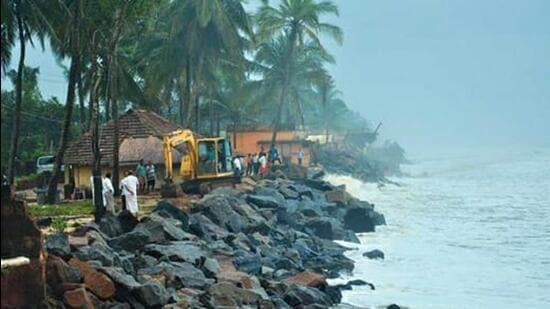
The government was quick to announce a new project to tackle the erosion problem. The announcement came to even chief minister Basavaraj Bommai admitted that large funds spent on these projects have been ineffective.
The projects that chief minister called ineffective were mostly related to sea wall construction. Since 2010, under an Asian Development Bank project, ₹160 crore have been spent on sea wall construction.
Two reefs over an area of 200 meters for ₹110 crore and 10 burns for ₹30 crore are set up at Uchila Battapadi limits. Sea walls already cover between 10% and 15% of Karnataka’s coast.
The port department has put huge black stones to prevent the sea from washing away houses built on the sea shore. However, the problems during the monsoon continue.
According to a status report by the ministry of earth science’s national centre for coastal research, 22% of Karnataka’s coast is eroding, while 48 per cent was in a stable state. The findings were based on a shoreline analysis between 1990-2016. Illegal constructions in the CRZ area and encroachment of rivers and seas have increased the intensity of sea erosion. Ullal, Someshwara and Ucchila are prone to sea erosion. Every year more than 20 houses are washed away into the sea.
Another research paper in 2019 – “Long-term coastal erosion assessment along the coast of Karnataka, west coast of India” -- noted that between 1990-2016, there was severe erosion in Ullal, which had lost land at 1.3 metres per year. “Both anthropogenic activities like ports, seawalls, breakwaters, etc and natural processes like longshore drift, seasonal variation, etc are factors affecting the shoreline change along the Karnataka coast,” noted the paper.
A recent analysis noted that due to the rise in sea level, key infrastructure in many coastal cities including Mangalore might submerge.
While it is clear that it is time for action, the government is unable to think beyond the physical structure of the sea. Even though experts have told the government that sea walls, dropping stones in the water and similar methods do not provide a permanent solution to the problem, the latest proposal from the government is to build wave breakers, which is another form of physical obstruction in the sea.
“The experts have recommended sea wave breaker technology to prevent sea erosion. It has been decided to implement the technology as a permanent measure for the prevention of sea erosion,” Bommai said announcing the government’s proposal to tackle the erosion problem.
“Through ADB we have spent close to ₹300 crore. We cannot let it go to waste. We will investigate the shortcomings and take necessary action,” he added.
Talking about the government’s proposal VN Naik, retired marine biologist and a resident of Karwar, said idea of having any physical structure in the sea is only going to worsen the situation.
“The erosion and accretion are natural to the sea. It happens every year, the sea comes in and at the end of the monsoon, the shore is reclaimed naturally as well. If you look at the records, no lives have been lost due to erosion. The problem is the encroachment of the shore and the biggest culprit in the problem is tourism,” said Nayak.
According to him, instead of addressing the fundamental problem of encroachment and facilitating relocation to avoid property damage, the government is focusing on sea walls.
“If you build any structure in the water, it simply moves the erosion to another beach. It doesn’t solve the problem. But it causes a big disruption to marine life. For example, any structure on the shore would affect the turtle population and it would not allow the fishermen community to drag their nets back from the sea,” he said.
Prakash Mesta, a marine biologist based in Honnavar, said with a comparison of the maps of Karnataka’s coastal region made during the British era and current shoreline maps, it could be seen that sea erosion has claimed shore, i.e. areas with a survey number currently underwater, are only two locations.
“This indicates that the natural process has not claimed any of our shores. Now when they are dumping stones into the water or creating a wall, what we have seen is that over time it gets absorbed by the sea bed and it further aids the problem. The government has spent a lot of money on this, which has literally gone into the water,” he said.
Mesta further added that the biggest problem in the state’s solution to sea erosion is the lack of experts. “We don’t have any marine engineers. These works are undertaken by the civil engineers in the government machinery, who are experts in building reservoirs. Despite having a large coastline, none of the engineering colleges teaches this subject,” he pointed out.
Nayak said in all the plans proposed by the government so far to counter sea erosion, the experts living in the region and the fishermen’s community have not been consulted.
A senior, bureaucrat who spoke on the condition of anonymity, said sea walls are a political tool as well. “Fishing castes are an important political force in the coastal belt. These communities form a large vote bank for the two major political parties that have won elections in the region. For voter base, the concrete structure is more visible as a government undertaking work than doing more scientific work which will not have visible structures,” he said.


