Sign in

Most hunting proposals cleared without scientific study, reveals RTI

The environment ministry apparently approved proposals allowing hunting of animals without any scientific study as required in its own advisory of December 2014, reveals ministry’s Right To Information (RTI) replies.

Updated on: Jun 10, 2016, 07:21:07 IST
Hindustan Times | By , New Delhi
Share
Share via
  • facebook
  • twitter
  • linkedin
  • whatsapp
Copy link
  • copy link

The environment ministry apparently approved proposals allowing hunting of animals without any scientific study as required in its own advisory of December 2014, reveals ministry’s Right To Information (RTI) replies.

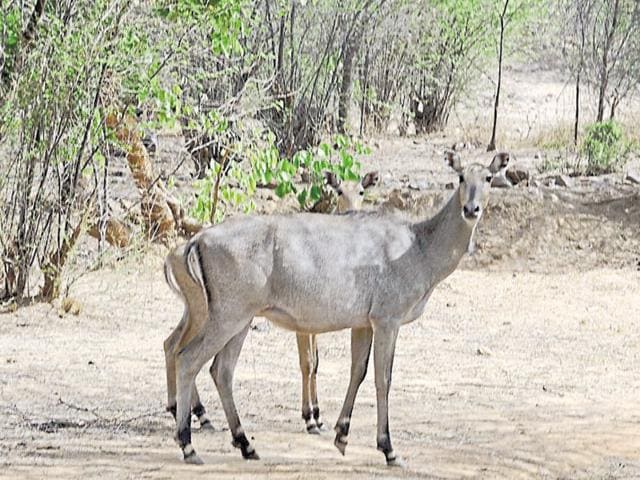
The documents assessed from states such as Himachal and Uttarakhand also showed that proposals without any backing of scientific study on overpopulation were approved. (HT File Photo)

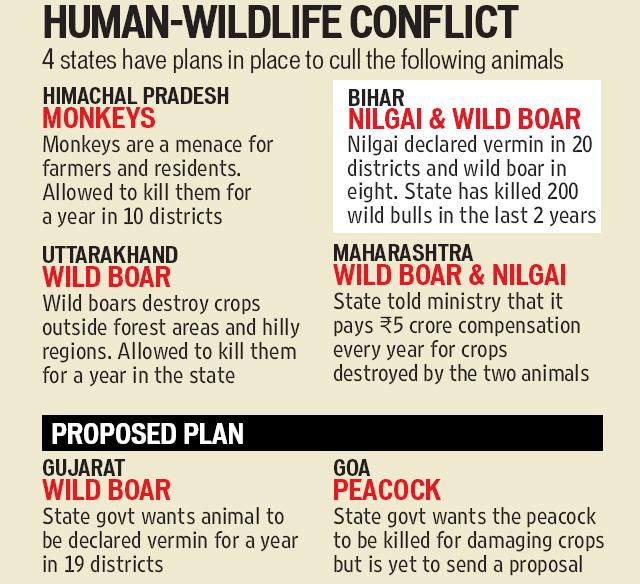
Sources also said the ministry did not pay heed to advice of its wildlife wing against allowing hunting of animals and cleared proposals from as many as three states for killing animals across districts for a year.

The advisory, the first of its kind since hunting was banned in 1972, was issued after several chief ministers and members of Parliament sought permission to kill animals whose population was rising and leading to increase in crop damage. It clearly asked the states to submit the proposals for declaring animals causing damage to crops and humans on basis of scientific study and expert opinion.

Documents inspected under RTI by Prevention of Cruelty to Animals showed that Bihar got approval for killing of red bulls and wild boar on basis of a three-page letter written by the state’s forest secretary Vivek Kumar Singh.

The state submitted minutes of the state wildlife board meeting headed by chief minister Nitish Kumar clearing proposal for hunting and documents related to compensation given to farmers for crop loss in the last few years.

“The ministry approved the proposal even though there was no scientific study on growth of population of wild boar and red bulls in the state and fragmentation of forest leading to increase in human-animal conflict,” said Gauri Maulekhi, who has sought the information under RTI.

The documents assessed from other states such as Himachal and Uttarakhand also showed that proposals without any backing of scientific study were approved.
Article image

The environment ministry officials, however, insisted that proposals were approved as per the provisions of the Wildlife Protection Act and after due diligence.

“Last year, more than 500 people lost their lives in human-wildlife conflicts. There are standard operating processes laid down in the Wildlife (Protection) Act 1972. Therefore, the Ministry has not given any permission to kill either Deer, Peacock or Elephant,” said S. K Khanduri, inspector general of the forest on human-wildlife conflicts.

He said five states have submitted the proposal and of three has been approved. “The Ministry examines the proposal in detail and allows scientific management in a specific area for a limited time,” he added.

Prakash Javadekar had earlier also ruffled feathers with his cabinet colleagues.

Women and Child Development Minister Maneka Gandhi had resisted his ministry’s decision to allow bull fighting sport called Jallikattu in Tamil Nadu before the recently concluded state assembly polls. The Prevention of Cruelty to Animals, with whom Gandhi is associated, had got a stay from the Supreme Court.

Water Resources Minister Uma Bharati had also opposed environment ministry’s bid to allow hydro projects in upper reaches of Uttarakhand saying it would destroy the national river and had written a letter to him opposing the affidavit filed in the Supreme Court by the green ministry.

Javadekar has, however, refused to enter verbal duel with his cabinet colleagues and had left the job of issuing clarification to his ministry officials.

Read | Maneka, Javadekar spar over culling in man-animal conflict zones

  • Chetan Chauhan
    ABOUT THE AUTHOR
    Chetan Chauhan

    Chetan Chauhan is the National Affairs Editor looking into all aspects of news and features from across India. A Chevening scholar with over three decades of experience in reporting and news management, Chetan has extensively covered all important aspects of the social sector, political economy, environment and climate change nationally and internationally. He did a journalism course at the Reuters Institute of Journalism in Oxford and Digital Media training at Nanyang Technological University in Singapore. He started as a reporter with The Statesman in 1996 and joined the Hindustan Times in 2000 in the metro bureau covering environment, crime and Delhi politics. He covered hot local news, from the Jessica Lal murder case to the rebellion of Delhi Congress MLAs against then Chief Minister Sheila Dikshit, to the replacement of toxic vehicle fuel with cleaner compressed natural gas (CNG) in the national capital. Some of his stories on air pollution became part of the Supreme Court’s landmark MC Mehta versus Government of India case in the National Capital Region (NCR), forcing the government to take corrective measures. As part of the national political bureau since 2004, he covered important central sectors such as environment, education, social justice, labour, rural development, water resources, renewable energy, agriculture, broadcasting and the Planning Commission for more than a decade producing several exclusive and investigative breaking stories. His specialisation is the environment, having covered at least a dozen United Nations global conferences on climate change, biodiversity and wildlife including climate summits in Paris, Copenhagen and Bali. He also covered India’s two five-year plans ---11th and 12th and reported on drafting and execution of right based laws such as Right to Education, Right to Information and rural job guarantee law, MG-NREGA, now being introduced in new format as VG-RAM-G Act. He has in-depth knowledge of social sector issues. He was one of the first to report on tigers vanishing from Sariska and Panna wildlife reserves in 2004 and 2008, respectively, leading to the setting up of the National Tiger Conservation Authority (NTCA) and the introduction of stringent penal provisions for poaching. He has written extensively on the rising human-animal conflict in India and the degradation of India’s biodiversity hotspots because of mining and other activities. Since 2004, Chetan has covered Parliament comprehensively and participated in training on the nuanced coverage of Parliament proceedings. He has travelled extensively across India to cover national and provincial elections since 1998, especially in the Hindi heartland states, considered India’s road to power. He writes a regular column for Hindustan Times, Ecostani, on important national politics, economy, Himalayan ecology and environmental issues. His other responsibilities include providing inputs for edits and edit page articles for the publication, apart from managing news flow from across India.Read More

Check India news real-time updates, latest news on Hindustan Times and more across India.