
 E-Paper



Central forces in Bengal as violent protests over Waqf turn 'grave and volatile': 10 points
Violent protests over the Waqf (Amendment) Act in West Bengal have resulted in at least three deaths and numerous injuries.

 Prefer HTon Google


At least three people have been killed and dozens, including police personnel, injured in violent protests that erupted over the controversial Waqf (Amendment) Act in West Bengal's Murshidabad. The Calcutta High Court stepped in and ordered the immediate deployment of Central Armed Police Forces (CAPF) to restore order as clashes continued for a second day on Saturday.
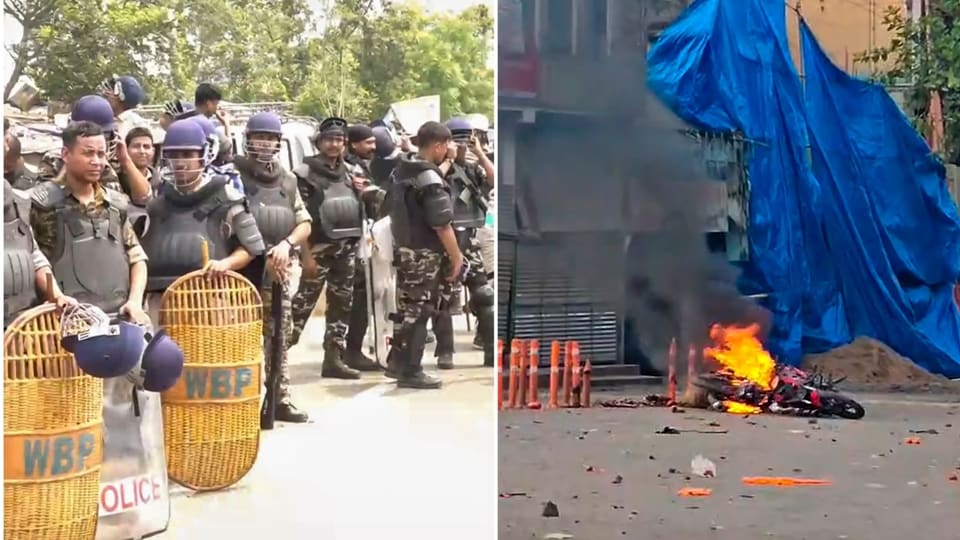
The unrest, which began earlier in the week, intensified on Friday and Saturday, with reports of arson, mob violence, and police firing in several areas.
Violence in Bengal over Waqt act: Key developments
- Three people were killed on Friday night in Murshidabad in the aftermath of mob violence against the Waqf (Amendment) Act in the district, West Bengal Police said. Victims include Haragobindo Das (65) and his son Chandan Das (40), who were allegedly dragged from their home and killed in Samserganj, and Ezaz Ahmed (25), who succumbed to bullet injuries in Suti.
2. Protests turned violent in Suti, Samserganj, and Dhuliyan, with mobs setting vehicles on fire, attacking homes, and clashing with police. Over 138 people have been arrested so far.
3. Videos of a mob attacking the block development office in Jalangi and ransacked office of a railway gateman in Azimganj surfaced on social media. Rioters could be seen in video clips looting an outlet of a retail chain. Police had reportedly resorted to lathi-charge and tear gas shells after vehicles were torched, shops were looted and policemen were attacked. The National Highway was blocked.
4. The Calcutta High Court ordered deployment of central forces not just in Murshidabad but in any other district where similar violence is reported, criticizing the state’s delayed response.
5. The High Court called the situation “grave and volatile” and emphasized that constitutional courts cannot remain passive when citizens’ safety is at risk. The state government has been ordered to submit detailed reports to the court by April 17.
6. West Bengal Governor CV Ananda Bose backed the court's intervention, calling it timely and necessary to restore peace and order.
7. The BJP accused the ruling Trinamool Congress of encouraging lawlessness for vote-bank politics. TMC hit back, alleging the Opposition was politicising the issue and exploiting religious sentiments.
8. The Union Home Ministry deployed additional BSF companies and held high-level discussions with the state administration. BSF personnel have been tasked with assisting local authorities in restoring calm.
9. BJP leader Suvendu Adhikari petitioned for an NIA investigation into the Murshidabad violence, alleging that a particular community was being targeted.
Also read: ‘Hindus not safe in Bengal', alleges BJP after 3 killed in Murshidabad
10. A protest rally in Kailashahar, Tripura also turned violent on Saturday, with clashes between demonstrators and police. Multiple injuries were reported, including among journalists.
The Waqf (Amendment) Act, 2025 - which aims to reform the management of Islamic charitable endowments - has become a flashpoint, triggering violent unrest in areas with significant Muslim populations. Authorities are urging calm while promising stern action against those responsible for the disturbances.


