
 E-Paper



Nagaland civic polls, held up for over a decade over women’s quota, on May 16
The 33% reservation of seats for women in civic bodies has been a contentious issue in Nagaland and the urban local body (ULB) elections have not been conducted for 13 years in the northeastern state

 Prefer HTon Google


The Nagaland state election commission on Thursday notified the long-pending civic body elections that had been held up due to opposition to 33% reservation for women. The poll watchdog’s order comes ahead of the Supreme Court’s March 14 deadline. State election commissioner T Mhabemo Yanthan said the election will be held on May 16 with 33% women’s quota.
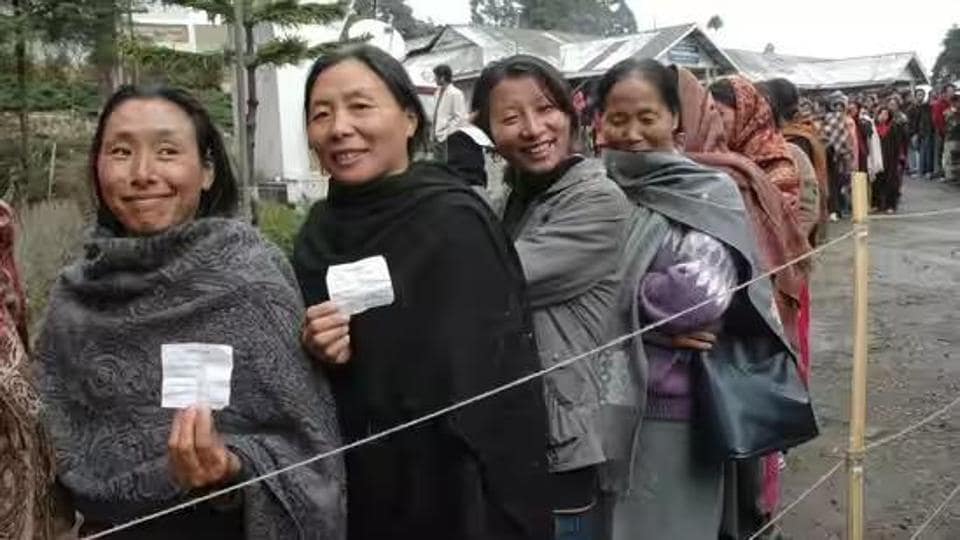
The 33% reservation of seats for women in civic bodies has been a contentious issue in the northeastern state and the urban local body (ULB) elections have not been conducted for 13 years.
The issue became controversial with various tribal organisations opposed the move on the assertion that Article 371(A) of the Constitution of India, which grants special provisions to Nagaland, protects the state over the mandatory 74th Amendment (Clause IV), which deals with reservation of seats in order to provide for adequate representation of SC/ST and of women in the municipal bodies.
The state enacted its Municipal Act in 2001, under which the first elections were conducted. The Act was later amended in September 2006 to insert the 33% of reservation of seats for women in accordance with the requirements of the 74th Amendment Act.
Contentions cropped up when the state, with Article 371A safeguarding its cultural, traditional and religious practices, and land and its resources, was exempted from the 73rd Amendment vis-à-vis the Panchayati Raj institutions, but when the Parliament passed the 74th Amendment for setting up of municipalities in the same year, Nagaland was not exempted as its town administrations were not part of customary practices.
However, the general elections to municipal towns and councils, which were notified in March 2012, could not be held on account of objections from tribal bodies and subsequently in September 2012, the state assembly passed a resolution to exempt Nagaland from Article 243T of the Constitution relating to women reservation.
Another resolution was passed by the state assembly in November 2016 revoking the earlier resolution of September 2012 and general elections with 33% women reservation to constitute the civic bodies were notified in December 2016.
Many continued to oppose the move, largely suspected to be on political grounds, and violence broke out in the state’s commercial city Dimapur and the capital Kohima in January and early February 2017, which claimed two lives. This led the state government to declare the process to conduct election null and void in February 2017.
The state election commissioner said the model code of conduct for the May 16 civic body polls will come into force with immediate effect, filing of nominations will take place from April 3-10, scrutiny of nomination papers will be done on April 12 and 13 while the last date of withdrawal of candidature is set on April 24. The counting and declaration of results will be done on May 19.
The election notification came days after the state got its first women legislators in 60 years in Salhoutonou Kruse, 56, and Hekani Jakhalu, 47. Kruse became the first woman minister in the state after she was inducted into chief minister Neiphiu Rio’s cabinet on Wednesday.
Nagaland has more women voters than men, and the 2011 census said women constitute 55.75% of the state’s population. But the state has had no woman MLA with Rano M Shaiza having been the only MP (Lok Sabha) from 1977-1980.
“We are overwhelmed to learn that the ULB elections are going to be conducted finally with 33% women reservation. It has been a long struggle for us,” said Abeiu Meru, president of the Naga Mothers Association (NMA) which had been at the forefront over the issue of women representation in the civic bodies.
“The NMA is grateful to the state government and the men-folk as well for acknowledging the long-felt need of the presence of women in decision making bodies. We hope there will be no more objections on the matter and the right persons will be elected. We are really looking forward to the participation of our women in the upcoming ULB elections. I hope the election will be conducted peacefully,” she added.
“This is very encouraging. It should be welcomed and supported by everyone,” said K Temjen Jamir, editor of Tir Yimyim, a vernacular daily newspaper. Referring to the recent election of two women MLAs in the state for the first time, Jamir maintained it is time to have women representation in the state’s civic bodies as well.


