E-Paper



Women’s reservation in politics will lead to corruption: Nagaland tribal leaders
Women have no role to play in Nagaland politics, prominent leaders of local tribal outfits insisted on Saturday in the aftermath of violent protests against holding local body polls with 33% reservation for women.

 Prefer HTon Google


Women have no role to play in Nagaland politics, prominent leaders of local tribal outfits insisted on Saturday in the aftermath of violent protests against holding local body polls with 33% reservation for women.
“Reservation for women will encourage instability and corruption in our society,” said Vekhosayi Nyekha, co-convener of Joint Coordination Committee (JCC), the umbrella body of tribal organisation which had been spearheading the agitation against women’s reservation in elections.
He argued that since the seats reserved will not be permanent, it will lure elected women representatives to indulge in corruption, which in turn will lead to instability.
“Reservation for women in elected bodies will be detrimental to our society as it is against our traditional laws,” said Peter Rutsa, president of another tribal outfit, the Angami Youth Organisation (AYO).
A Christian-majority state, tribal bodies play a very important role in Naga society where many traditional and customary rules are still followed.
It was opposition from the tribal bodies which forced chief minister TR Zeliang’s government to sign a deal with JCC on January 30 to postpone urban local body polls scheduled to be held on February 1 by two months.
But a Gauhati high court order on January 31, asking the Naga Peoples’ Front-led government to go ahead with the polls made the state government hold elections in 12 of the 32 urban local bodies as scheduled.
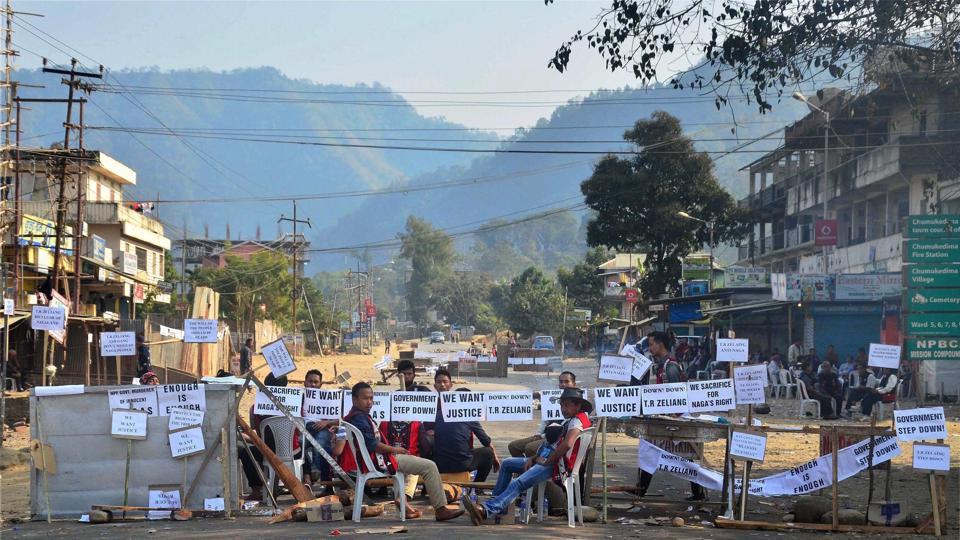
Meanwhile, tribal outfits took to the streets and two youths were killed and several others injured in police firing on January 31 in the state’s commercial hub of Dimapur when they tried to enter Zeliang’s private residence.
Two days later, violence erupted in the state capital Kohima with unruly mobs burning down 21 government buildings and 11 vehicles.
Women have never been active in Naga political sphere. The state has never elected a woman MLA since it gained statehood in 1963. The lone woman MP from the state was late Rano M Shaiza, who got elected in 1977.
Threats of excommunication and social boycott if they took part in polls with reservation for women had forced 140 candidates to withdraw and no one had filed nominations in 10 municipal bodies.
The violence has now forced the government to declare elections held in the 12 local bodies null and void.
“But we will continue our protests till the CM and his entire cabinet steps down and the police officers responsible for the Dimapur firing incident are suspended,” said tribal leader KT Vilie.
No ‘bandh’ was imposed in Dimapur on Saturday, but there were restrictions on movement of government vehicles in Kohima. From Monday, tribal outfits are planning a total shutdown of government offices across the state.
Read | Reserving seats for women is a patronising, sexist move by Air India