E-Paper



New in the Northeast | Voting and violence, funds and festivities
While Manipur went to vote, some voters took to violence. This, along with political rhetoric in Assam and tensions across the state due to the Bihu festivities. This week in NE:


High voter turnout, and violence, in Manipur
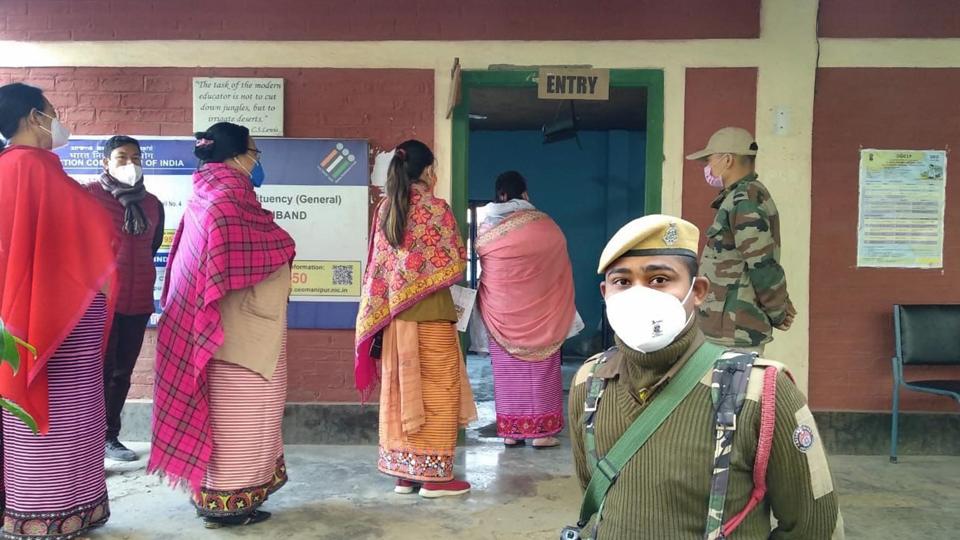
Voting for the keenly contested Manipur assembly polls ended on Saturday with the conclusion of polling for 22 seats in the second and final phase. The state’s voters have given their verdict, which will be known on Thursday, when counting takes place.
Unlike most previous electoral contests in Manipur, which used to be two-cornered between the ruling party and main party in Opposition, this election was a bit different, with at least four main players in fray: The ruling Bharatiya Janata Party (BJP), the Opposition Congress, the National Peoples’ Party, and the potential dark horse, Janata Dal (United).
As is usual in most Northeastern states, both phases of polling in Manipur witnessed high voter turnouts. The first phase held on February 28 recorded 85.45% polling and the second one witnessed 84.20%. The overall polling for both phases was 84.82%.
Although compared to several states in other parts of the country, this was a good polling percentage, but was considerably less than what Manipur witnessed in 2017. Five years ago, the state recorded 90.38% polling. This time, the figure was about 5% less.
There could be several reasons for the drop in polling figures. But one immediate possibility could be the number of violent incidents witnessed in the state ahead of polling, on the days when polling was held along with incidents recorded between both phases of polling.
Incidents of sporadic violence, damage to electronic voting machines (EVMs) and deaths of a security personnel in “accidental firing” were reported during polling for 38 of the total 60 seats in the first phase. Incidents of damage to EVMs were reported in seven polling stations in five seats.
One person was injured in a clash between the BJP and Kuki People's Alliance workers at a polling booth in Singhat constituency in Churachandpur district. Alleged Congress workers vandalised a BJP polling booth in the Kakwa area in Langthabal constituency in Imphal West district, while a vehicle of an NPP candidate was damaged by supporters of a rival group in Keirao assembly seat.
In the second phase, one person was killed and another injured when security personnel opened fire at a group of people trying to snatch an EVM from a polling booth in Karong seat in Senapati district. In another incident that took place on Friday night hours, prior to the beginning of polling, a worker of a political party was killed in firing by workers from a rival party in Thoubal district. Election officials informed that there were twelve incidents of damage to EVMs by miscreants at six polling stations in four seats during the second phase.
‘Vote for a cow, not a bull’
While the focus was on the assembly polls in Manipur, another election was also underway in Assam’s Majuli seat, which had fallen vacant after former chief minister Sarbananda Sonowal, who represented the seat twice, was elevated as a Union minister last year and inducted into the Narendra Modi Cabinet in New Delhi.
The ruling BJP in Assam chose Bhuban Gam, a businessman from the district, as its candidate while Congress, which had decided earlier not to field any candidate from the seat decided on supporting Chittaranjan Basumatary, a candidate from Assam Jatiya Parishad.
Since the seat was held by the state’s former chief minister, winning Majuli is an issue of prestige for the BJP. The party devoted a lot of time and energy to the island constituency and chief minister Himanta Biswa Sarma (Sonowal’s successor) attended nearly a dozen poll meetings in the last two days of campaigning.
And it was Sarma’s election speeches in which he compared the businessman-turned-politician Gam to a cow that became the focus of attention prior to polling in the seat on March 7.
“You all are aware voters. Tell me what is more profitable, a cow which gives 16 litres of milk daily or a bull which doesn’t give any milk? Vote for Gam as he will be productive like a cow and work for Majuli’s development in the coming years. On the other hand, the opposition candidate is like a bull. Will you get any milk from a bull?” Sarma said in election rallies.
This comment immediately gave fodder to the Opposition to target Sarma and urge voters in Majuli to cast their ballot for Basumatary.
“The CM has compared BJP’s candidate to a milk-yielding cow. That is his statement, not ours. Now voters in Majuli have to decide whether they want a cow as their representative or a human being,” commented Jagadish Bhuyan, general secretary of Assam Jatiya Parishad.
The debate over the duration of Bohag Bihu festivities
Assam chief minister Himanta Biswa Sarma was in the news for another reason last week. That was on the issue of the duration of Bohag Bihu festivities in the state. Celebrated in the middle of April to mark the start of Assamese New Year, Bohag Bihu is the most important festival in Assam observed by all communities of the state.
The festivities start with giving a bath to cattle and praying for their good health on the first day and continue for six days. The traditional Bihu dance, which used to be performed in fields earlier, and now on stage, and other cultural programmes mark the seven days and the rest of Bohag month.
Last month, in a bid to stop the state’s nearly 1,900 Bihu committees from collecting donations (sometimes forcibly) from people and businesses to organise the cultural events, the state government announced a sum of ₹1.5 lakh each to these committees provided they hold their events on the first seven days of the festival itself.
While the decision to offer monetary relief to the Bihu organisers was welcomed by many, the condition of holding the events within the first week of Bohag didn’t do down well with some Bihu committees, singers and cultural troupes who had not been able to perform Bihu events in the past two years due to Covid-19.
“Who are you to tell us for how many days do we need to celebrate Bihu? If the public wants to celebrate it for two months, they will. Or if they want to observe it for a day, it is their wish as well. There should be no restrictions or conditions on that,” popular singer-composer Zubeen Garg targeted the state government on this without naming Assam chief minister who made the announcement last month.
“It is the duty of ministers and legislators to work for the welfare of the people and the all-round development of the state. They don’t have to worry about how long Bihu festivities should continue. I am not taking for myself, but for those artists who have not been able to perform the past two years,” the youth icon said at an event recently.
Taken aback by the unexpected turn of events, Sarma clarified on Monday that his comments on the issue had been twisted and taken out of context.
“There is no point making baseless allegations about something which I have not said. I had said the state government would give ₹1.5 lakh to each Bihu committee that organises cultural events on the first week of Bohag. If someone wants to celebrate Bihu for six months or one year, I don’t have any objection. I would be content if people are happily celebrating Bihu. But they should refrain from collecting donations forcibly to hold these events,” he said.
 ABOUT THE AUTHORUtpal Parashar
A seasoned senior journalist, I have nearly three decades of experience across print, digital, and online platforms, covering political transitions, insurgencies, environmental issues, and development stories in India and Nepal. I am skilled in breaking news, leading editorial teams and launch of newspaper editions. I am adept at leveraging digital trends and social media to expand global reach, with a strong ethical foundation and a reputation for impactful journalism. An alumnus of Asian College of Journalism, I joined Hindustan Times in New Delhi as a trainee reporter in May 1997. Over the years, I have been posted in Dehradun, Kathmandu (Nepal) and Guwahati. Currently, as Senior Assistant Editor at Hindustan Times, I lead a team reporting on India’s northeastern states. My work involves in-depth analysis, and engaging multimedia storytelling across formats, including text, photo, video, and interactive content. I am skilled in producing timely, shareable content, leveraging digital platforms and social media to engage global audiences. Throughout my career with the Hindustan Times, I have led diverse editorial teams, designed capacity-building activities, and supported reporters in developing strong story ideas, ethical reporting practices, digital skills, and fact-checking techniques. As Senior Assistant Editor for Northeast India, I have been responsible for guiding correspondents through complex political, humanitarian, and community-level stories using multimedia formats. Earlier, as Foreign Correspondent in Nepal, I produced extensive reporting during Nepal’s democratic transition and the 2015 earthquake and its aftermath.Read More