E-Paper



New India-Bangladesh bridge boosts access to Chattogram port
Prime Minister Narendra Modi inaugurated the 1.9-km Maitri Setu over Feni river, built at a cost of ₹133 crore, during a video conference. His Bangladesh counterpart Sheikh Hasina said in a video message the bridge will be a “trading lifeline” for northeastern India

 Prefer HTon Google


A new bridge between India and Bangladesh opened on Tuesday will boost trade and connectivity and make Agartala, the capital of the northeastern state of Tripura, the Indian city closest to an international sea port.
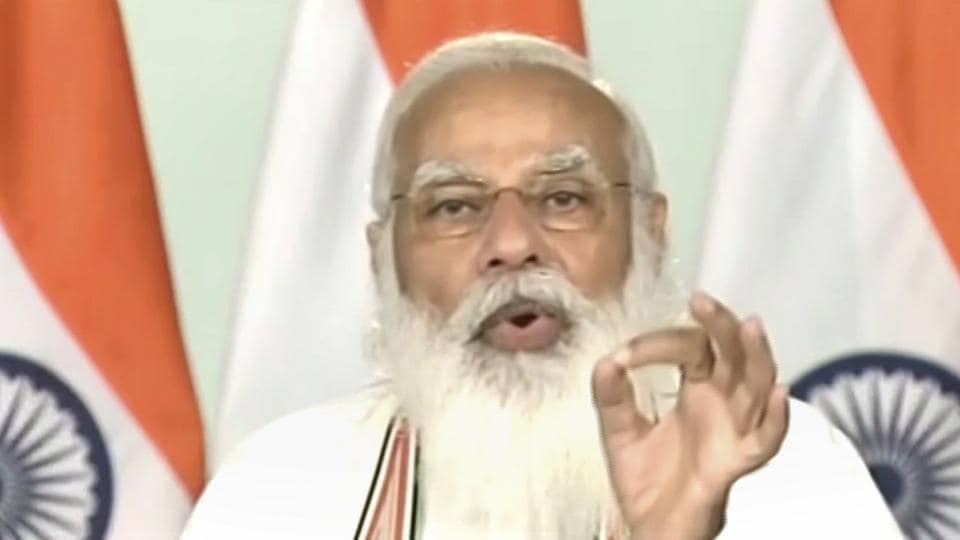
Prime Minister Narendra Modi inaugurated the 1.9-km bridge over Feni river, built at a cost of ₹133 crore, during a video conference. His Bangladesh counterpart Sheikh Hasina said in a video message the bridge will be a “trading lifeline” for northeastern India as it cuts the distance between Agartala and Chattogram port to less than 100 km.
The Maitri Setu or “friendship bridge” was inaugurated a little more than a fortnight before Modi’s visit to Dhaka to join celebrations marking the golden jubilee of Bangladesh’s independence and 50 years of diplomatic ties. It is the latest in a slew of connectivity initiatives aimed at linking India’s landlocked northeastern states to new markets.
Modi said connectivity is strengthening friendship between the two sides and the region is being developed as a trade corridor between northeast India and Bangladesh. Rail and water connectivity projects completed in recent years will be strengthened by the bridge, he said.
“Due to this bridge over Feni river, Agartala will become the Indian city that is nearest to an international sea port,” Modi said.
Also Read | PM Modi to travel to Bangladesh on March 26, his first visit abroad in 15 months
Noting that the bridge’s foundation stone was laid during his visit to Dhaka in June 2015, Modi thanked Hasina and her government for helping to complete the project. Besides Tripura, the bridge will improve connectivity for south Assam, Mizoram and Manipur and boost economic opportunities within Bangladesh, he added.
The construction of a ₹232-crore integrated check post (ICP) at Sabroom, which will be a logistics hub with parking lot, warehousing and container trans-shipment facilities, will further boost trade, while the widening of National Highways 8 and 208 will facilitate the movement of local produce to new markets across the border, Modi said.
In her video message, Hasina said: “The opening of Feni bridge is testimony to the Bangladesh government’s continued commitment to support our neighbour India in strengthening connectivity in the region, particularly for the northeast of India.”
She added, “This bridge will be a trading lifeline for the northeast of India. As you all know, Bangladesh has already allowed the use of Chattogram and Mongla ports for the movement of goods to and from India.”
Earlier, the nearest sea port for Agartala was Kolkata, located at a distance of more than 1,600 km, whereas the new bridge will reduce the distance between Agartala and Chattogram to less than 100 km, Hasina pointed out.
At the same time, Hasina outlined her expectations for Indian support to help Bangladesh trade with other regional countries.
“We are creating a new era in South Asia through providing connectivity to India. We are in a region which has remained conservative in opening up and where inter-regional trade is far below potential,” she said.
“I believe political boundaries should not become physical barriers to trade. We expect the framework that we are inaugurating today will also help Bangladesh to trade more easily not only with India but also with Nepal and Bhutan,” she added.
Bangladesh wants to maximise the advantages accruing from its location to become a connectivity hub between South and Southeast Asia, and the cross-border transport system being developed with India will enable her country to play an important role in regional trade, Hasina said.
She also highlighted India’s role in Bangladesh’s war of independence in 1971. Switching to Bengali, she said: “We haven’t forgotten how, in 1971, you sheltered our people and supported us and cooperated with us so that we became victorious in our war of independence.”