
 E-Paper



‘You sell dreams, we deliver’: FM Sitharaman counters Opposition
Union Finance Minister Nirmala Sitharaman highlighted the Modi government's economic achievements and criticized the previous UPA government in a trilingual speech. She emphasized the government's approach of empowering all and appeasing none and its success in delivering on promises and implementing welfare schemes. She also mentioned India's economic growth and resilience compared to other countries. Sitharaman responded to criticism in Tamil and defended the installation of 'Singol' in the new Parliament house as a restoration of Tamil pride. She also mentioned an incident involving Jayalalitha's saree being pulled in the Tamil Nadu Assembly.


In a trilingual speech, Union finance minister Nirmala Sitharaman on Thursday spoke of the Narendra Modi government’s track record in managing the economy and ability to deliver, even as she responded strongly (and politically) to points previously raised by speakers in the debate on the No Confidence Motion.
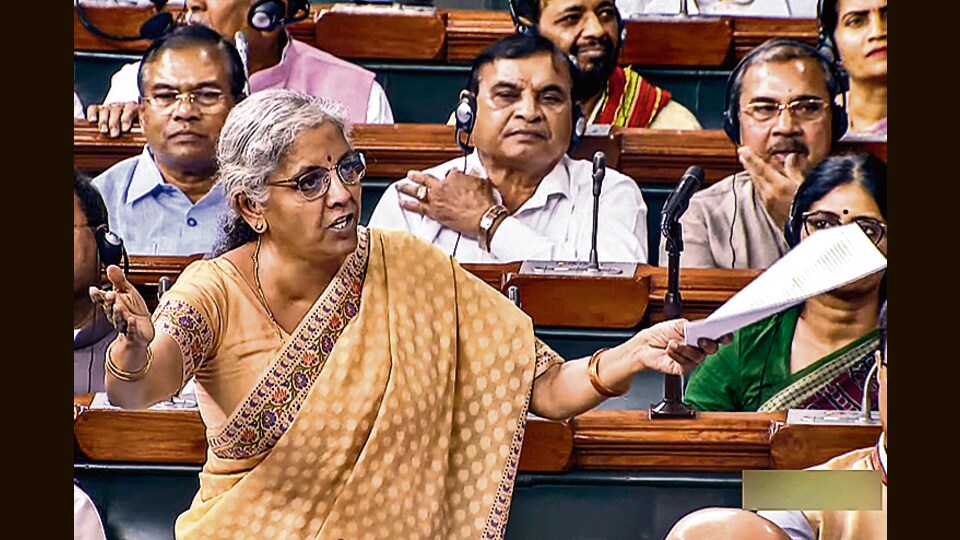
She emphasised that her government’s approach -- “empowering all and appeasing none” is how she described it -- and its economic policies have not just acted as a shield against the global economic devastations cause by the Covid-19 pandemic, but also made India the fastest growing major economy in the world. In contrast, she painted the period between 2004 and 2014, when the Congress-led United Progressive Alliance governed India as the country’s “lost decade”.
Sitharaman accused the UPA of making false promises of eradicating poverty, providing houses and toilets to the poor, ensuring universal access to drinking water, healthcare facilities, electricity connections, rural roads, banking facilities and ensuring easy institutional credit facilities to farmers and small enterprises. Everything was a promise, she explained -- something that could happen in the future during the NDA regime.
The FM said the UPA regime was happy to launch schemes, but not keen on their implementations. During UPA regime, it was “banega, milega” and in the Modi government, it is “ban gaye, mil gaye”, she said, enumerating welfare schemes such as PM Aawas Yojana, Jal Jeevan Mission, Jan-Dhan accounts etc.
Citing example of “Jan aushadhi kendras” (medical stores for people), she said that during the UPA regime “people kept on waiting that they will see opening of stores to buy medicines cheaper,’magar nahi hua unke karya kaal mein’ [but it did not happen in their tenure]”. PM Modi ensured it to poor by taking direct interest – and opened 9,484 such stores across the country in nine years of NDA rule whereas during the UPA regime (from 2008-14) only 80 of them were launched.
The Modi-led National Democratic Alliance government has, in nine years., delivered on the promises, she said.
“Earlier, for about six decades, we used to hear [the slogan] of ‘garibi hatao’ [eradicate poverty], but it was actually never eradicated. Now, we have been able to reduce poverty ,” she said. According to a NITI Aayog report, released on July 17, 135 million people came out of poverty in India in the last five years as the country registered a decline of 9.89 percentage points in the number of India’s multidimensionally poor from 24.85% in 2015-16 to 14.96% in 2019-2021 with the fastest decline being seen in rural areas.
Criticising the UPA government’s approach of assurances to the people as a “post-dated cheque”, she said, “ Modi ji has transformed the entire approach…You sell dreams to the people and we realise their dreams“.
Switching between Hindi, English, and Tamil (the last, especially to respond to some of the comments made during the debate by members of the Dravida Munnetra Kazhagam), Sitharaman said that during the UPA regime, Morgan Stanley included India “among the five most fragile economies… The same Morgan Stanley, today, upgraded Bharat… .” Morgan Stanley, last week, upgraded India to ‘overweight’ on its resilient macro indicators, saying that India’s ability to leverage multipolar world dynamics is a significant advantage. It, however, downgraded China to ‘equal weight’.
This transition happened in just nine years because of “policies of our government despite Covid, and today we are the fastest growing [major] economy”. Our real GDP growth was 7.2% in 2022-23 and it is projected to grow at 6.5% in 2023-24. These are projections, given by not just one agency but several global agencies, and our own RBI projection is also saying this… So, India is in a rare position… of being optimistic and positive for its future growth,” Sitharaman said.
She cited the challenges facing the global economy and also many developed countries -- high inflation and also slow growth -- and spoke of India’s resilience. For example, in 2022, the global economy saw growth of a little over 3%, and the World Bank is now forecasting that in 2023 this will be 2.1%, she said.
Some developed countries, such as the UK, are facing very challenging times, and the Bank of England has raised interest rates 14 consecutive times. The European Central Bank (ECB) has raised interest rates nine consecutive times, and today it is at a 20-year high. The IMF expects the German economy to contract by 0.3% in 2023, she added.
She also cited examples of the US and China, the top two global economies in order to show the nature and intensity of global headwinds, even as India is still standing tall.
India is the only major economy which is having high growth and low inflation. She said the government has taken several measures such as encouraging imports of food grains, particularly pulses and vegetables such as tomatoes and onions to check food inflation, which is mostly seasonal and because of supply disruptions due to incessant rains.
RBI governor Shaktikanta Das on Thursday said there was a pick-up in headline inflation to 4.8% in June due to an upturn in food inflation. Although it is within the RBI’s tolerance band of 4-6%, the governor pointed at both fiscal and monetary measures to cool down the prices. “The month of July has witnessed accentuation of food inflation, primarily on account of vegetables. The spike in tomato prices and further increase in prices of cereals and pulses have contributed to this,” he said.
Sitharaman reserved the last part of her speech to respond, in Tamil, to criticism of the Modi government, particularly raised by opposition members of the state.
Emphasising on PM Modi’s maxim of “sabka saath” in the country’s development, and citing major infrastructure projects of the southern region, Sitharaman said the government has extended ₹25,245 crore to five southern states as 50-year, interest-free loans for capital expenditure. On one particular question raised on the installation of ‘Singol’ by PM Modi in the new Parliament house, she said using Tamil that it was done with proper historical knowledge, which was aimed at restoring the Tamil pride. She said the Singol was given to the first Prime Minister of India after Independence, and it was then used as a “walking stick by Prime Minister Nehru” besides being kept in a private house. “It was forgotten in history… and kept in a museum saying that it was some kind of walking stick,” she said questioning wasn’t it insult to the Tamil. “The Hon’able Prime Minister [Modi] restored it to its rightful place [the new Parliament house],” she added.
Replying to DMK MP Kanimozhi on the Manipur issue, FM said that the violence in the northeastern states pained all, but she also wanted to remind her about an incident that happened on March 25, 1989 in the Tamil Nadu Assembly when the then Leader of Opposition Jayalalitha’s saree was pulled.


