
 E-Paper



North India shivers under 'cold day' conditions; no relief expected | 10 points
Delhi and other parts of North India to experience cold day to severe cold day conditions on Friday, warns IMD.
Updated on: Jan 5, 2024, 10:06:06 IST


Share via


Copy link

Delhi is expected to face cold day to severe cold day conditions on Friday, indicating a significant drop in temperatures. Punjab, Haryana, Chandigarh, and isolated places in Uttar Pradesh will also experience these chilly conditions, according to Indian Meteorological Department (IMD). Isolated places in Punjab and Rajasthan are likely to be gripped by cold wave conditions, adding to the winter chill.
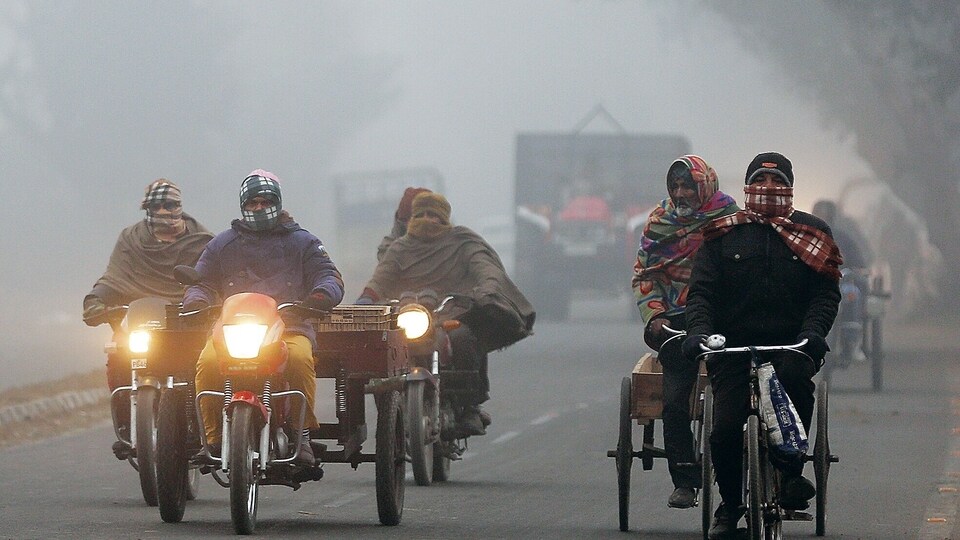
A cold day is declared if the maximum temperature dips between 4.5-6.4 degrees below the normal for the season. A severe cold day is declared if temperatures are 6.5 degrees below normal for the season.
Here are the top weather updates:
- Large tracts of northern India, including Punjab, Haryana, Chandigarh, Uttar Pradesh, and West Rajasthan, is likely to witness dense to very dense fog. Isolated areas in East Rajasthan will also be affected, according to IMD.
- Uttarakhand is likely to experience dense fog at a few places, while Jammu division of Jammu and Kashmir and Himachal Pradesh will witness it at isolated locations.
- The reduced visibility poses potential challenges for commuters and travelers.
- On Thursday, mercury touched a maximum of 12.5 degrees Celsius -- 6.8 degrees below normal -- at the Safdarjung observatory in the national capital.
- Hissar in Haryana recorded 12 degrees Celsius, which was 6.8 degrees below normal for the season, while Patiala in Punjab clocked 10.5 degrees Celsius, a departure of 8.1 degrees from normal.
- Kota in Rajasthan shivered at 14.1 degrees Celsius, which was 8 notches below normal for the season, Bhopal in Madhya Pradesh recorded a maximum of 16.7 degrees Celsius which was 7.3 degrees below normal.
- Chandigarh registered a maximum temperature of 17.1°C while neighbouring areas like Ambala, Hisar, and Rohtak noted temperatures at 15.8°C, 12.0°C, and 13.3°C, respectively.
- Punjab's Ludhiana, Patiala, and Amritsar witnessed maximum temperatures at 11.0°C, 10.5°C, and 11.4°C, respectively.
- In Uttar Pradesh, cities like Meerut, Lucknow, Shahjahanpur, Fursatganj, Bareilly, Jhansi, and Aligarh observed maximum temperatures ranging from 14.6°C to 17.2°C.
- The minimum and maximum temperatures are likely to rise by 2-4 degrees Sunday onwards under the influence of warm and moist southwesterly winds, the weather office said.


