E-Paper



Not the era of war, Modi tells Putin amid Ukraine invasion
The two leaders met on the margins of the SCO summit in Uzbekistan's Samarkand. This was also the first meeting between them since their summit in New Delhi last December and since the Ukraine war began this February.

 Prefer HTon Google


Prime Minister Narendra Modi on Friday told President Vladimir Putin that “today’s era is not of war”, nudging him to end the Ukraine invasion and return to the path of peace and dialogue, and stressing that Putin would have to consider the problems of food and energy security being faced by developing countries in the wake of the conflict.
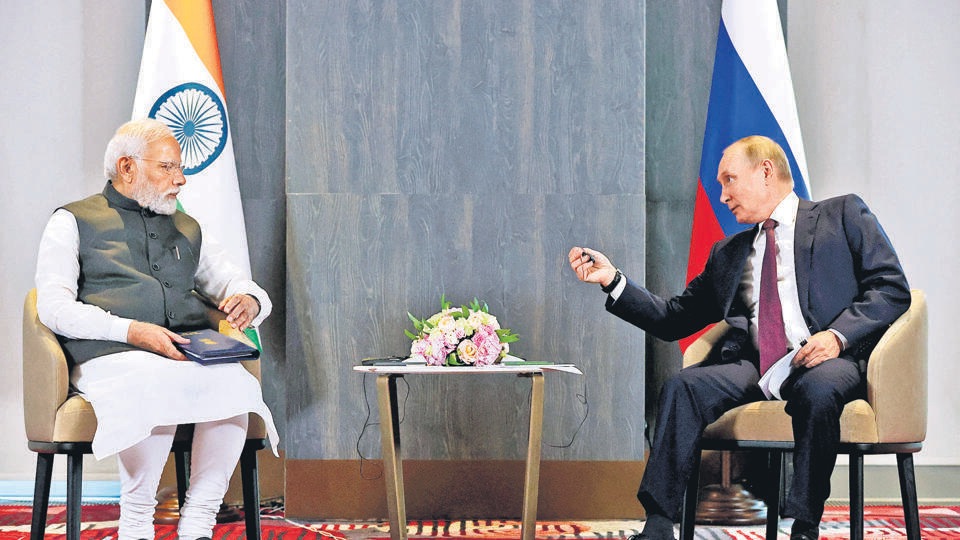
Modi made the call for an early cessation of hostilities at a bilateral meeting with Putin — the first between the two leaders since their summit in New Delhi last December and since the Ukraine war began this February — on the margins of the Shanghai Cooperation Organisation (SCO) in the historic city of Samarkand in Uzbekistan.
“I know today’s era is not [an era] of war. We discussed this issue with you on phone several times, that democracy, diplomacy and dialogue touch the entire world,” Modi said, speaking in Hindi, while delivering his televised opening remarks at the meeting with Putin.
He said he hoped to talk about “how we can move forward on the road of peace in the coming days”.
“Today the biggest worry before the world, especially developing countries, is food security, fuel security [and] fertilisers. We must find ways on these problems and you will also have to consider it,” he said.
Modi has, in past phone conversations with the leaders of Russia and Ukraine, even suggested direct talks between the two sides. But this was the first time he publicly called on Putin to end the fighting.
Putin, who spoke before Modi and referred to the Indian premier as a “dear friend”, said he knew about Modi’s position and “concerns” on the Ukraine conflict. “We want all of this to end as soon as possible. But... the leadership of Ukraine has... refused to engage in the negotiating process. They said that they want to achieve their objectives... on the battlefield militarily,” he said.
Addressing reporters later in the day, Putin said there were no plans to adjust his country’s military operations in Ukraine despite a counteroffensive. “The plan is not subject to adjustment. Our offensive operations in Donbas itself do not stop... We are not in a hurry,” Putin said. On Thursday, Putin held a one-on-one meeting with Chinese President Xi Jinping and thanked him for his government’s “balanced position” on the Ukraine war, while adding that he was ready to discuss unspecified China’s “concerns” about Ukraine.
India has consistently called for an end to the fighting in Ukraine and pushed for dialogue while refraining from publicly censuring Putin for the invasion launched in February. The Indian side has not voted against Russia at the UN but also repeatedly raised the impact of the Ukraine crisis on food and energy prices, especially for vulnerable countries.
Foreign secretary Vinay Kwatra told a news briefing that it was not a question of who takes the first step — Russia or Ukraine — in the current situation. The underlying intent and objective that India has always stood for is that hostilities should cease and the path to the resolution of the is through diplomacy and dialogue, he said.
Modi skipped an informal dinner and several ceremonial events for the SCO leaders on Thursday, flying into Samarkand well after most of the activities were over. During an extended session of the SCO Summit that included leaders of observer states and countries invited by Uzbekistan, the host of the summit, Modi raised the impact of the Covid-19 pandemic and the Ukraine crisis on global supply chains and the resultant “unprecedented energy and food crisis”. Though a recent withdrawal of Indian and Chinese troops at PP-15 on the Line of Actual Control had raised expectations of a meeting between Modi and President Jinping, there was no such encounter between them.
Following the summit, Modi held separate bilateral meetings with Putin, Turkish President Recep Tayyip Erdoğan, Iranian President Ebrahim Raisi and Uzbek President Shavkat Mirziyoyev. During the meeting with the Russian President, Modi emphasised his close ties with Putin and India’s strategic relationship with Russia, describing it as an “unbreakable friendship” that has lasted decades. He also spoke of his personal relationship with Putin going back to 2001, when he was the chief minister of Gujarat.
“Ties between India and Russia have grown manifold. We give importance to the relationship as we have been friends who have stayed together for many decades and the world knows what Russia’s relations with India have been and what India’s relationship with Russia have been. The world knows this is an unbreakable friendship,” he said. Modi thanked the Russian and Ukrainian leadership for their help in evacuating over 22,000 Indians, most of them students, from Ukraine. “I am confident that our bilateral talks will help in strengthening bilateral ties and in fulfilling the aspirations of the world,” he told Putin.
Putin conveyed his best wishes for Modi’s birthday on Saturday, and noted that Russia’s strategic and privileged partnership with India was developing very rapidly. The two sides are actively engaging at international platforms on all key global issues and it is important that “we constantly coordinate our positions”, he said.
“We have constructive relations and our trade is growing. In particular... the supplies of Russian fertilisers [to India] have grown more than eightfold... I am hopeful that this is going to be of huge help to the agricultural sector of India...,” he added.
Since the start of the Ukraine conflict, India has taken up Russia’s offer of discounted commodities, especially oil, despite pressure from the US and other Western nations not to accelerate the purchase of Russian energy. Indian refiners, which rarely bought Russian crude before the Ukraine crisis, increased imports to 757,000 barrels a day during April-August, compared to 20,000 bpd a year earlier.
Sameer Patil, senior fellow at the Observer Research Foundation (ORF), said: “Modi is using the position of being a leader who isn’t pro-West or anti-Russia to put forward India’s genuine concerns of being caught in the crossfire of the Ukraine crisis and, therefore, has conveyed his frank opinion. “The fact that since the start of the conflict, India has consistently stood up to Western pressure lends Modi the authority to be blunt. Putin may or may not alter his behaviour but he is now aware of the concerns of one of his closest partners.”