E-Paper



Testing agency NTA ordered to fix accountability, audit all exam processes
The development came a day after the agency cancelled the UGC-NET exams for three subjects.


A day after the National Testing Agency (NTA) announced a re-examination for the University Grants Commission National Eligibility Test (UGC-NET) in English, commerce and sociology following errors in the question papers flagged by a panel, the Union education ministry on Monday took action to “fix accountability” and directed the agency to conduct a “thorough audit” of all examination processes and submit a “report on corrective action” within 30 days, officials said.
The ministry spokesperson, responding to HT’s questions, said the committee’s detailed findings were “internal” adding that NTA had “began verification immediately on receiving the complaints” after examinations which were completed on June 30.
The spokesperson cited “several levels of checks and verification,” discussion with UGC and adherence to “due process” behind the delay in deciding on the re-examination.
Also Read | NTA to re-conduct UGC-NET for 3 subjects; 2nd exam cancellation this year after NEET leak
Ministry reviews NTA processes
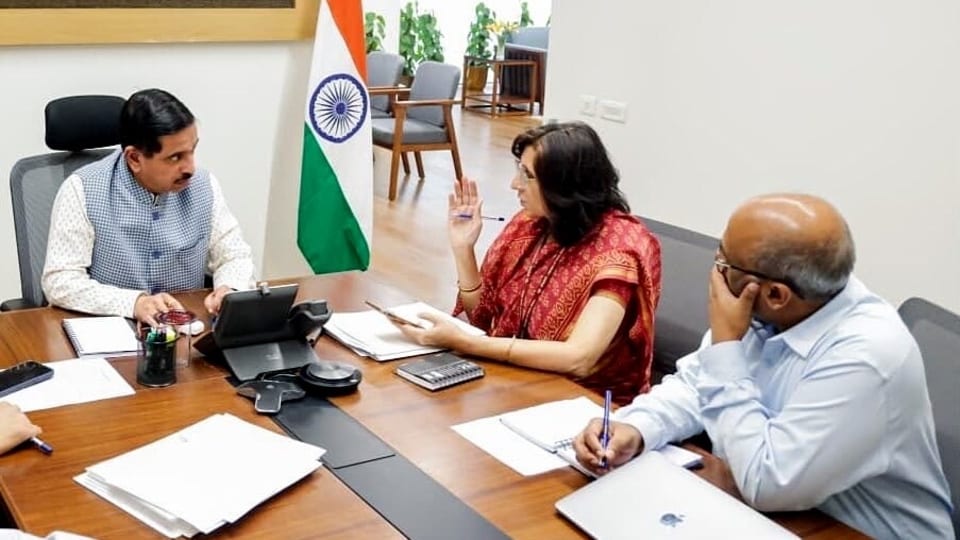
The developments came after Union education minister Pralhad Joshi held a meeting with higher education secretary Deepti Gaur Mukerjee, NTA director general Abhishek Singh and other senior officials to review steps taken by the agency following recent examination-related issues.
In a post on X, the ministry said officials apprised Joshi that more than 50 NTA staff have been removed, while 10 new professional leadership positions, including chief technology officer, chief finance officer, chief information security officer, test security and research and development/psychometrics roles, are being filled. Domain specialists from the private sector are also being brought in for cybersecurity, psychometrics, question-paper design and other specialised areas.
NTA ordered to overhaul confidential operations
Joshi directed strict compliance with established examination protocols and a “Complete overhaul of Confidential Operations (CONOPS) architecture including secluded rooms, air-gapped systems, device-deposit protocols” on a “war footing”.
CONOPS was introduced following the October 2024 recommendations of a high-level committee headed by former ISRO chief K Radhakrishnan. It refers to secure protocols for the preparation and delivery of question papers.
NTA’s question-paper preparation involves multiple stages, with separate experts handling question-writing, moderation, vetting and translation.
Subject panels comprising faculty members prepare a large question bank, from which moderators select questions for multiple sets. Vetters independently solve the sets and discrepancies are resolved before finalisation. Questions are translated into regional languages and back-translated into English to check accuracy.
Also Read | NTA paper-setting process: From question bank to sealed sets, how exam papers are prepared
Multiple sets are then generated through randomisation, printed, packed and kept in secure storage until the examination.
The process is conducted at NTA’s Delhi office, where subject experts work in isolation for about a week. They surrender mobile phones and other digital devices on entry, while security personnel monitor their movement and reference material is provided within the premises.
After finalisation, question-paper sets are printed, packed, transported and kept in secure storage under CONOPS protocols, with the final set selected on the morning of the examination.
Also Read | 'Rapid, rigorous investigations': NTA revamps top ranks, creates new roles to probe exam malpractices
Why did re-examination take more than a month?
On why complaints took more than a month after the examinations ended on June 30 to result in a decision on re-examination, the ministry spokesperson said NTA “began verification immediately on receiving the complaints”.
The papers were examined through “several levels of checks and verification,” and the matter was also examined with UGC before the decision of re-examination was taken.
The ministry said the findings of the committee constituted by NTA that examined the three papers would not be made public.
“The Committee's findings are internal,” it said, adding that NTA's focus was on conducting the examination on time, declaring results without delay and ensuring that Junior Research Fellowships (JRF) awards and PhD admissions were not affected.
The panel’s findings formed the basis for NTA’s decision to re-conduct the examinations after identifying factual, typographical and translation errors, as well as repeated questions from previous examinations.
Re-examination for over 157,000 candidates
On reimbursement to more than 157,000 affected candidates for additional travel and accommodation expenses for the September 9 and 10 re-examinations, it said NTA would, “as far as possible,” allot candidates centres in their preferred cities.
On safeguards against repeated questions and spelling, typographical and translation errors, the spokesperson said NTA had been instructed to introduce “remedial measures and adequate checks and balances” for forthcoming examinations. The ministry did not specify the measures, though.
NTA on Sunday said that a panel found factual, typographical and translation errors in the three papers, along with questions repeated from previous examinations.
For the three subjects, the number of candidates qualifying for assistant professorship will be 6% of those appearing in the original examination or re-examination, “whichever is higher”. The number already allocated for each subject “shall not be reduced under any circumstances.”
UGC-NET determines eligibility for JRF, assistant professor posts and PhD admissions in 87 subjects and is usually held twice a year in CBT mode.
NTA expands institutional capacity
NTA is also rebuilding its institutional capacity in line with the Radhakrishnan committee’s recommendations. Between May 15 and August 6, it invited applications for 22 posts covering cybersecurity, test-centre operations, and vigilance, investigation and forensics. It also floated a ₹7.5 crore tender on July 25 for round-the-clock security services at its headquarters, regional offices and other notified locations.
Rahul targets NTA
Congress leader Rahul Gandhi on Monday attacked the government and demanded that the National Testing Agency (NTA)’s leadership be held accountable.
He said that Dharmendra Pradhan’s resignation as Union education minister on July 25 after student protests against examination irregularities was not the last step but only the first.
“UGC-NET exams for sociology, English and commerce were held between 22 and 30 June. Nearly two months later, NTA has cancelled all three because it set faulty papers and repeated old questions. Thousands of candidates who prepared for years, filled forms, paid the fees, and travelled to distant centres must now do it all again in September. NTA makes the mistake, but the student serves the sentence.”
Deep Dive