E-Paper



Number Theory: Are there long-term changes happening in western disturbances?
One reason IMD scientists cited for low snowfall this winter was that strong western disturbances were not arriving over India.
Published on: Feb 12, 2024, 08:25:42 IST


Share via


Copy link

By all accounts, the ongoing winter is exceptional in India. This season, which begins officially in December, started feeling winter-like only towards the end of December. Snowfall and winter rain in India’s hilly states was so late that they experienced record number of active fires this January. India’s snow pack this winter is also the lowest in satellite records. Despite these signs of a warm winter, the northern and north-western plains experienced daytime temperatures well below normal all January because of fog higher up in the atmosphere. Since the immediate reason behind all these trends is the lack of strong western disturbances over India, it is worth understanding them in more detail. Here are four charts that do that.
Are there long-term changes happening in western disturbances?
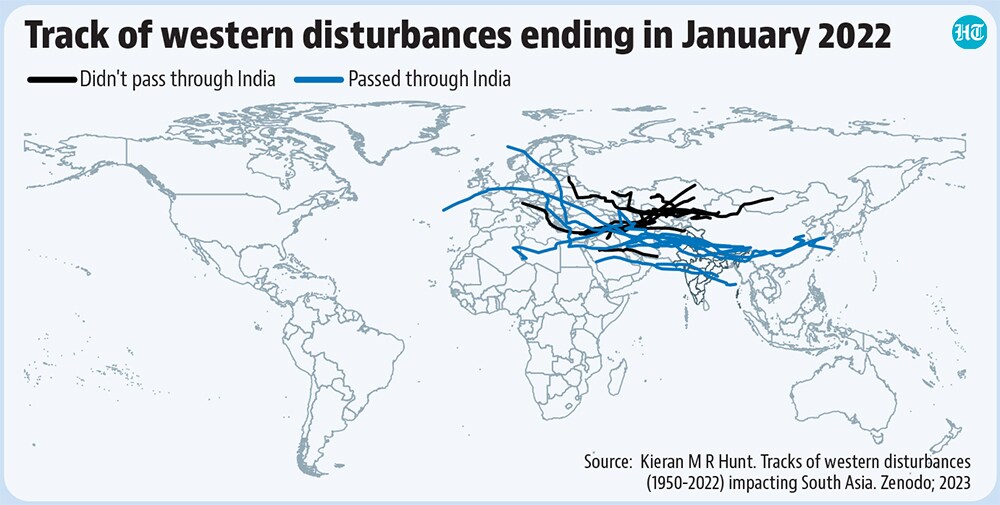
 What are western disturbances?As the name suggests, it is defined as a cyclonic storm that originates west of India and affects the country. The glossary of the India Meteorological Department (IMD) is more specific. It defines a western disturbance as “cyclonic circulation/trough in the mid and lower tropospheric levels or as a low-pressure area on the surface, which occur in middle latitude westerlies and originate over the Mediterranean Sea, Caspian Sea and Black Sea and move eastwards across north India”. In practice, however, a western disturbance need not originate exactly over those three seas or necessarily pass over India. A paper by Kieran M. R. Hunt and others published in Quarterly Journal of the Royal Meteorological Society in January 2018 (its data was released last year and is one of the first long-term comprehensive datasets on western disturbances matching their anecdotal frequency) shows this clearly. The accompanying map made by HT using Hunt’s dataset, for example, shows 21 western disturbances ending in January 2022. Of these 21, only 12 passed over India’s political boundaries. Some of those not passing through India either ended in Pakistan or kept north of India. Similarly, some originated further west of the Mediterranean region in the North Atlantic Ocean. To be sure, some of these differences are simply because there is no universally accepted definition of a western disturbance. For example, one reason IMD scientists cited for low snowfall this winter was that strong western disturbances were not arriving over India. That would not be the case if only a storm passing over India – as IMD’s glossary suggests – was classified as a western disturbance.
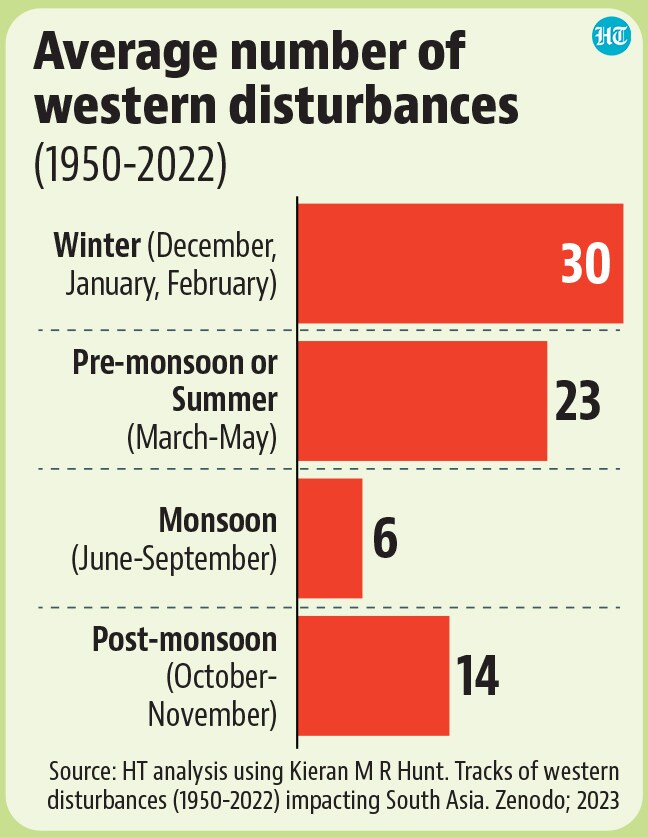
- When do western disturbances occur the most?This was the most significant finding of the paper by Hunt and others. While these storms are known to strike India most during the winter season, there was no long-term data that came close to the anecdotal frequency. HT filtered the western disturbances in Hunt’s 1950-2022 dataset that passed over India and classified them by season. This shows that on an average 72 such storms pass over India every year. Winter (the period of December to February) has the highest frequency of these storms (30 per year), followed by the March-May pre-monsoon/summer season (23 storms per year), post-monsoon season of October-November (14 per year), and the June-September monsoon season (six storms per year).
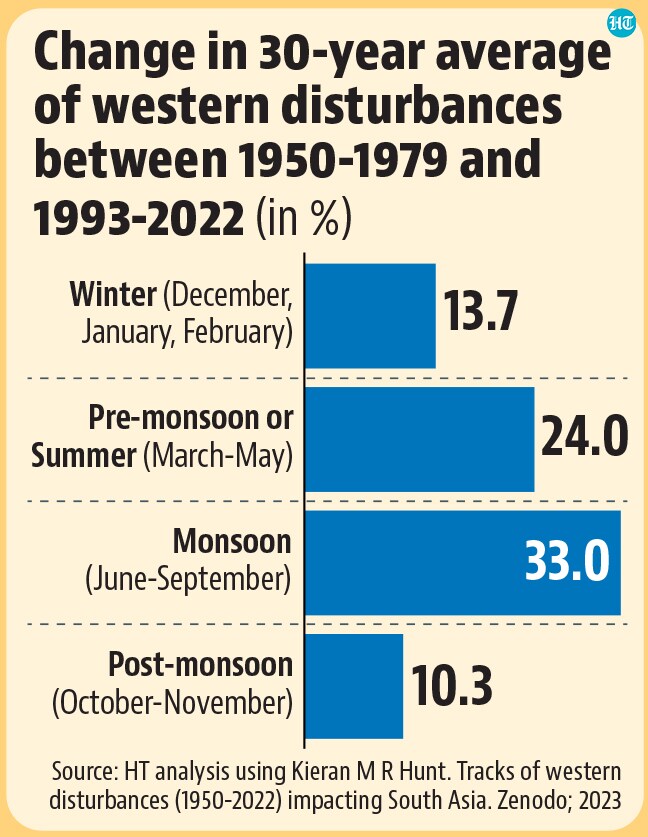
- How has their frequency changed over time?Depending on the region and season being studied or even the dataset used, western disturbances appear to have increased, decreased, or show no significant trend. To be sure, studies that have used weather reports to count them – they have generally focused on northwestern Himalayas or India’s northern states -- have generally reported a declining frequency. In Hunt’s dataset – it used features of the storm to count them and study their path – they show an increasing frequency over India. However, the growth in their frequency was much lesser in the winter season than in the monsoon or pre-monsoon seasons. Moreover, an increasing frequency of western disturbance may not mean more rain and snowfall if their strength decreases.
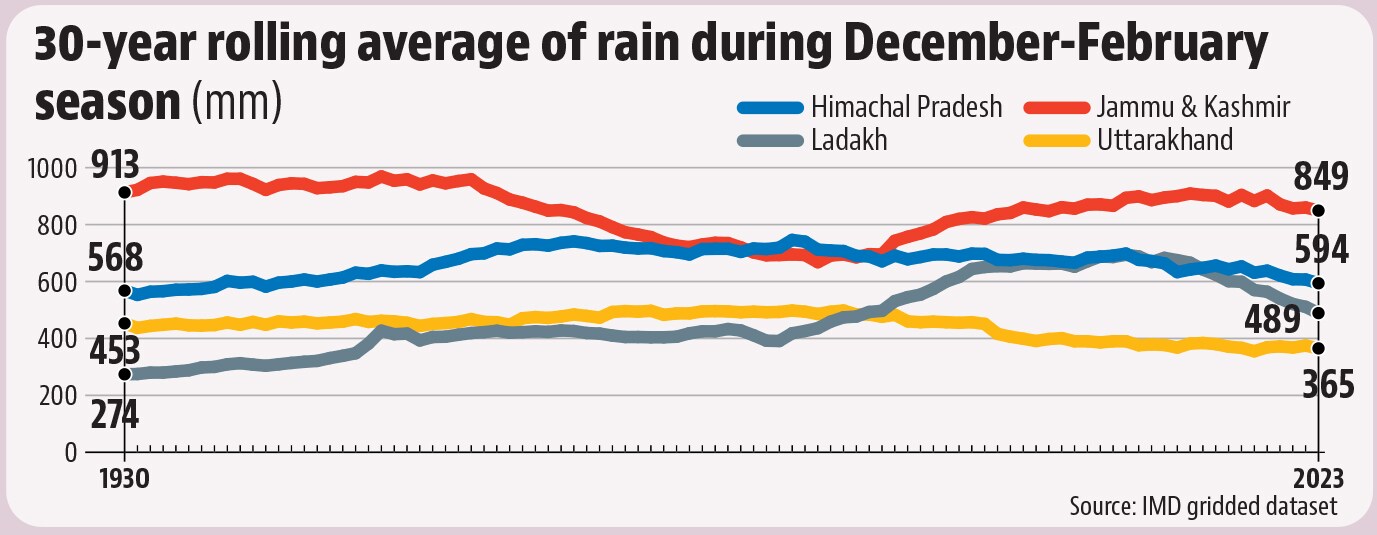
- Rainfall data shows the impact of changes in western disturbancesWhile there is no consensus on what is happening with western disturbances, it is easier to check the trends in their impact. The most important impact of western disturbances for India is rain in India’s northern states; and rain data for India is available from IMD since 1901. This shows that the four northern states and UTs – Jammu and Kashmir, Ladakh, Himachal Pradesh, and Uttarakhand – have experienced somewhat different trends in winter precipitation. Over Himachal Pradesh and Uttarakhand, for example, the 30-year rolling average of rain has been decreasing since the 1980s. On the other hand, rain was increasing over Jammu and Kashmir and Ladakh in the 1980s. Even in these two UTs, however, rain has started decreasing in the past decade. This explains why India’s snow pack has been decreasing in satellite records that begin in 2000.