E-Paper



Number Theory: How to read the bypoll results, in three charts
The ECI announced the results of bypolls to 7 assembly constituencies (ACs) on September 8, spread over 6 states. Should we try to read the results together?
Published on: Sep 9, 2023, 10:13:00 IST

 Prefer HTon Google
Share via


Copy link


Here are four charts which try and answer this question
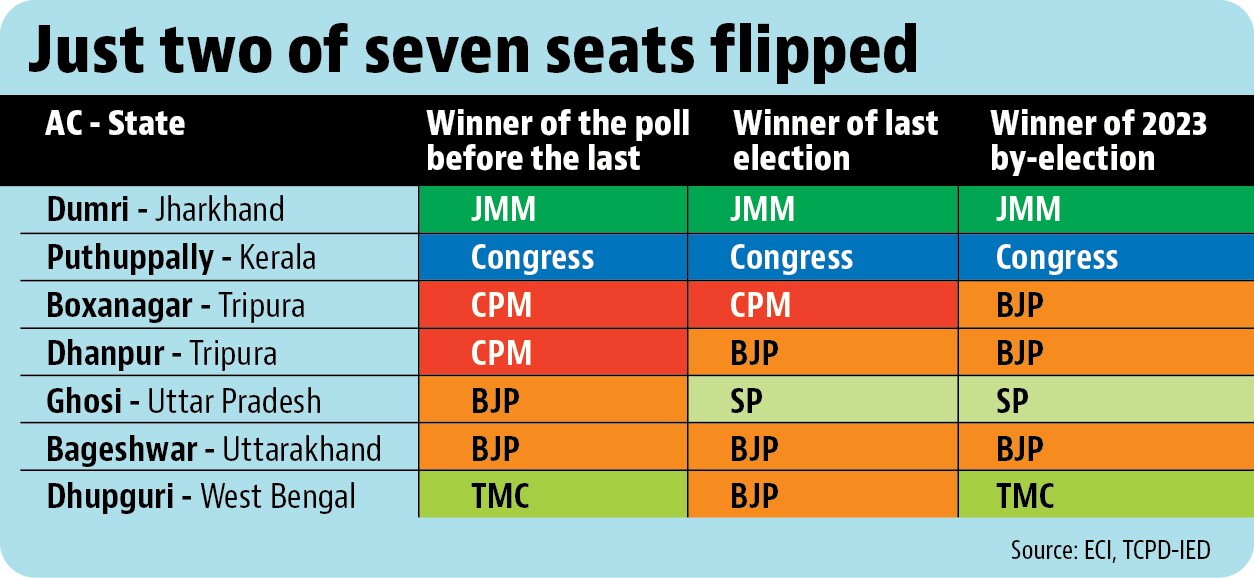
 AC-wise incumbents have won in five out of seven ACsOf the seven ACs which went to the polls, two are located in Tripura and one each is in the state of Uttarakhand, Uttar Pradesh, Jharkhand, West Bengal and Kerala. In five out of these seven ACs, the party which held the AC has been re-elected once again. The only ACs which have elected a different party compared to the last elections are Boxanagar in Tripura and Dhupguri in West Bengal. While the Bharatiya Janata Party (BJP) has wrested the former from the Communist Party of India (Marxist) or CPI (M), the All India Trinamool Congress (TMC) has snatched the latter from the BJP.
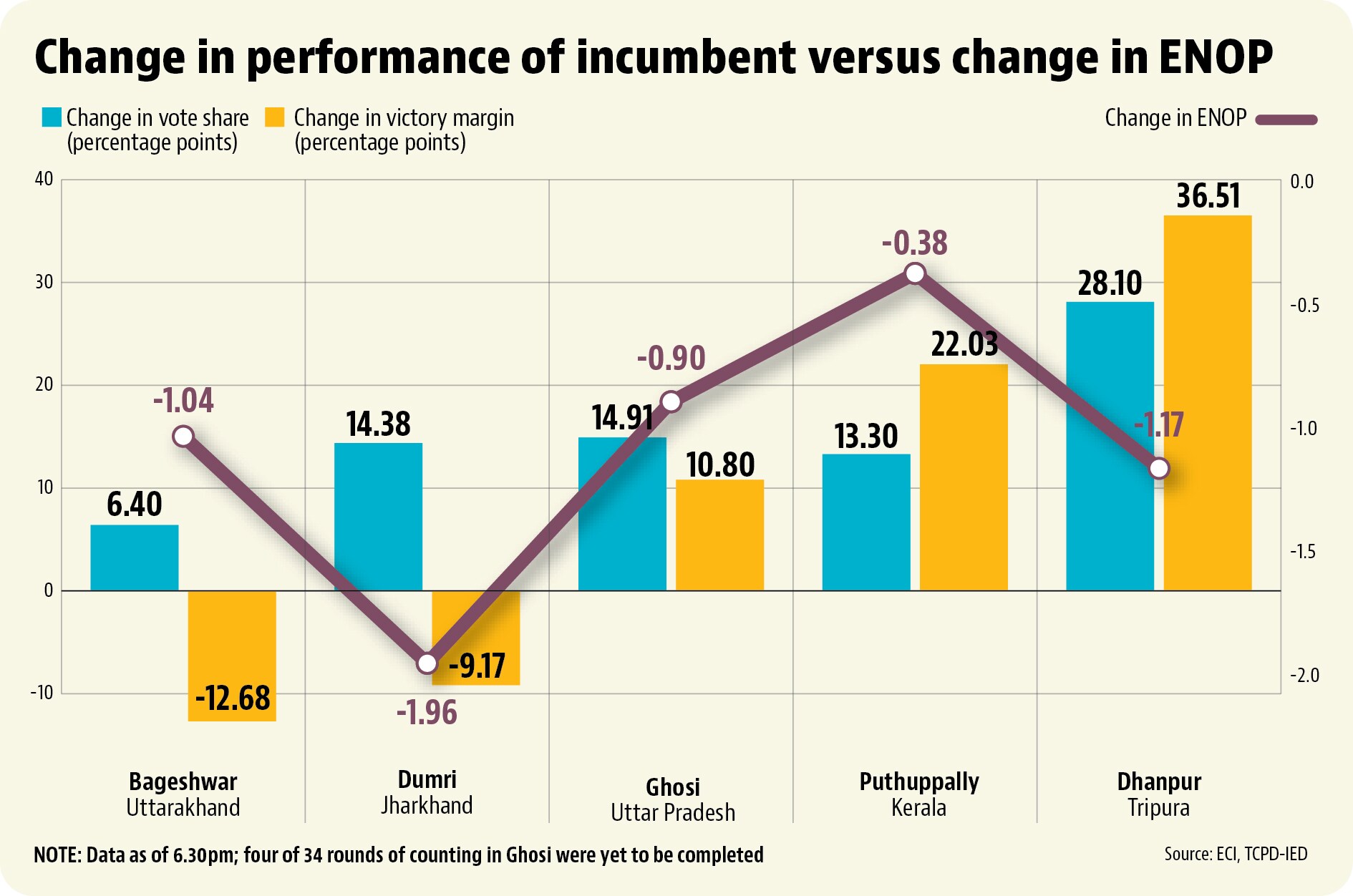
- Incumbents gained vote share everywhere, but not necessarily resulting in a bigger marginIn all five ACs where the incumbent party has returned to power, the incumbent party’s vote share has increased compared to the last assembly election . However, this has not led to an increase in victory margin for these parties, which, in fact, has fallen significantly in some of the ACs. The victory margin of the Jharkhand Mukti Morcha (JMM) decreased 9.2 percentage points compared to the last assembly election in Dumri while BJP’s victory margin decreased by 12.7 percentage points in Uttarakhand’s Bageshwar AC. The reason why vote shares of winning parties have increased whereas victory margins have not is that elections were more polarized compared to last time, which can be seen from the fact that the Effective Number of Parties (ENOP) – it is the reciprocal of the sum of square of vote shares of each parties – has fallen in each of the seven ACs compared to the previous elections.
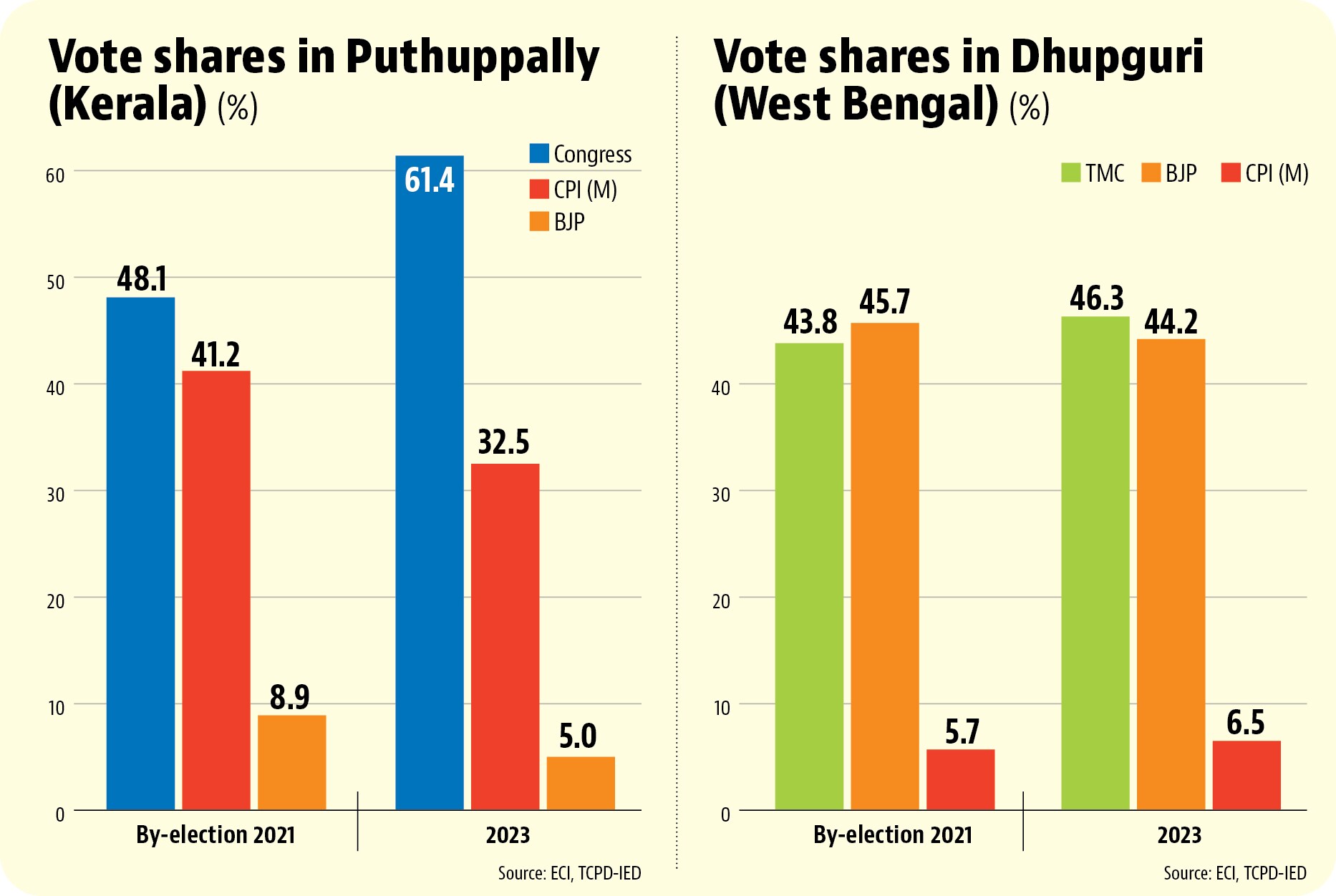
- What do the results mean for INDIA bloc?Whether or not one should give too much importance to bypoll results is in itself an important question (more on this later). With this caveat in place, the headline number – a four-three tally against the BJP – might suggest that the results can give a big boost to the newly announced INDIA (Indian National Developmental Inclusive Alliance) bloc. However, this is a shallow reading of the situation. While the INDIA bloc parties have won five out of the seven ACs, the results in at least two ACs – Dhupguri in West Bengal and Pothuppally in Kerala – saw an acrimonious contest between INDIA Bloc parties. While the BJP finished a distant third in the Puthuppally contest, the Congress supported CPI (M) candidate actually managed to get more votes than the victory margin of the TMC candidate against the BJP in Dhupguri. This is likely to increase tensions between the TMC and Congress-CPI (M) in West Bengal. To be sure, the INDIA bloc is likely to amplify the narrative around Samajwadi Party’s victory in Ghosi in Uttar Pradesh.
- Why bypoll results should not be given too much importanceIt is expected that winners in these elections will try and link the results to the 2024 contest. This is a statistical leap of faith given the fact that voters have been voting differently even in assembly and national elections in India even when they are held together. Bypoll results possibly mean even less. An analysis by Gilles Verniers published in The Indian Express after the Gorakhpur and Phulpur bypolls in Uttar Pradesh in 2018 shows this clearly. The party winning a bypoll to a parliamentary constituency won the following general election in Uttar Pradesh less than a third of the times between 1962 and 2014. The results are similar for bypolls held in ACs.